Every successful customer relationship follows a predictable journey—from the moment a prospect first discovers your business to the point where they become a loyal advocate who brings you new customers. Understanding the customer relationship management cycle is essential for designing the strategies, workflows, and CRM tools that support customers at every stage of their journey.
In this comprehensive guide, we’ll break down the CRM cycle stage by stage, explain what businesses should do at each phase, and identify the CRM tools and strategies that make each stage more effective.
What Is the Customer Relationship Management Cycle?
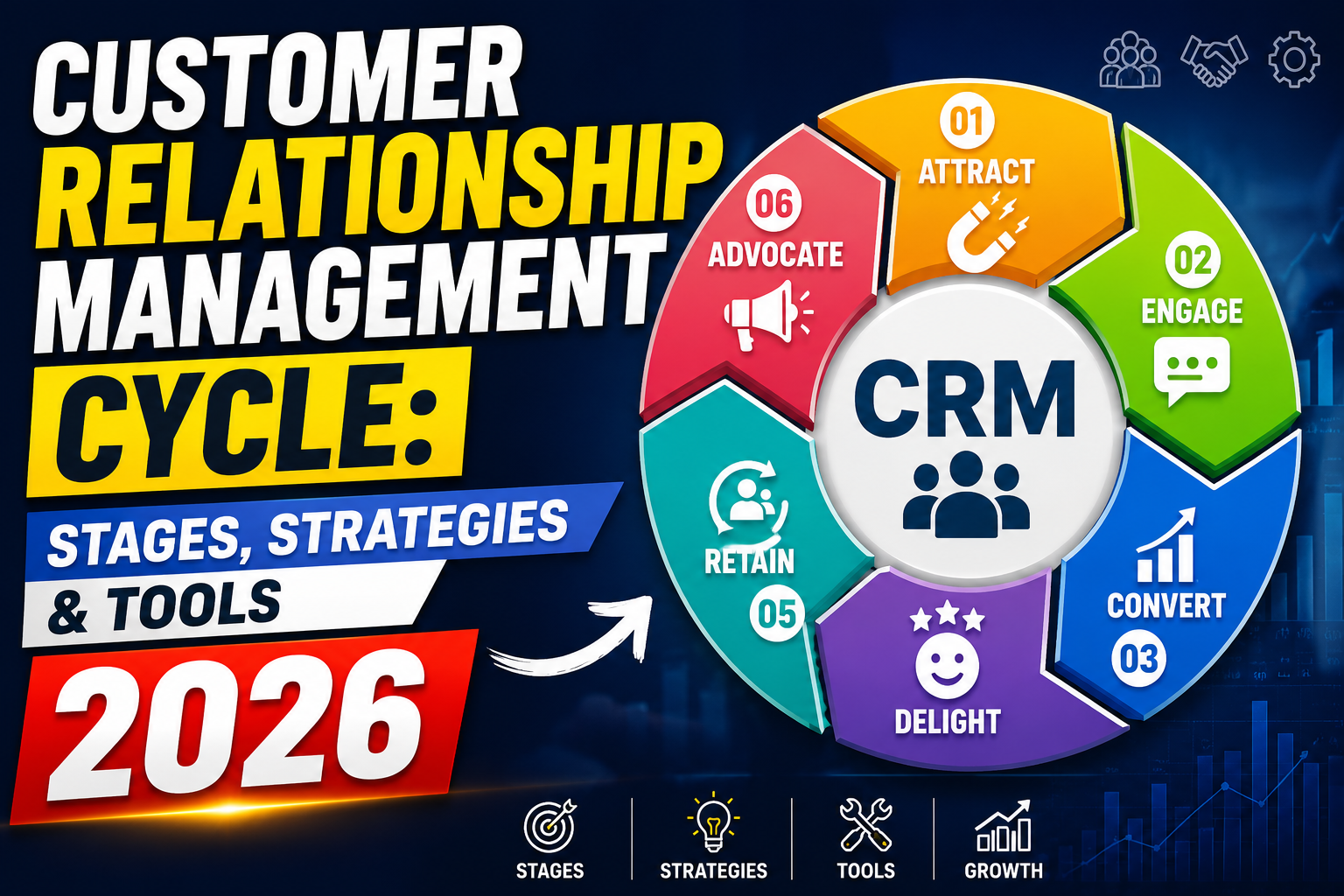
The customer relationship management cycle (also called the CRM cycle or customer lifecycle) describes the ongoing process of managing customer relationships from initial awareness through acquisition, retention, and advocacy. Unlike a linear sales funnel, the CRM cycle is circular—satisfied customers create new leads through referrals, completing the cycle.
The Five Stages of the CRM Cycle
Stage 1: Awareness and Acquisition
What it is: The customer first becomes aware of your business through marketing channels—search, social media, referrals, advertising, or content marketing. They enter your CRM database as a prospect or lead.
CRM activities at this stage:
- Lead capture from website forms, landing pages, and social media
- Lead source tracking to understand which channels drive the most valuable prospects
- Automated welcome sequences for new leads
- Lead scoring based on demographics and initial behavior
Key metrics: Lead volume, cost per lead, lead source distribution, initial engagement rate
Stage 2: Qualification and Engagement
What it is: Not all leads are ready to buy. This stage involves qualifying prospects—determining their needs, budget, timeline, and decision-making authority—and engaging them with relevant content and conversations that move them toward a purchase decision.
CRM activities at this stage:
- Lead qualification workflows (BANT, MEDDIC, or custom criteria)
- Personalized email nurture sequences based on lead segment
- Sales rep follow-up task creation and activity logging
- Content delivery aligned with buyer journey stage
- Meeting scheduling and demo booking
Key metrics: Lead-to-opportunity conversion rate, engagement rate, sales activity volume
Stage 3: Conversion (Closing the Sale)
What it is: The prospect makes a purchase decision and becomes a customer. This stage includes proposal delivery, negotiation, contract execution, and payment processing.
CRM activities at this stage:
- Proposal and quote management within the CRM
- Deal stage tracking and pipeline management
- Contract and e-signature workflow integration
- Competitor and objection tracking
- Revenue forecasting based on pipeline data
Key metrics: Win rate, average deal size, sales cycle length, revenue by product/segment
Stage 4: Retention and Satisfaction
What it is: Post-purchase engagement aimed at delivering on promises, ensuring successful product adoption, and building the customer’s satisfaction and loyalty over time. Retaining existing customers is significantly cheaper than acquiring new ones.
CRM activities at this stage:
- Onboarding workflow automation with milestone tracking
- Customer success outreach and check-in scheduling
- Support ticket tracking and resolution monitoring
- Customer health scoring (usage data, engagement, support history)
- Contract renewal reminders and upsell/cross-sell opportunity tracking
- NPS and CSAT survey automation
Key metrics: Customer satisfaction scores, churn rate, product adoption rate, support ticket volume, NPS
Stage 5: Advocacy and Loyalty
What it is: Highly satisfied customers become advocates—referring new leads, providing testimonials, writing reviews, and participating in case studies or reference programs. This stage closes the loop and feeds new prospects back into Stage 1.
CRM activities at this stage:
- Referral program tracking and reward management
- Customer community and loyalty program integration
- Case study and testimonial request workflows
- VIP customer segment identification and special treatment
- Advocacy metric tracking (referral volume, review scores, NPS promoters)
Key metrics: Referral rate, customer lifetime value (CLV), NPS promoter percentage, review scores
The Circular Nature of the CRM Cycle
The CRM cycle is circular because advocates create new leads. A customer who refers a colleague sends a new prospect into Stage 1 of the cycle. The highest-performing sales organizations invest as much in the retention and advocacy stages as they do in acquisition—because satisfied customers are their most cost-effective source of new business.
CRM Tools That Support Each Stage
| Stage | Key CRM Features Needed |
|---|---|
| Awareness | Lead capture forms, source tracking, marketing integration |
| Qualification | Lead scoring, email sequences, sales activity management |
| Conversion | Pipeline management, quoting, contract integration |
| Retention | Customer health scores, onboarding workflows, support integration |
| Advocacy | Referral tracking, NPS tools, segmentation for VIP customers |
Common CRM Cycle Challenges and Solutions
Leads Fall Through the Cracks
Solution: Implement automated follow-up sequences and task creation so no lead goes more than X days without contact.
Poor Lead-to-Customer Conversion
Solution: Analyze pipeline stage conversion rates to identify where deals are lost. Often, the issue is at a specific stage (e.g., proposal to close)—targeted training or process changes at that stage can dramatically improve overall conversion.
High Customer Churn
Solution: Implement customer health scoring in your CRM to identify at-risk accounts early. Proactive outreach to low-health-score customers before they decide to leave is far more effective than win-back campaigns after churn.
Low Advocacy Rates
Solution: Build formal advocacy programs into your CRM workflows—identify promoters via NPS surveys, reach out personally, and make it easy for them to refer or review.
Related Resources
Frequently Asked Questions
What is the customer relationship management cycle?
The customer relationship management cycle is the ongoing process of managing customer relationships across five stages: awareness and acquisition, qualification and engagement, conversion, retention and satisfaction, and advocacy and loyalty. It is circular—satisfied advocates create new prospects who re-enter the cycle.
Why is the CRM cycle important?
The CRM cycle provides a framework for designing customer-centric strategies at every stage of the relationship. Businesses that actively manage all five stages—rather than focusing only on acquisition—achieve higher customer lifetime value, lower churn rates, and more efficient revenue growth through referrals.
What CRM features support the customer lifecycle?
Supporting the full CRM cycle requires lead management and scoring (awareness stage), pipeline and activity management (qualification and conversion stages), customer health scoring and onboarding automation (retention stage), and referral tracking and NPS tools (advocacy stage).
How does CRM improve customer retention?
CRM improves retention by enabling proactive, personalized customer management. Health scores identify at-risk accounts early, automated check-in workflows ensure consistent touchpoints, support integration provides full context for service teams, and renewal alerts prevent lapsed contracts from churning.
Conclusion
Understanding and actively managing the customer relationship management cycle is the foundation of sustainable business growth. By investing equally in all five stages—from initial awareness through loyal advocacy—businesses build customer relationships that drive compounding revenue growth year after year.
Want a custom CRM that supports every stage of your customer lifecycle? Explore VBWebSol’s CRM solutions or contact us today for a free consultation.