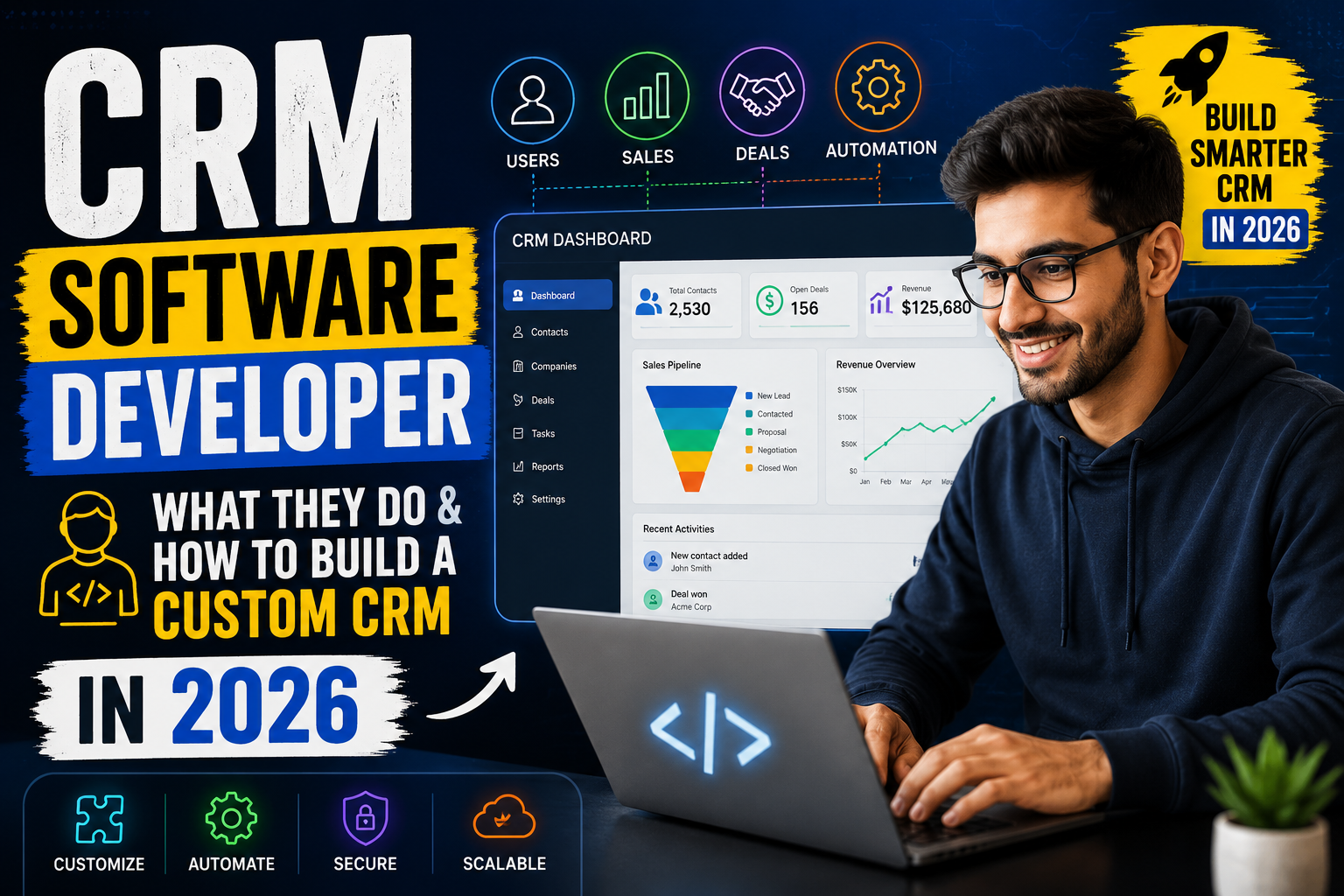
As businesses grow and their customer management needs become more complex, off-the-shelf CRM solutions often fall short. This is where a CRM software developer becomes essential—a specialized professional (or development team) that designs, builds, and maintains custom CRM systems tailored precisely to a business’s unique workflows, data structures, and integration requirements.
In this guide, we’ll explore what CRM software developers do, the skills and technologies they use, the benefits of custom CRM development, and what the development process looks like from inception to launch.
What Does a CRM Software Developer Do?
A CRM software developer is responsible for building and maintaining customer relationship management systems. Their work spans the full development lifecycle:
Requirements Analysis
Working with business stakeholders to understand sales processes, customer data needs, integration requirements, and reporting goals. Good CRM developers translate business language into technical specifications.
System Architecture Design
Designing the database schema, API architecture, user permission model, and integration framework that will power the CRM. Decisions made here affect scalability, performance, and maintainability for years.
Frontend Development
Building the user interface—dashboards, contact records, pipeline views, reporting screens—that sales, marketing, and service teams interact with daily. Modern CRM UIs are typically built with React, Vue.js, or Angular.
Backend Development
Building the server-side logic, APIs, data processing, and automation workflows that power the CRM. Common technologies include Node.js, Python (Django/FastAPI), Ruby on Rails, or Java Spring.
Database Design and Management
Designing and optimizing the database for CRM workloads—typically involving complex relational data structures for contacts, accounts, opportunities, and activities. Both SQL (PostgreSQL, MySQL) and NoSQL (MongoDB) databases are used depending on requirements.
API Integration Development
Building integrations with third-party systems—email platforms, accounting software, ERP systems, telephony providers, and marketing tools. This is a significant portion of CRM development work.
Automation and Workflow Development
Implementing business process automation—lead scoring, email triggers, task creation, approval workflows, and notification systems—within the CRM.
Testing and Quality Assurance
Writing automated tests, conducting integration testing, and performing user acceptance testing to ensure the CRM works correctly before and after each release.
Skills Required for CRM Software Development
Technical Skills
- Full-stack web development (frontend + backend)
- Database design and SQL/NoSQL proficiency
- REST API design and development
- Authentication and security (OAuth 2.0, JWT)
- Cloud platforms (AWS, Azure, GCP)
- DevOps and CI/CD pipelines
- Version control (Git)
Domain Knowledge
- Understanding of sales processes and pipeline management
- Familiarity with marketing automation concepts
- Knowledge of customer service workflows
- Experience with CRM data models (contacts, accounts, opportunities, activities)
Soft Skills
- Ability to translate business requirements into technical solutions
- Communication with non-technical stakeholders
- Problem-solving and system thinking
- Project management and deadline management
Benefits of Custom CRM Development
Perfect Process Fit
A custom CRM is built around your exact sales process, not a generic one. This eliminates workarounds and increases user adoption—reps use tools that match how they actually work.
No Per-Seat Licensing
SaaS CRM costs scale with users. A custom CRM involves upfront development costs but eliminates ongoing per-seat fees—delivering better economics as your team grows.
Complete Data Ownership
Your customer data lives in your own database, under your control. No concerns about vendor data sharing policies, API rate limits, or service discontinuation.
Unique Competitive Features
Build CRM features that reflect your unique business advantages—proprietary scoring algorithms, industry-specific data fields, or workflows that no off-the-shelf vendor supports.
Seamless Integration
Custom CRMs can be built to integrate precisely with your existing systems—no compromise on data mapping or workflow translation.
The Custom CRM Development Process
Phase 1: Discovery and Requirements (2–4 weeks)
Workshops with sales, marketing, and IT stakeholders to map current workflows, identify pain points, define required features, and document technical requirements.
Phase 2: Design and Architecture (2–3 weeks)
Database schema design, API architecture, UI/UX wireframes and prototypes, technology stack selection, and project planning.
Phase 3: Development Sprints (8–20 weeks)
Agile development in 2-week sprints. Core modules (contacts, pipeline, activities) first, then integrations, automation, and reporting. Regular demos with stakeholders.
Phase 4: Testing and QA (2–4 weeks)
Automated and manual testing across all modules. User acceptance testing with actual sales team members. Performance testing under realistic data volumes.
Phase 5: Deployment and Training (1–2 weeks)
Production deployment, data migration from legacy systems, and training for all user roles.
Phase 6: Ongoing Support and Evolution
Post-launch bug fixing, performance monitoring, and iterative feature development as business needs evolve.
Technologies Used in Custom CRM Development
| Layer | Common Technologies |
|---|---|
| Frontend | React, Vue.js, Angular, TypeScript |
| Backend | Node.js, Python, Java Spring, Ruby on Rails |
| Database | PostgreSQL, MySQL, MongoDB, Redis |
| Cloud | AWS, Azure, Google Cloud |
| Automation | Celery, BullMQ, Apache Kafka |
| APIs | REST, GraphQL, WebSockets |
Related Resources
Frequently Asked Questions
What does a CRM software developer do?
A CRM software developer designs, builds, and maintains customer relationship management systems. Their work includes requirements analysis, system architecture, frontend and backend development, database design, API integration, automation workflow development, and ongoing maintenance of custom CRM platforms.
How much does custom CRM development cost?
Custom CRM development costs depend on complexity and team location. Simple CRM builds with core features typically range from $20,000–$80,000. Full-featured enterprise CRMs with multiple integrations and advanced automation can cost $100,000–$500,000+. Ongoing maintenance typically adds 15–20% of the initial development cost annually.
How long does it take to build a custom CRM?
A basic custom CRM with core contact, pipeline, and activity management takes 3–6 months to build. Full-featured enterprise CRMs with complex integrations, advanced automation, and reporting can take 6–18 months depending on scope and team size.
Should I build a custom CRM or buy an existing one?
Off-the-shelf CRM is usually the right choice for businesses with standard sales processes and moderate customization needs. Custom CRM development is worthwhile when your workflows are unique, you have proprietary data models, you’re growing rapidly (and per-seat costs become prohibitive), or you need deep integration with industry-specific systems.
Conclusion
A skilled CRM software developer can build a system that perfectly fits your business—delivering competitive advantages that no off-the-shelf platform can match. Whether you’re starting from scratch or replacing a legacy CRM, custom development is a strategic investment in your sales infrastructure.
Ready to build a custom CRM for your business? Explore VBWebSol’s custom CRM development services or contact us today for a free consultation.