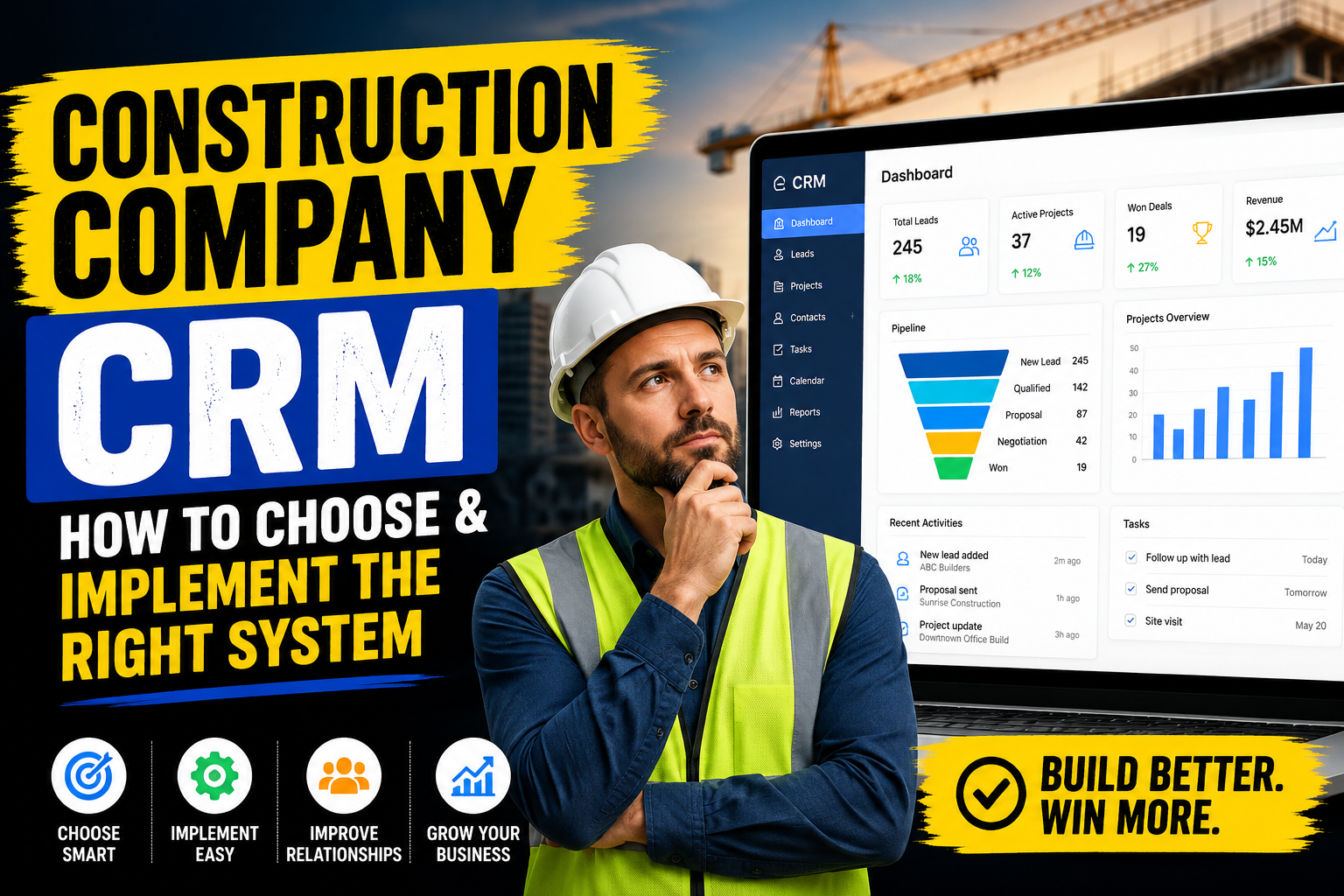
Running a construction company involves managing a complex web of relationships—clients, architects, engineers, subcontractors, suppliers, and local authorities. A construction company CRM is the tool that brings all these relationships into a single organized system, helping your business win more bids, deliver better client experiences, and grow revenue systematically.
This guide will walk you through everything a construction company needs to know about choosing and implementing the right CRM system.
Why Does a Construction Company Need a CRM?
Many construction companies still manage client relationships through spreadsheets, email inboxes, and paper-based systems. This approach creates critical problems as the business grows:
- Lost leads: Enquiries fall through the cracks when there’s no systematic follow-up process.
- Missed bid opportunities: Without a pipeline, it’s easy to forget to follow up on submitted proposals.
- Poor client communication: Clients get inconsistent updates when information lives in different people’s inboxes.
- No business intelligence: Without data, you can’t answer questions like “What’s our bid-to-win ratio?” or “Which referral sources bring our most profitable projects?”
- Key person dependency: When a sales rep leaves, they take all their client relationship knowledge with them.
A construction company CRM solves all of these problems by centralizing client and project data, automating follow-up, and giving management the visibility they need to grow the business strategically.
What to Look for in a Construction Company CRM
Lead and Bid Tracking
Track every enquiry from initial contact through bid submission, follow-up, and decision. Know the current status of every bid in your pipeline and receive automatic reminders to follow up when decision dates approach.
Project Pipeline Visualization
See all active opportunities organized by stage—pre-qualification, bidding, under negotiation, contract awarded, in delivery. A visual pipeline board helps business development teams prioritize where to focus their energy.
Client and Stakeholder Management
Maintain detailed records for every key contact: clients, architects, quantity surveyors, consultants, and decision-makers. Log every interaction so any team member can pick up a relationship without missing context.
Project-to-Client Relationship Mapping
Link every project to the relevant client, contacts, subcontractors, and documents. This gives you a complete view of every project relationship in one place.
Document Management
Store RFQs, proposals, contracts, and correspondence linked directly to the relevant client and project records—eliminating the need to search through email folders or shared drives.
Mobile Access
Your team needs to log calls and update records from the road, the site office, or client meetings. A strong mobile app is non-negotiable for construction professionals who aren’t desk-bound.
Reporting and Analytics
Track your bid-to-win ratio, average project value, revenue by client type, and lead source performance. These metrics are essential for making data-driven decisions about where to invest business development resources.
Best CRM Options for Construction Companies
Buildertrend
Combines CRM with project management, client communication, and financial tracking. Particularly strong for residential home builders and remodelers managing multiple simultaneous projects.
JobNimbus
Popular with roofing and exterior contractors. Simple pipeline management, contact tracking, and proposal generation make it an accessible entry point for smaller construction companies.
Salesforce Construction Cloud
Enterprise-grade CRM for large general contractors. Deep customization, ERP integration, and compliance features make it suited to complex multi-million-dollar project environments.
HubSpot CRM
A flexible, scalable option for construction companies wanting strong marketing automation alongside sales CRM. The free tier provides an excellent starting point with upgrade paths as the business grows.
Custom Construction CRM
For businesses with unique estimating workflows, proprietary project classifications, or specific integration needs, a custom-built construction CRM ensures the system works the way your business works—not the other way around.
How to Implement a CRM in a Construction Company
Step 1: Map Your Sales Process
Document your bid lifecycle: How do leads come in? What qualification criteria determine whether to bid? Whats stages does a bid go through? What triggers a follow-up? This map becomes your CRM pipeline structure.
Step 2: Migrate Existing Data
Import your existing contacts, live bids, and project history into the CRM. Clean your data before import—remove duplicates, update contact information, and standardize company names.
Step 3: Configure Automations
Set up automated reminders for bid follow-ups, contract renewal alerts, and check-in reminders for key client relationships. These automations ensure nothing falls through the cracks without requiring manual discipline.
Step 4: Train Your Team
Run hands-on training with your estimating, business development, and project management teams. Focus on the daily workflows that each role will use—don’t try to cover everything at once.
Step 5: Review and Optimize
After 60–90 days, review adoption rates and data quality. Refine pipeline stages, tweak automations, and identify training gaps based on real usage patterns.
Related Resources
Frequently Asked Questions
What does a construction company CRM do?
A construction company CRM centralizes client, prospect, and project relationships in one system. It tracks leads and bid opportunities through the pipeline, logs all client interactions, manages key contacts, stores project documents, and provides reporting on sales performance—replacing spreadsheets and fragmented email-based relationship management.
What is the best CRM for a small construction company?
For small construction companies, JobNimbus and HubSpot CRM offer the best combination of affordability and functionality. JobNimbus is purpose-built for contractors with simple setup, while HubSpot provides a powerful free tier with upgrade options as the business grows.
How much does a construction CRM cost?
Construction CRM costs vary from free (HubSpot basic) to $25–$100+/user/month for purpose-built platforms like Buildertrend or Salesforce. Custom construction CRM development involves upfront costs but eliminates ongoing per-seat fees and provides a perfectly tailored solution.
Can a CRM help win more construction bids?
Yes—construction companies using CRM systems consistently report higher bid win rates. The improvement comes from systematic follow-up (never missing the right moment to check on a decision), better proposal personalization using relationship history, and data analysis revealing which bid types and client segments have the highest win rates.
Conclusion
A construction company CRM is the foundation of a systematic, data-driven business development operation. By centralizing client relationships, tracking every bid, and automating follow-up, construction companies using CRM win more work with less effort.
Ready to implement a CRM built for your construction business? Explore VBWebSol’s custom CRM solutions or contact us today for a free consultation.