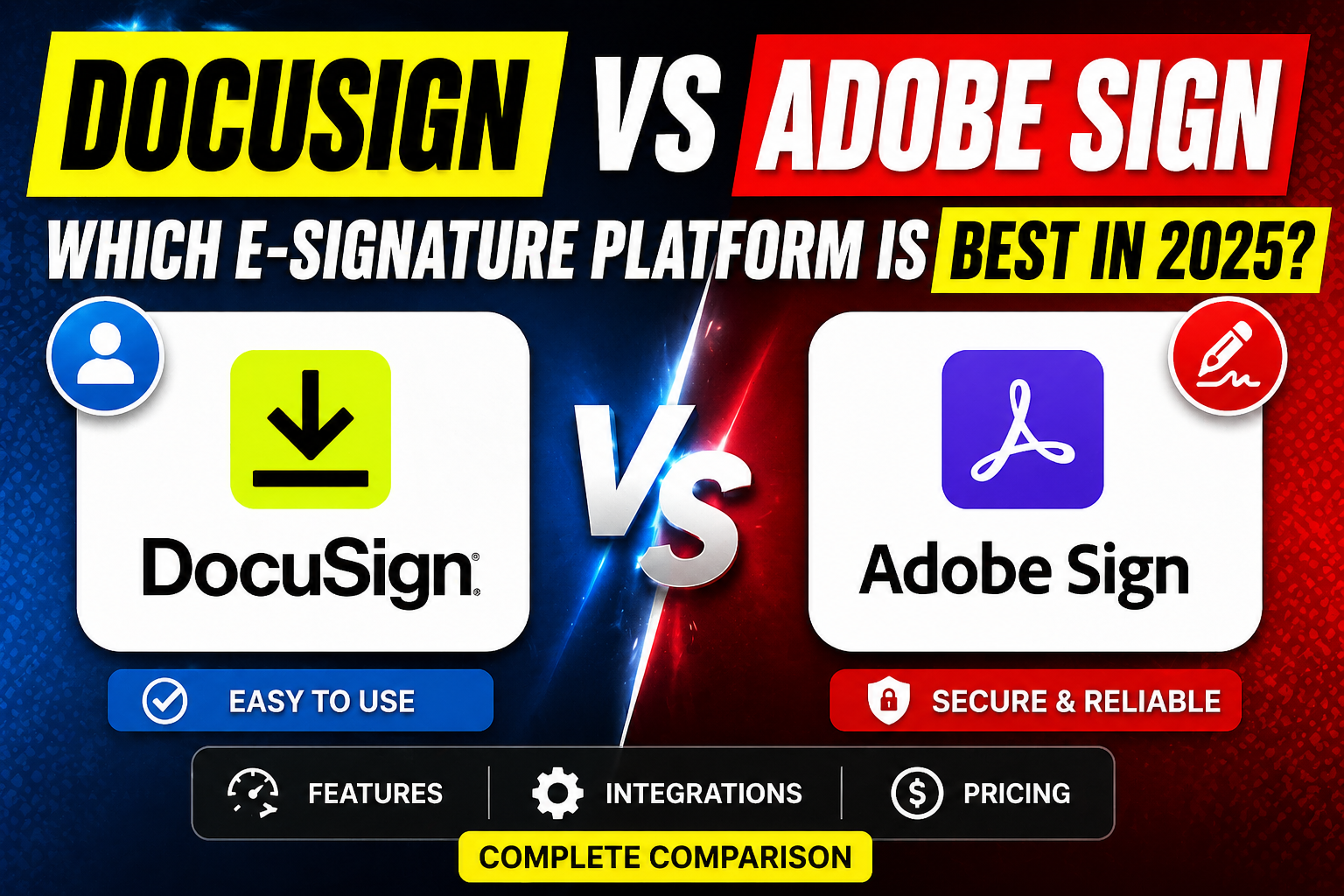
Two platforms dominate the e-signature market: DocuSign and Adobe Acrobat Sign (formerly Adobe Sign). This DocuSign vs Adobe Sign comparison breaks down the key differences in features, pricing, integrations, and use cases to help you choose the right platform.
Overview
DocuSign is the world’s most widely used e-signature platform—processing over 1.5 billion transactions annually. It’s the default choice for real estate, legal, financial services, and enterprise contract management.
Adobe Acrobat Sign is deeply integrated into the Adobe ecosystem—particularly Adobe Acrobat and Creative Cloud—making it the natural choice for organizations already invested in Adobe products.
Feature Comparison: DocuSign vs Adobe Sign
| Feature | DocuSign | Adobe Sign |
|---|---|---|
| E-signature | ✓ | ✓ |
| Template library | ✓ (large) | ✓ |
| Bulk send | ✓ | ✓ |
| In-person signing | ✓ | ✓ |
| Payment collection | ✓ | ✓ (limited) |
| Notary services | ✓ DocuSign Notary | Limited |
| PDF editing | Limited | ✓ (full Acrobat) |
| ID verification | ✓ | ✓ |
| Salesforce integration | Native (best-in-class) | Native |
| Microsoft 365 | Strong | Very strong |
| Adobe CC integration | Limited | Native |
Pricing: DocuSign vs Adobe Sign
DocuSign Pricing
- Personal: $15/month — 5 envelopes/month, 1 user
- Standard: $45/user/month — Unlimited envelopes, basic workflows
- Business Pro: $65/user/month — Advanced fields, payment collection, bulk send
- Advanced Solutions: Custom pricing — Enterprise features, AI, analytics
Adobe Acrobat Sign Pricing
- Acrobat Standard (with Sign): ~$22.99/month — Unlimited signatures, basic features
- Acrobat Pro (with Sign): ~$29.99/month — Full PDF + Sign features
- Business/Enterprise: Custom pricing — Advanced workflows, bulk send, compliance
Adobe’s pricing advantage: If you’re already paying for Acrobat Pro, e-signature is included—effectively free compared to DocuSign.
When to Choose DocuSign
- Real estate transactions (DocuSign is industry standard)
- Legal and financial services (deepest compliance certifications)
- Salesforce-centric workflows (best-in-class Salesforce integration)
- Need notarization services
- Complex multi-party signing with conditional routing
When to Choose Adobe Sign
- Your team already uses Adobe Acrobat or Creative Cloud
- Microsoft 365/SharePoint-centric workflows
- Need integrated PDF editing alongside e-signature
- Cost-conscious organizations on Adobe’s all-apps plans
Compliance and Legal Validity
Both DocuSign and Adobe Sign comply with all major e-signature laws including ESIGN Act (US), eIDAS (EU), and UETA. Both support advanced electronic signatures (AES) and qualified electronic signatures (QES) for high-trust scenarios. DocuSign holds marginally more industry-specific certifications (FedRAMP, SOC 1/2, ISO 27001, and more).
FAQ
Is DocuSign better than Adobe Sign?
DocuSign is better for real estate, legal, and financial services with deeper industry integrations and broader compliance certifications. Adobe Sign is better for organizations already in the Adobe or Microsoft ecosystem, particularly when PDF editing and e-signature need to work together. Neither is universally superior—the best choice depends on your ecosystem and use case.
Is Adobe Sign cheaper than DocuSign?
Adobe Sign is generally cheaper, especially for organizations already paying for Adobe Acrobat Pro where e-signature is included. DocuSign’s entry pricing is higher and scales up with features. For pure e-signature without Adobe’s broader PDF tools, compare total costs carefully at your expected usage volume.
Are DocuSign and Adobe Sign legally binding?
Yes—both DocuSign and Adobe Acrobat Sign produce legally binding electronic signatures compliant with ESIGN, UETA, and eIDAS regulations. Both provide audit trails with timestamps, IP addresses, and authentication records that provide strong legal evidence of signer intent.
Can DocuSign and Adobe Sign be used with Salesforce?
Yes—both integrate natively with Salesforce. DocuSign’s Salesforce integration (DocuSign eSignature for Salesforce) is particularly deep and widely used in Salesforce-centric enterprise environments. Adobe Sign also offers a Salesforce connector with strong functionality.
Conclusion
The DocuSign vs Adobe Sign decision depends primarily on your existing software ecosystem and industry. DocuSign wins for real estate, legal, and Salesforce-centric businesses. Adobe Sign wins for teams invested in Adobe or Microsoft products who want e-signature as part of an integrated document workflow.
Need help integrating e-signature capabilities into your business applications? Explore VBWebSol’s development services or contact us.