
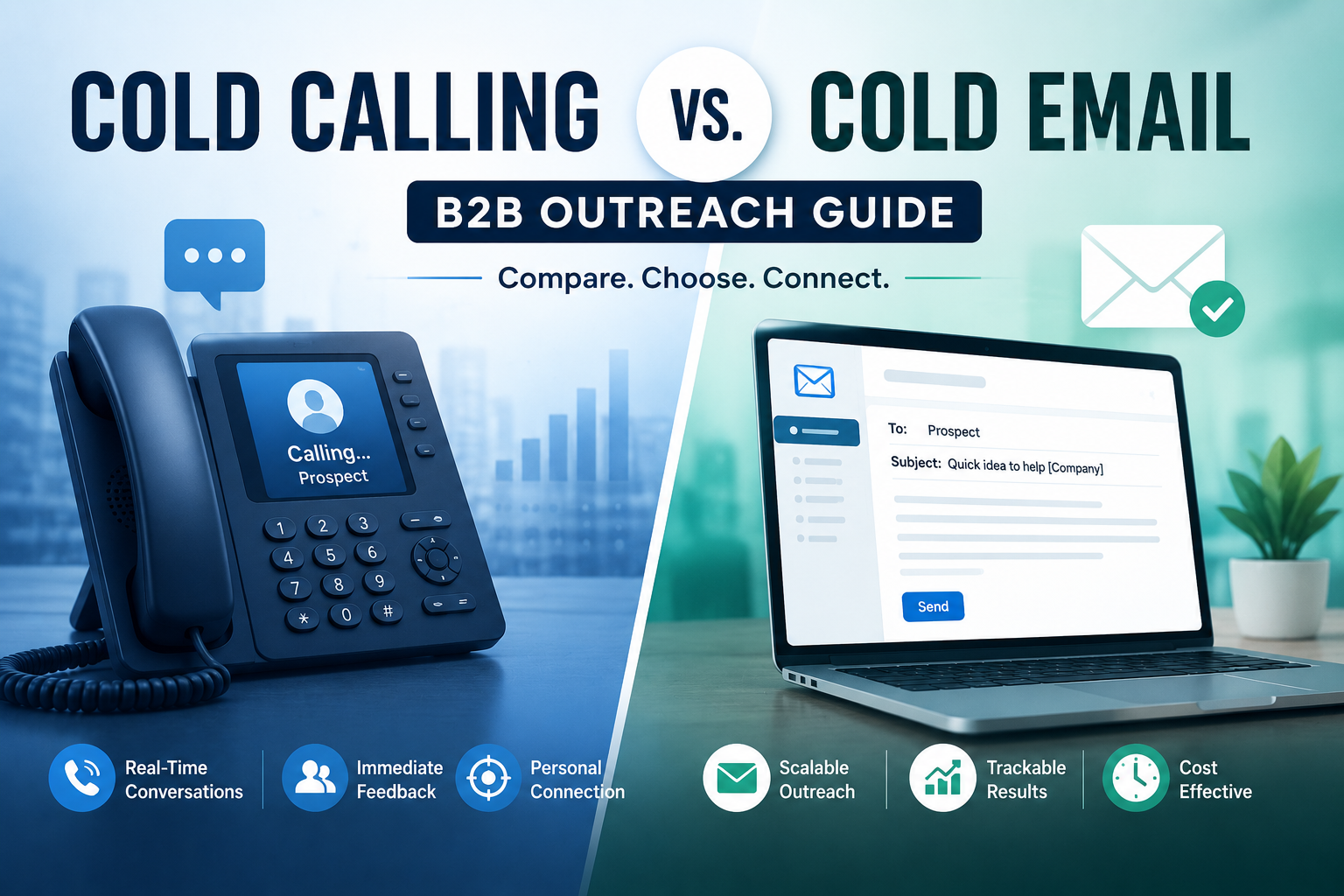
Cold outreach remains a core B2B sales tactic despite decades of predictions about its decline, but the effectiveness of cold calling versus cold email varies significantly by industry, deal size, and target buyer, and most successful outbound sales strategies use both in combination rather than choosing exclusively one. This guide compares the two channels directly, covers best practices for each, and outlines how to build an integrated multi-channel outreach approach.
Cold Calling: Strengths and Challenges
Strengths of Cold Calling
Cold calls offer real-time, two-way conversation — allowing immediate objection handling, tone and relationship building that email can’t replicate, and the ability to quickly qualify or disqualify a prospect in a single interaction rather than waiting on email response cycles. For complex, high-value B2B deals where relationship and trust-building matter significantly, the personal connection of a voice conversation carries real advantages.
Challenges of Cold Calling
Cold calling has a notoriously low connect rate — the majority of calls go to voicemail or aren’t answered at all, and the calls that do connect can be interrupted, poorly timed, or immediately dismissed given how conditioned many professionals are to reject unsolicited calls. It’s also more time-intensive per attempt than email, limiting overall volume compared to email outreach for the same time investment.
When Cold Calling Works Best
Cold calling tends to be most effective for higher-value, complex B2B deals where a genuine conversation adds real value to the prospect’s decision process, for industries and roles where phone communication remains a primary business communication channel, and for account-based sales strategies targeting a smaller number of high-value accounts where the time investment per prospect is justified by deal size.
Cold Email: Strengths and Challenges
Strengths of Cold Email
Email allows significantly higher outreach volume for the same time investment, doesn’t interrupt the recipient’s day the way an unexpected phone call can, gives recipients time to consider and research before responding, and is far easier to track and measure systematically (open rates, click rates, response rates) than phone outreach.
Challenges of Cold Email
Cold email faces increasingly sophisticated spam filtering, generally low response rates for generic, non-personalized outreach, and a genuinely crowded inbox environment where most professionals receive significant volumes of similar cold outreach daily, making differentiation and relevance more important than ever for standing out.
When Cold Email Works Best
Cold email tends to be most effective for higher-volume outbound motions targeting a broader total addressable market, for lower-to-mid complexity deals where extensive real-time conversation isn’t essential to the buying decision, and as an initial touchpoint that can be systematically tracked and optimized before escalating to phone or meeting-based conversation.
Comparing Response Rates and Effectiveness
Direct response rate comparisons between cold calling and cold email vary enormously by industry, target seniority level, message quality, and list targeting accuracy, making generic benchmark comparisons less useful than tracking your own specific campaigns’ performance systematically. What’s more consistently true across most B2B contexts is that highly personalized, well-researched outreach — whether by phone or email — meaningfully outperforms generic, mass-produced outreach in either channel, suggesting that outreach quality and targeting precision matter more than channel choice alone.
Best Practices for Cold Calling
Research Before Every Call
Understanding the prospect’s company, role, and likely pain points before dialing dramatically improves both connect quality and the prospect’s willingness to continue the conversation, compared to generic, unresearched calls.
Lead With Value, Not a Pitch
Opening with a genuine, specific insight or question relevant to the prospect’s situation, rather than immediately launching into a product pitch, significantly improves engagement in the critical first seconds of a cold call.
Prepare for Objection Handling
Having thoughtful, prepared responses to common objections (not now, not interested, send me information) allows the conversation to continue productively rather than ending abruptly at the first pushback.
Track and Optimize Call Timing
Testing different times of day and days of week for outbound calling, and tracking connect rates by time slot, often reveals meaningful patterns specific to your target audience’s availability and receptiveness.
Always Have a Clear Next Step
Every call, whether it results in immediate interest or not, should end with a clear, specific next step — a scheduled follow-up, an agreed-upon email with more information, or an explicit understanding of when to reconnect.
Best Practices for Cold Email
Personalize Beyond the First Name
Generic mail-merge personalization (inserting a first name into an otherwise identical template) is easily recognized and doesn’t meaningfully improve response rates — genuine personalization referencing something specific about the prospect’s company, role, or recent activity performs significantly better.
Write Subject Lines That Earn an Open
Subject lines should be specific and relevant rather than generic or overly salesy, since an unopened email has zero chance of generating a response regardless of the body content’s quality.
Keep the Initial Email Short
Cold emails asking for significant time or attention in the first message tend to underperform shorter, more focused emails that make a single clear, easy-to-respond-to ask.
Build a Structured Follow-Up Sequence
Most positive responses to cold email outreach come from follow-up emails rather than the initial message, making a structured, multi-touch follow-up sequence — rather than a single email and no further contact — an important part of effective cold email strategy.
Monitor Deliverability Closely
Email deliverability (whether messages actually reach the inbox rather than spam folders) depends on sender reputation, list quality, and email content patterns — monitoring bounce rates, spam complaints, and engagement metrics helps maintain deliverability over time rather than risking sender reputation degradation from poor list hygiene or overly aggressive sending patterns.
Building an Integrated Multi-Channel Outreach Strategy
Rather than choosing exclusively between cold calling and cold email, most effective outbound sales strategies combine both channels — along with LinkedIn outreach and other touchpoints — in a coordinated sequence. A common pattern involves an initial cold email, followed by a cold call referencing that email if no response, continuing through a structured multi-touch sequence across channels rather than relying on a single channel or single attempt. This multi-channel approach generally outperforms single-channel outreach, since it increases the total surface area for a prospect to notice and respond to the outreach, and demonstrates genuine persistence and interest rather than a single low-effort attempt.
Compliance Considerations
Cold Calling Compliance
In the U.S., cold calling is subject to Telephone Consumer Protection Act (TCPA) requirements, including Do Not Call registry restrictions for consumer calls (B2B calling has some different regulatory treatment, though specific rules should be confirmed for your situation), and similar regulations exist in other jurisdictions that should be understood before running outbound calling campaigns.
Cold Email Compliance
Cold email is subject to regulations like CAN-SPAM in the U.S. and GDPR in the EU, requiring clear sender identification and functional unsubscribe mechanisms — B2B cold email generally has somewhat more regulatory latitude than consumer marketing email in many jurisdictions, but compliance requirements should be confirmed based on your specific target markets.
Frequently Asked Questions
Is cold calling still effective in 2026? Yes, for the right use cases — particularly higher-value, complex B2B deals where a genuine conversation adds real value, and for industries/roles where phone communication remains a primary business channel. Cold calling effectiveness has declined for low-value, high-volume outreach motions where cold email’s efficiency advantage is more pronounced.
What has a higher response rate, cold calling or cold email? There’s no universal answer — response rates vary enormously by industry, target seniority, message quality, and list targeting accuracy. Rather than relying on generic benchmarks, tracking your own specific campaigns’ performance across both channels for your particular audience produces more actionable insight.
Should I use cold calling or cold email for enterprise sales? Complex, high-value enterprise deals often benefit from a combination approach, with cold email providing an efficient initial touchpoint and cold calling adding the relationship-building and real-time conversation value that complex enterprise sales cycles typically require at some point in the process.
How many follow-up emails should a cold email sequence include? There’s no universal number, but most successful cold email sequences include multiple follow-ups rather than stopping after a single email, since most positive responses come from follow-up messages rather than the initial outreach — the right sequence length should be tested and optimized based on your own response and unsubscribe data.
Is it better to combine cold calling and cold email, or focus on just one channel? Combining channels in a coordinated, multi-touch sequence generally outperforms single-channel outreach, since it increases the total surface area for a prospect to notice the outreach and demonstrates genuine persistence, though the right specific channel mix depends on your target audience’s communication preferences and your team’s resources.
What’s the biggest mistake in cold outreach, regardless of channel? Generic, unpersonalized outreach that doesn’t demonstrate genuine research into the specific prospect’s situation is one of the most common and effective-reducing mistakes across both cold calling and cold email, since prospects can easily recognize and dismiss mass-produced, low-effort outreach regardless of which channel it arrives through.