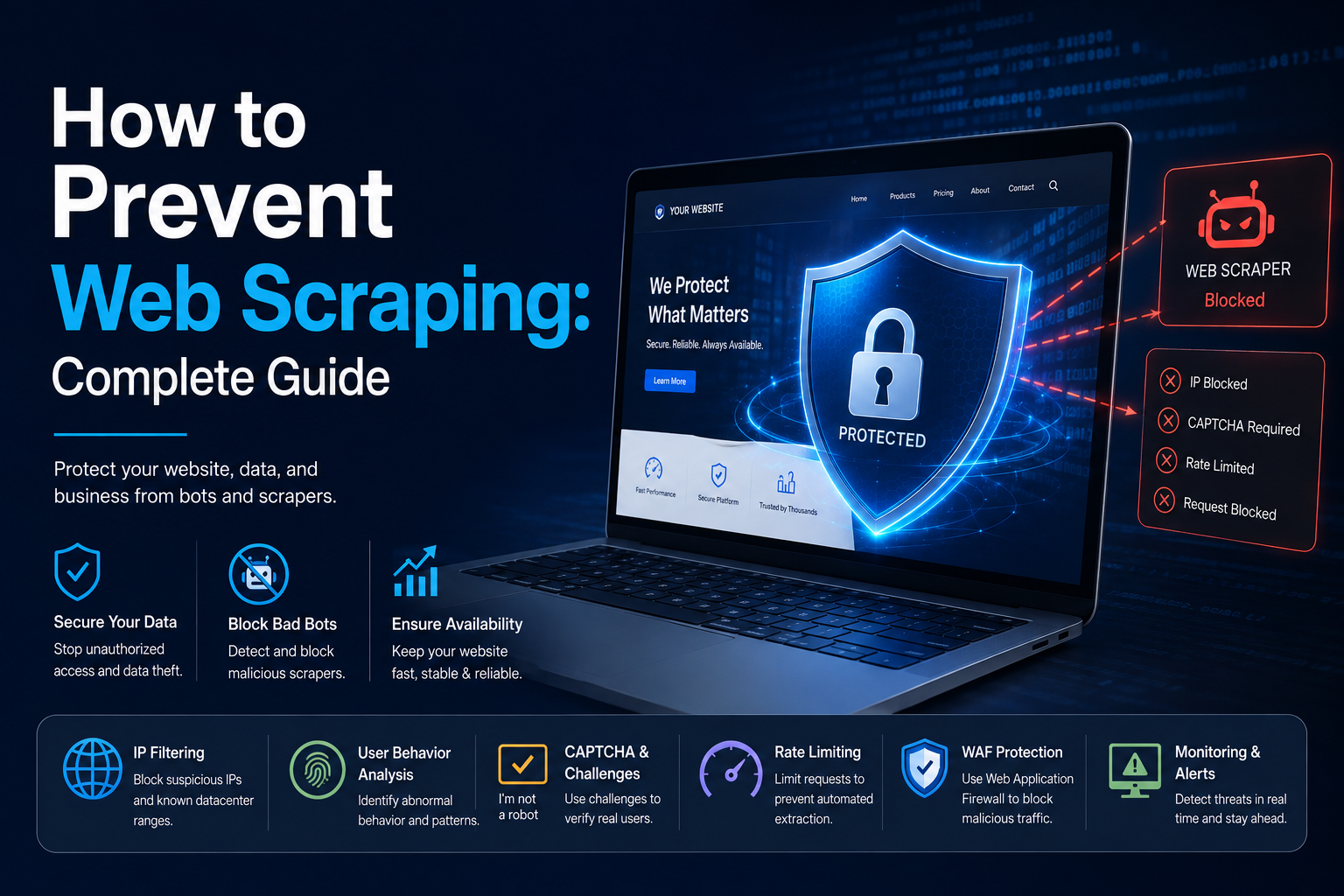
Web scraping — automated extraction of data from websites — has become a persistent challenge for businesses whose content, pricing, or proprietary data represents real competitive or commercial value. While some scraping is benign (search engine indexing, legitimate research), unauthorized scraping can undercut pricing strategies, steal proprietary content, overload server infrastructure, and violate terms of service. This guide covers practical, layered strategies for detecting and preventing unwanted web scraping.
Why Web Scraping Matters as a Business Concern
Competitive Pricing Intelligence
E-commerce and travel businesses in particular are frequent scraping targets, with competitors scraping pricing data to inform their own dynamic pricing strategies — a practice that can erode pricing power if left unaddressed.
Content Theft and Duplication
Publishers and content-driven businesses face scraping aimed at republishing content elsewhere, which can dilute SEO value and, in cases of near-verbatim duplication, raise copyright concerns.
Infrastructure Load and Cost
Aggressive scraping bots can generate significant server load, particularly problematic for smaller sites without robust infrastructure to absorb high-volume automated traffic alongside legitimate user traffic.
Data Privacy and Security Concerns
For sites handling user-generated content or any personal data, unauthorized scraping raises data privacy concerns beyond pure business/competitive considerations, particularly under regulations like GDPR.
Layered Approaches to Preventing Web Scraping
robots.txt (Baseline, Not True Prevention)
The robots.txt file signals to well-behaved bots which parts of a site shouldn’t be crawled, but it’s an honor-system mechanism — malicious scrapers routinely ignore it entirely, meaning robots.txt should be considered a baseline courtesy signal rather than an actual security control.
Rate Limiting
Limiting the number of requests a single IP address or session can make within a given time window is one of the most fundamental scraping deterrents, since it directly targets the high-volume, rapid request pattern characteristic of automated scraping versus normal human browsing behavior.
CAPTCHA and Bot Challenge Systems
Services like Cloudflare’s bot management, hCaptcha, and reCAPTCHA present challenges designed to be difficult for automated scripts while remaining passable for legitimate human users, though sophisticated scrapers increasingly use CAPTCHA-solving services or AI-based solving techniques, making this an imperfect but still valuable layer.
User-Agent and Header Analysis
Scraping bots often have detectable patterns in their HTTP headers — missing or generic user-agent strings, absence of headers a real browser would send — that can be used to flag and challenge suspicious traffic, though sophisticated scrapers increasingly spoof legitimate browser headers to evade this detection method.
Behavioral Analysis
More advanced bot detection analyzes behavioral patterns — mouse movement, scroll behavior, timing between actions — that are difficult for automated scripts to convincingly replicate, offering a more robust detection method than simple header analysis alone.
IP Reputation and Blocking
Maintaining and consulting IP reputation databases (or using a service that does this, like Cloudflare or a dedicated bot management platform) allows blocking or challenging traffic from known data center IP ranges and previously identified malicious sources, though scrapers increasingly use residential proxy networks specifically to evade this detection method.
Honeypot Traps
Embedding invisible links or form fields that legitimate human users would never interact with (since they’re hidden via CSS) but that automated scrapers following all links might trigger, providing a reliable signal to flag and block the offending bot.
Content Obfuscation
Techniques like rendering critical data (particularly pricing) via JavaScript rather than static HTML, using image-based text for sensitive data, or implementing dynamic class names that change frequently can increase the technical difficulty of scraping, though these techniques can also complicate legitimate accessibility and SEO considerations, requiring careful balance.
Legal Terms of Service and Cease-and-Desist Options
Beyond technical measures, clear terms of service explicitly prohibiting unauthorized scraping provide legal standing for cease-and-desist action or, in more serious cases, litigation against persistent unauthorized scrapers, particularly relevant for cases involving significant commercial harm.
Dedicated Bot Management and Anti-Scraping Services
Cloudflare Bot Management
Cloudflare offers comprehensive bot detection and management as part of its broader CDN and security platform, using machine learning-based traffic analysis to distinguish legitimate users from automated bots, with configurable response actions (challenge, block, rate limit) based on detected bot likelihood.
DataDome
DataDome specializes specifically in bot and scraping protection, offering real-time detection and mitigation with particular focus on e-commerce and travel industry use cases where pricing scraping is a common, high-impact concern.
PerimeterX (HUMAN Security)
PerimeterX (now part of HUMAN Security) offers bot detection and mitigation with a focus on protecting against sophisticated, evasive scraping techniques including those using residential proxy networks and advanced browser automation.
Akamai Bot Manager
Akamai’s bot management solution integrates with its broader CDN and security infrastructure, commonly used by large enterprises already leveraging Akamai’s content delivery network for other performance and security needs.
Balancing Anti-Scraping Measures Against Legitimate Access Needs
Overly aggressive anti-scraping measures can inadvertently block legitimate traffic — search engine crawlers essential for SEO, accessibility tools used by users with disabilities, and legitimate API integrations or research access. Effective anti-scraping strategy requires distinguishing between different traffic types rather than applying blanket restrictions, typically through allowlisting known legitimate bots (search engine crawlers) while applying stricter scrutiny to unidentified automated traffic.
Building a Layered Defense Strategy
No single technique reliably stops determined scrapers — effective anti-scraping strategy combines multiple layers:
- Baseline signals — robots.txt and clear terms of service establishing intent, even though not independently enforceable against malicious actors
- Rate limiting as a fundamental technical control applied broadly across the site
- Bot detection and challenge systems (CAPTCHA, behavioral analysis) targeting suspicious traffic specifically rather than all users
- Dedicated bot management service for sites where scraping represents significant business risk, given the sophistication of modern anti-detection evasion techniques
- Legal recourse as a backstop for persistent, high-impact unauthorized scraping that technical measures alone don’t fully deter
Frequently Asked Questions
Is web scraping illegal? The legality of web scraping is genuinely complex and varies by jurisdiction, the specific data being scraped, and how the scraped data is used — publicly accessible data scraping has faced mixed legal outcomes in various court cases, while scraping that violates explicit terms of service, bypasses technical access controls, or involves copyrighted content raises clearer legal concerns. This is a general overview, not legal advice, and specific situations should be evaluated with legal counsel.
Can I completely stop all web scraping of my website? No technical measure provides complete prevention against a sufficiently determined and resourced scraper — the realistic goal of anti-scraping measures is raising the cost and difficulty of scraping enough to deter most attempts and significantly slow down persistent ones, not achieving absolute prevention.
Will blocking scrapers also block search engines like Google? It can, if anti-scraping measures aren’t configured to distinguish between malicious scrapers and legitimate search engine crawlers — allowlisting known, verified search engine bot IP ranges and user-agents is an important part of implementing anti-scraping measures without harming SEO.
What’s the difference between rate limiting and CAPTCHA for stopping scrapers? Rate limiting restricts the volume of requests from a given source within a time window, addressing high-volume scraping patterns directly, while CAPTCHA presents a challenge intended to distinguish human users from automated scripts regardless of request volume — the two techniques address different aspects of scraping behavior and are often used together.
Do I need a dedicated bot management service, or are basic measures enough? For sites where scraping represents significant business risk (e-commerce pricing, proprietary content, high-value data), a dedicated bot management service is generally worth the investment given the sophistication of modern scraping techniques, including residential proxy usage and CAPTCHA-solving services, that basic measures alone often can’t reliably detect.
How do I know if my website is being scraped? Signs include unusual traffic spikes without corresponding marketing activity, requests following unusual patterns (rapid sequential page access, ignoring normal user navigation flow), traffic originating disproportionately from data center IP ranges rather than residential/mobile networks, and server load anomalies — monitoring tools and dedicated bot management services can help identify these patterns more systematically than manual log review alone.