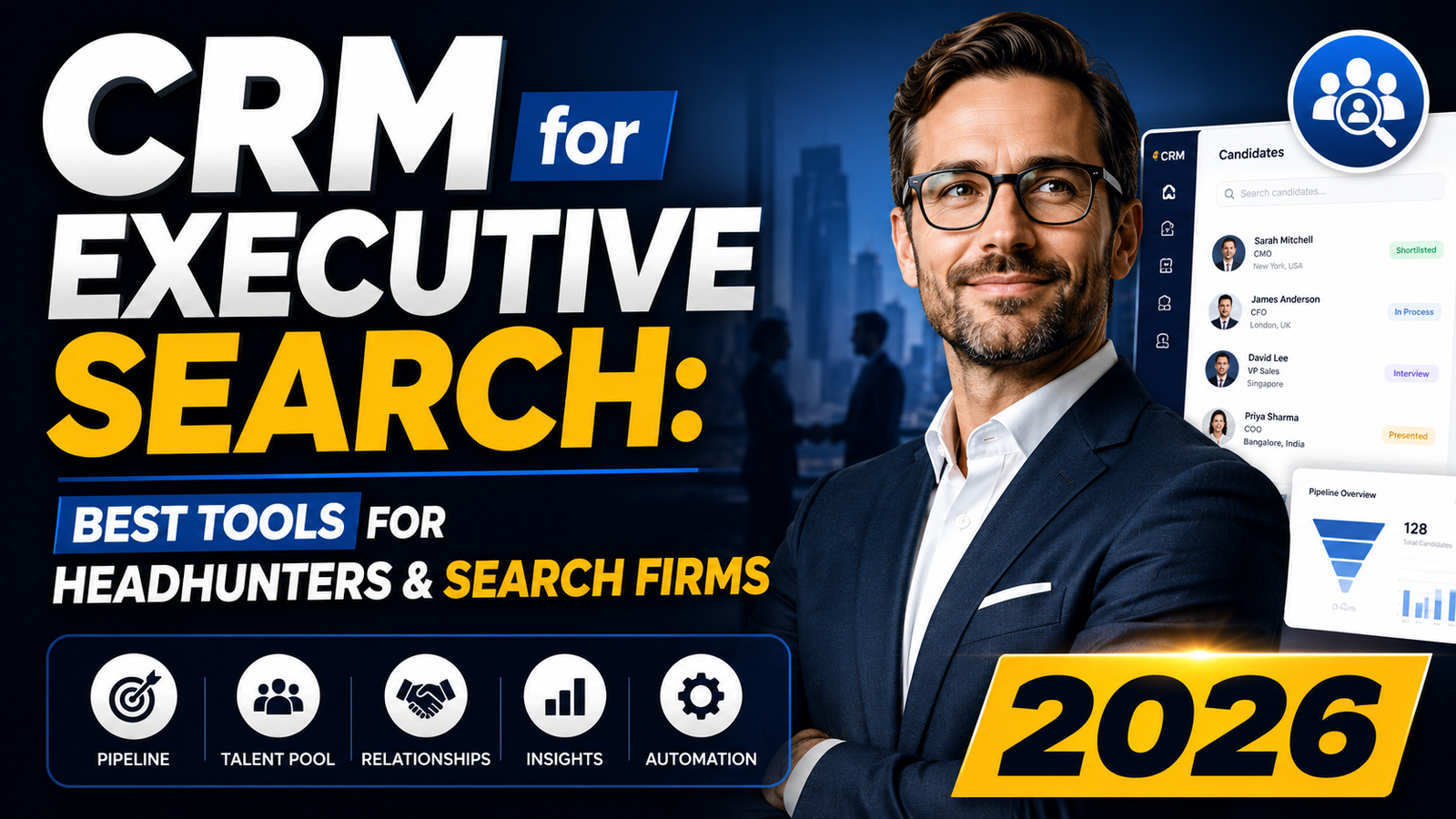
Executive search is uniquely relationship-intensive. Unlike transactional recruitment, executive search firms build long-term relationships with both clients (organizations seeking leaders) and candidates (executives in active or passive career transitions). A CRM for executive search must manage both sides of this equation—client mandates and candidate relationships—while providing the workflow tools that make searches run efficiently and successfully.
What Makes Executive Search CRM Different?
Standard CRMs are designed for sales pipelines. Executive search requires a fundamentally different data model:
- Candidate relationship management: Tracking executives over years as their career evolves, even when not actively seeking a move
- Client mandate tracking: Each search is a project with a brief, candidate pipeline, shortlist, and placement outcome
- Relationship mapping: Understanding who knows whom in target industries—connections between candidates, clients, and referral sources
- Confidentiality management: Executive searches are often confidential. CRM must support appropriate access controls
- Long-term history: Tracking candidates placed years ago who may be future clients—or future candidates again
Key Features for Executive Search CRM
Dual-Database Model
Separate but linked databases for clients (companies with search mandates) and candidates (executives). Each record type has unique fields—candidates have career history, compensation data, and skills; clients have mandate details and organizational information.
Search Mandate Pipeline
Track each search mandate from briefing through research, long-listing, shortlisting, interviews, offer, and placement. Multiple candidate pipelines run simultaneously under each mandate.
Candidate Research and Sourcing
Integration with LinkedIn, company databases, and research tools to identify and profile potential candidates during the research phase.
Relationship Strength Indicators
Track relationship quality with candidates and clients—how recently contacted, interaction frequency, personal connection notes—to prioritize relationship maintenance.
Placement and Revenue Tracking
Log placements with fee amounts, guarantee periods, and outcome data. Track revenue by client, consultant, and search type for business performance analysis.
Confidentiality Controls
Role-based access controls ensure sensitive search details are visible only to assigned consultants and approved team members.
Best CRM Solutions for Executive Search
Invenias (by Bullhorn)
Purpose-built for executive search firms, Invenias provides best-in-class dual-database architecture, search management, LinkedIn integration, and relationship tracking designed specifically for retained search.
Clockwork Recruiting
Popular among boutique executive search firms. Strong search project management, candidate pipelines, client portals, and reporting. Good balance of power and usability.
Vincere
Recruitment CRM with strong executive search features including dual client/candidate databases, pipeline management, and LinkedIn integration. Good for firms doing both search and contingency recruiting.
Salesforce (Customized)
Large executive search firms sometimes build on Salesforce for its flexibility and integration ecosystem. Requires significant customization investment but delivers unlimited scalability.
Custom Executive Search CRM
Boutique firms with highly specialized methodologies often find that a custom-built executive search CRM best reflects their unique process and delivers competitive differentiation.
FAQ
What CRM do executive searchs firms use?
Leading executive search firms use purpose-built platforms like Invenias (Bullhorn), Clockwork, and Vincere. Large global firms may use customized Salesforce implementations. Boutique firms with unique methodologies often use custom CRM development.
Can a standard CRM be used for executives search?
A standard CRM can be adapted for executive search with customization, but the dual-database requirement (clients + candidates) and search-specific workflows often exceed what generic CRMs handle well without significant development. Purpose-built or custom solutions typically deliver better ROI for executive search firms.
What is the most important CRM feature for executives search?
Relationship management and candidate tracking over long time horizons are the most critical features. Executive search success depends on deep, trusted relationships with candidates who may be clients today, placed executives tomorrow, and referral sources forever—requiring CRM that captures and maintains relationship context over years.
How does CRM improve executive search results?
CRM improves executive search outcomes by maintaining comprehensive candidate databases from previous searches, tracking relationship strength to identify warm connections to target candidates, managing parallel candidate pipelines within each mandate, and providing the client reporting that builds trust and demonstrates search rigor.
Conclusion
A purpose-built CRM for executive search is essential infrastructure for search firms that want to manage complex, relationship-intensive mandates efficiently while delivering the quality and confidentiality their clients expect.
Explore VBWebSol’s custom CRM development or contact our team for a consultation.