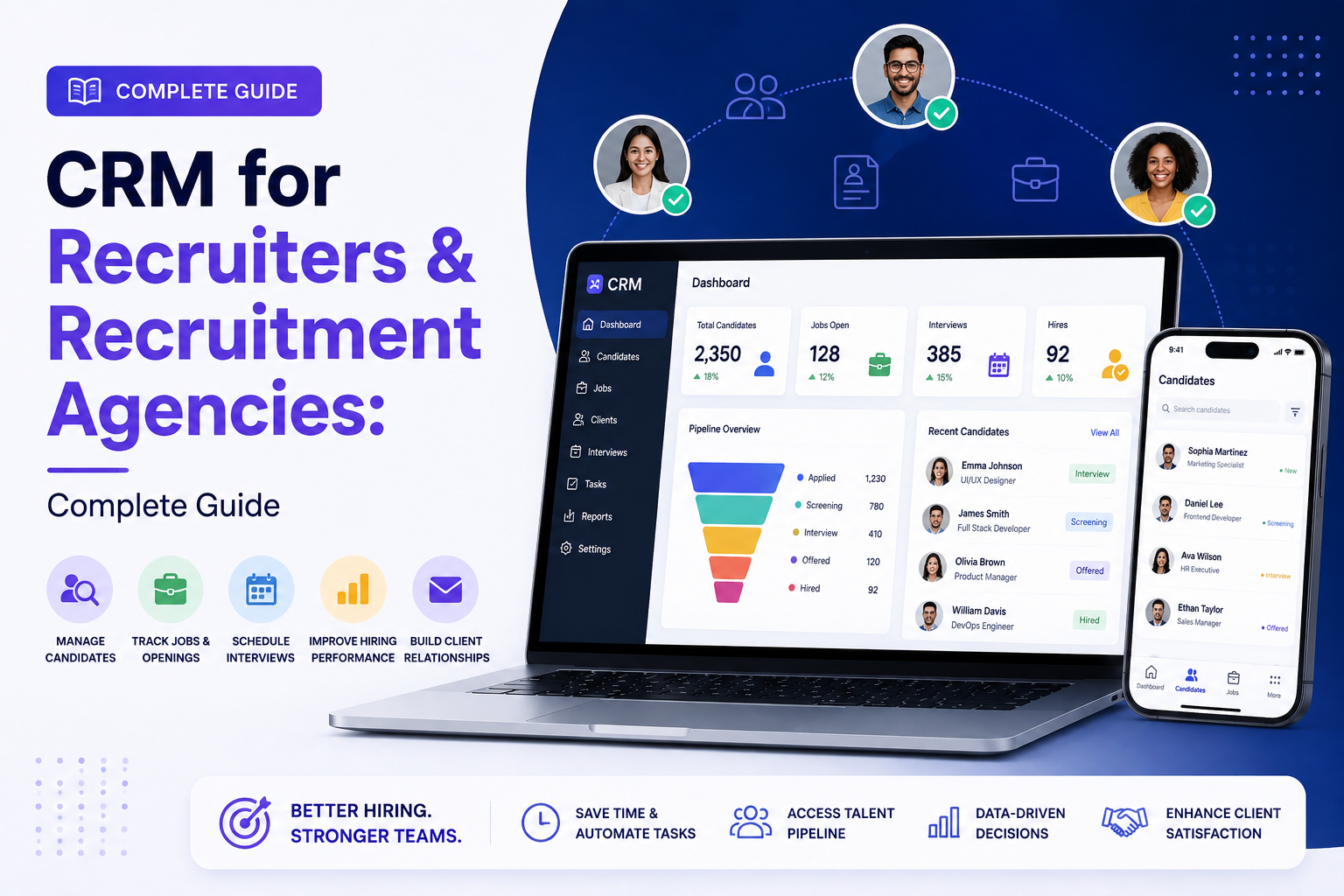
Recruitment agencies and internal talent acquisition teams manage a relationship structure that doesn’t map cleanly onto a standard sales CRM: they’re simultaneously managing candidate relationships and client (hiring company) relationships, often for multiple concurrent job openings, with a pipeline that moves candidates through stages rather than deals. This dual-sided relationship management is why a dedicated category of recruitment CRM — often called an Applicant Tracking System (ATS) with CRM capability, or a recruitment CRM — has emerged distinct from both generic sales CRMs and pure ATS platforms.
This guide covers what recruiters actually need from a CRM, compares leading platforms, and explains the relationship between CRM and ATS functionality in recruiting.
CRM vs. ATS: Understanding the Difference in Recruiting
An Applicant Tracking System (ATS) is primarily built around tracking candidates through a hiring pipeline for specific open roles — application received, screening, interview, offer, hire/reject.
A recruitment CRM is built around relationship management over time — sourcing and nurturing candidates before they apply, maintaining relationships with passive candidates for future roles, and managing the client (hiring company) side of the relationship for agency recruiters.
In practice, most modern recruiting platforms combine both functions, since the two workflows are deeply intertwined — you need to both nurture a talent pipeline and track applicants through active hiring processes, often for the same candidates over time.
Why Recruiters Need Specialized CRM Capability
Dual-Sided Relationship Management
Agency recruiters in particular manage two distinct relationship types simultaneously — candidates (job seekers) and clients (companies with open roles) — each with different data needs, communication cadences, and pipeline stages. A generic sales CRM built around a single relationship type requires significant customization to model this dual structure.
Passive Candidate Nurturing
Much of effective recruiting involves maintaining relationships with strong candidates who aren’t actively job-seeking right now but might be a great fit for a future role — a nurture-style workflow closer to marketing lead nurturing than traditional sales pipeline management.
Resume and Skills Data Management
Recruitment CRMs need to store and make searchable structured candidate data — skills, experience, certifications, resume content — in a way that supports fast, accurate candidate matching against new job requirements, a data structure that generic CRMs don’t handle natively.
Compliance and Data Privacy
Recruiting involves handling sensitive personal data with specific regulatory considerations (GDPR in Europe, EEOC compliance in the U.S. for hiring-related data), making data privacy and retention policy management a more central CRM requirement than in typical sales use cases.
Multi-Channel Sourcing Integration
Recruiters source candidates from job boards, LinkedIn, referrals, and direct outreach — a recruitment CRM needs to ingest and de-duplicate candidate data from these varied sources into a single, clean candidate record.
Best CRM/ATS Platforms for Recruiters
Bullhorn
Bullhorn is one of the most widely used platforms specifically for staffing and recruitment agencies, combining ATS and CRM functionality with strong reporting on agency-specific metrics (placements, time-to-fill, revenue per recruiter). It’s particularly popular among mid-size to large staffing agencies needing robust client relationship management alongside candidate tracking.
Greenhouse
Greenhouse is widely used by internal talent acquisition teams (companies hiring for their own open roles, rather than agencies), with strong structured interview and hiring workflow tools, though it’s less focused on the dual candidate/client relationship management that agency recruiters specifically need.
Lever
Similar to Greenhouse, Lever is aimed primarily at internal talent acquisition teams, with a notable emphasis on candidate relationship nurturing and pipeline building for future roles, blending ATS and lightweight CRM functionality for companies building out proactive talent pipelines.
Loxo
Loxo combines ATS, CRM, and sourcing tools (including AI-assisted candidate sourcing) into a single platform aimed at both agency recruiters and internal talent acquisition teams, with a focus on reducing the number of separate tools recruiters need to juggle.
JobAdder
JobAdder is popular among recruitment agencies, particularly in Australia, the UK, and increasingly the U.S., offering combined ATS/CRM functionality with strong job board posting integration and a relatively accessible setup process for small to mid-sized agencies.
Salesforce (Customized) with Recruiting Add-Ons
Larger staffing agencies or enterprises with complex recruiting operations sometimes build custom recruiting workflows on top of Salesforce, either through custom configuration or dedicated Salesforce AppExchange recruiting products, trading simpler purpose-built setup for deeper customization capability.
Key Features to Prioritize
For Agency Recruiters
- Dual pipeline tracking for both candidates and client companies/job orders
- Placement and revenue reporting — tracking fees, time-to-fill, and recruiter performance metrics specific to agency business models
- Client relationship management — tracking hiring manager relationships, job order details, and account history separately from candidate data
For Internal Talent Acquisition Teams
- Structured interview workflow support — scorecards, interviewer feedback collection, and hiring team collaboration tools
- Employer branding and candidate experience tools — careers page integration, automated candidate communication, and application status transparency
- Diversity and compliance reporting — increasingly important for internal TA teams tracking hiring funnel diversity metrics and EEOC compliance data
Integration Considerations
Before choosing a recruitment CRM/ATS, confirm integration support for: – Job boards — LinkedIn, Indeed, and industry-specific job boards for posting and candidate sourcing – Email and calendar — for interview scheduling and candidate communication tracking – Background check and assessment tools — many recruiting workflows include a background check or skills assessment step that benefits from direct integration rather than manual status tracking – HRIS systems — for internal TA teams, integration with the company’s core HR information system smooths the transition from “candidate” to “employee” record
Common Mistakes When Choosing a Recruitment CRM
- Choosing a pure ATS without CRM capability for agency use cases that fundamentally require dual candidate/client relationship management
- Underestimating the importance of passive candidate nurturing tools — treating the platform purely as an application tracker rather than a proactive talent pipeline tool
- Ignoring compliance and data retention requirements specific to your jurisdiction’s employment and data privacy regulations
- Not confirming job board integration depth before committing, since manual cross-posting to multiple job boards without integration creates significant ongoing administrative overhead
Frequently Asked Questions
What’s the difference between an ATS and a recruitment CRM? An ATS is primarily built around tracking candidates through a specific hiring pipeline for open roles, while a recruitment CRM focuses on longer-term relationship management — nurturing passive candidates and, for agencies, managing client relationships. Most modern platforms combine both functions to varying degrees.
What CRM do staffing agencies use most commonly? Bullhorn is one of the most widely used platforms specifically for staffing and recruitment agencies, given its strong dual-sided candidate/client relationship management and agency-specific reporting capability.
Do internal talent acquisition teams need a CRM, or just an ATS? While a pure ATS covers basic hiring pipeline tracking, most internal TA teams benefit from at least lightweight CRM-style candidate nurturing capability (found in platforms like Lever) to build proactive talent pipelines rather than only reacting to active job openings.
Can I use a general sales CRM like Salesforce or HubSpot for recruiting? It’s possible with significant customization, and some larger organizations do build custom recruiting workflows on Salesforce specifically, but purpose-built recruitment CRM/ATS platforms typically require far less configuration to model the dual candidate/client relationship structure recruiting actually needs.
Is Greenhouse good for recruitment agencies? Greenhouse is generally better suited to internal talent acquisition teams hiring for their own company’s roles, rather than agency recruiters managing multiple client companies’ job orders, given its focus on structured internal hiring workflows rather than dual-sided agency relationship management.
What features matter most for a recruitment agency choosing a CRM? Dual pipeline tracking for both candidates and client job orders, agency-specific reporting (placements, time-to-fill, revenue per recruiter), and strong job board integration are generally the highest-priority features specifically for agency recruiting use cases.