
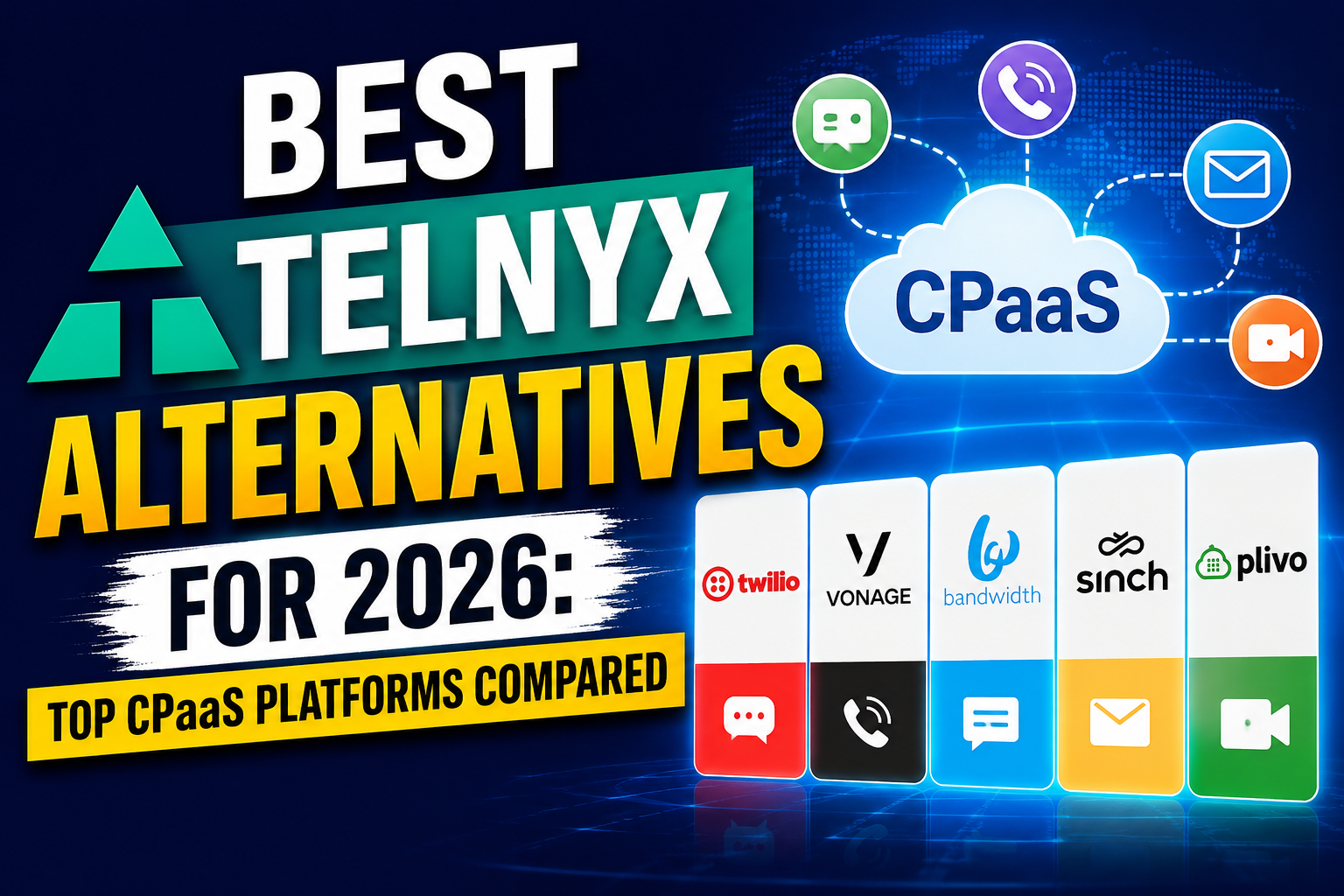
Telnyx is a well-regarded CPaaS (Communications Platform as a Service) provider known for competitive pricing through its own carrier network, strong SIP trunking capabilities, and developer-friendly APIs for voice, SMS, and messaging. However, organisations evaluating Telnyx as their communications infrastructure may have valid reasons to consider alternatives: specific geographic coverage requirements not served by Telnyx, integration requirements with platforms Telnyx doesn’t natively support, feature requirements outside Telnyx’s current offerings, or simply wanting to compare the competitive landscape before committing to a platform.
This guide reviews the best Telnyx alternatives in 2026, comparing each platform across pricing, geographic coverage, feature depth, developer experience, reliability, and specific use case fit to help you make an informed communication infrastructure decision.
Why Consider Telnyx Alternatives?
Telnyx has strong competitive advantages — particularly for voice and SIP trunking applications where its own carrier network delivers cost advantages over platforms routing through third-party carriers. However, several specific requirements might make alternatives worth evaluating. Omnichannel depth: If your application requires deep WhatsApp Business API, rich messaging (RCS), or email capabilities alongside voice and SMS, platforms like Twilio or Vonage offer more mature omnichannel tooling. Enterprise support requirements: Telnyx’s support model is primarily developer-focused and self-service — enterprises requiring SLA-backed enterprise support, dedicated account management, or 24/7 phone support may find Twilio or Vonage better suited.
Specific integrations: If your tech stack includes specific platforms requiring native CPaaS integrations — Salesforce, ServiceNow, Zendesk — the depth of pre-built integrations varies significantly between providers. Geographic coverage: While Telnyx has expanded its geographic coverage significantly, some regions and specific number types (short codes, specific inbound capabilities) may be better served by other providers with deeper local carrier relationships. Evaluating alternatives ensures you select the platform that best serves your current and anticipated future requirements.
Telnyx Pricing Overview
Telnyx’s pricing is generally competitive, particularly for voice. US inbound calling: from $0.002/minute. outbound calling: from $0.004/minute. US SMS: $0.004/segment outbound, $0.0055/segment inbound. These rates are lower than Twilio’s standard rates, reflecting Telnyx’s direct carrier network. Phone numbers: US local numbers from $1/month. Toll-free from $1.50/month. SIP trunks: from $0.004/minute. Volume discounts available for high-usage customers.
Best Telnyx Alternatives Reviewed
Twilio: The most comprehensive CPaaS platform with the broadest product range, deepest documentation, and largest developer community. Pros: unmatched SDK ecosystem, Segment CDP integration, 99.95%+ uptime, best-in-class developer experience, and the most mature omnichannel capabilities. Cons: higher per-minute/per-message pricing than Telnyx, particularly for voice. Best for: complex applications requiring rich omnichannel capabilities, organisations prioritising developer experience and ecosystem depth over lowest cost. Vonage (Ericsson): Strong enterprise CPaaS with comprehensive APIs for voice, SMS, video, and AI. Good European market coverage and enterprise support model. Competitive pricing with volume discount programmes. Best for: enterprise deployments requiring strong European coverage and dedicated support.
Sinch: Strong alternative for international SMS with direct carrier connections in 190+ countries. Competitive SMS pricing, particularly for international markets. Growing voice capabilities. Best for: applications with significant international SMS volume. Bandwidth: US-focused carrier-grade CPaaS with excellent direct US carrier connections, strong regulatory compliance tools, and enterprise support. Best for: US-focused voice applications requiring carrier-grade reliability and compliance support. Plivo: Cost-competitive CPaaS with straightforward pricing and good coverage for US/international SMS. Clean API design and solid documentation. Best for: cost-sensitive applications with straightforward SMS and voice requirements. MessageBird (Bird): Strong omnichannel messaging platform with excellent WhatsApp Business API implementation. Best for: WhatsApp-heavy customer communication applications.
Comparison Table: Key Metrics
Comparing Telnyx alternatives across four key dimensions: Pricing: Telnyx and Plivo offer the lowest per-minute/per-message rates for US voice and SMS. Twilio and Vonage are typically 20-50% higher at standard rates but offer volume discounts. Sinch is most competitive for international SMS. Geographic coverage: Twilio and Sinch have the broadest global coverage. Bandwidth has the deepest US coverage. Telnyx coverage is strong in North America, Europe, and Australia. Developer experience: Twilio has the best-in-class developer experience — documentation quality, SDK breadth, and community resources are unmatched. Telnyx and Plivo are both strong for developers. Vonage documentation has improved significantly.
Enterprise features: Twilio, Vonage, and Bandwidth offer the strongest enterprise support, SLA commitments, and compliance tooling. Telnyx and Plivo are primarily developer-self-service oriented with more limited enterprise support options. Recommendation framework: If cost is the primary driver and US voice/SMS is the primary use case: Telnyx or Plivo. If omnichannel completeness and ecosystem are the priority: Twilio. international SMS volume is primary: Sinch. US carrier reliability and enterprise support are paramount: Bandwidth. If European coverage and enterprise relationships are important: Vonage.
Frequently Asked Questions
Is Telnyx cheaper than Twilio?
Generally yes — Telnyx’s per-minute voice rates and per-message SMS rates are typically 30-50% lower than Twilio’s standard pay-as-you-go rates. This pricing advantage reflects Telnyx’s direct carrier network, which reduces the per-transaction costs compared to platforms using third-party carrier relationships. However, Twilio offers volume discounts that can close the gap for high-volume customers, and Twilio’s broader feature set and ecosystem may reduce total development and integration costs.
What is the best Telnyx alternative for SMS?
For pure SMS cost efficiency, Plivo and Sinch offer competitive alternatives to Telnyx. international SMS specifically, Sinch has the most competitive rates in many markets through its direct carrier relationships. For developers prioritising ecosystem and integration capabilities alongside SMS, Twilio remains the industry standard. WhatsApp-focused messaging applications, MessageBird (Bird) offers the strongest WhatsApp Business API implementation.
How does Telnyx compare to Twilio for voice?
Telnyx offers competitive advantages for voice applications: lower per-minute rates (typically 30-50% below Twilio standard rates) and strong SIP trunking capabilities from its own carrier network. Twilio advantages include: broader geographic coverage, more mature voice AI capabilities (Twilio Voice Intelligence, real-time transcription), better enterprise support SLAs, and deeper integration with Twilio’s broader product ecosystem. For straightforward voice applications where cost is primary, Telnyx has a clear advantage. For complex voice applications requiring the full Twilio ecosystem, the cost premium may be justified.
What CPaaS platform has the best global SMS coverage?
Sinch and Twilio have the broadest global SMS coverage, with direct carrier connections in 180-190+ countries. Vonage also has extensive global coverage through its partnership network. For specific markets in Southeast Asia, Latin America, and Africa, coverage and pricing vary significantly between providers — always test coverage and delivery rates for your specific target markets before committing to a platform for international SMS applications.
Conclusion
The best Telnyx alternative depends on your specific requirements: geographic coverage, feature needs, developer experience priorities, enterprise support requirements, and cost sensitivity. By evaluating the leading CPaaS platforms systematically against your actual use case and testing delivery quality in your target markets, you can identify the communication infrastructure that best supports your application’s requirements and your business’s growth trajectory.
Related Articles
Ready to grow your business with the right technology? Explore VBWebSol’s Web Development Services or contact our expert team for a free consultation. With over 12 years of IT expertise in Ahmedabad, we help businesses across India and globally implement solutions that deliver real, measurable results.