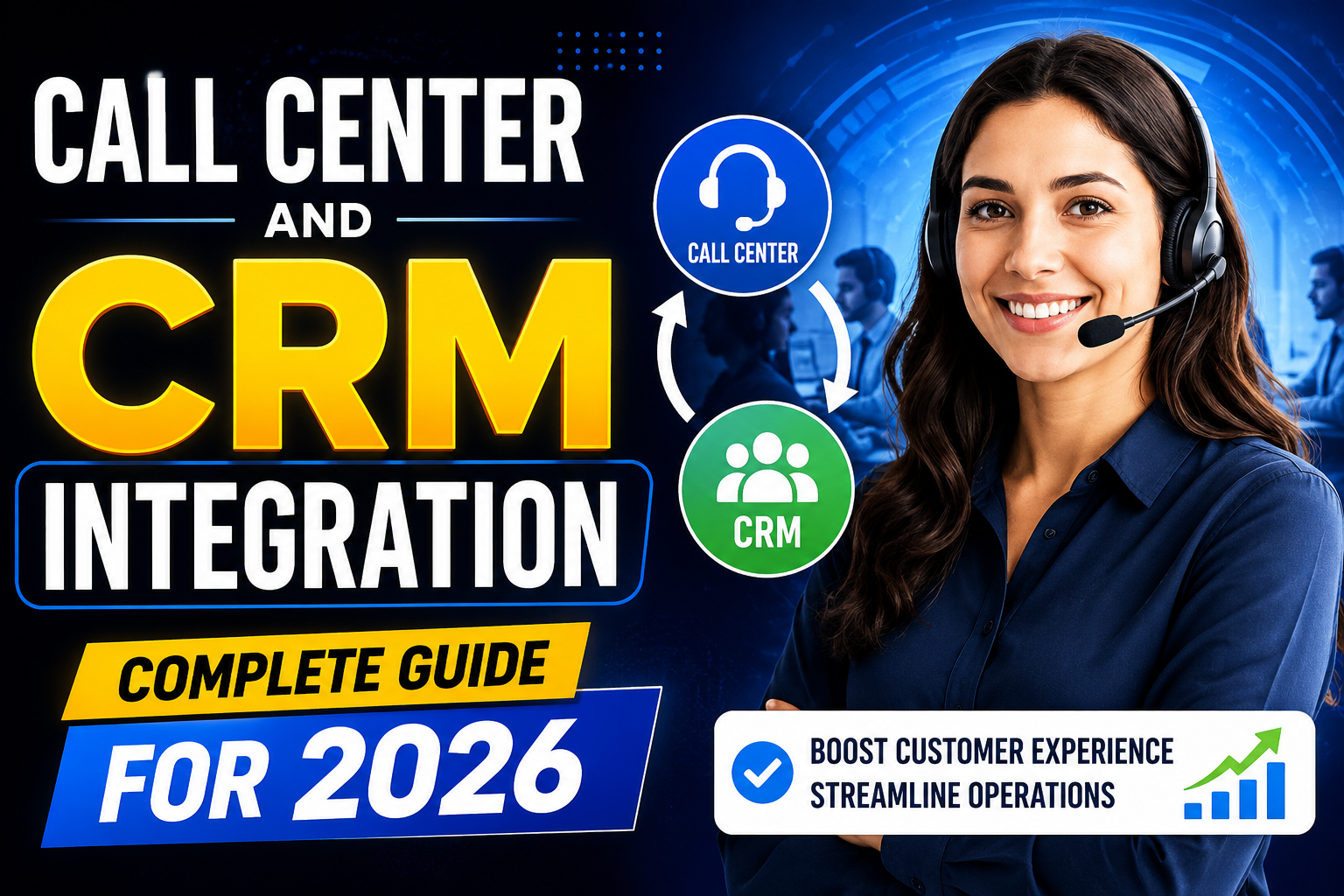
Integrating call center and CRM systems is one of the most impactful technology investments an organisation managing significant inbound or outbound call volumes can make. When the phone system and CRM operate as a unified platform — displaying complete customer context at the moment a call connects, automatically logging call details to the customer record, and routing calls intelligently based on CRM data — agent productivity improves dramatically, customer experiences become meaningfully better, and the organisation gains the operational intelligence to make data-driven decisions about staffing, processes, and customer engagement strategies.
This guide covers the full scope of call center and CRM integration — the specific capabilities the integration enables, the leading platforms that provide this unified experience natively or through integration, and a practical implementation guide for organisations building or improving their call center CRM infrastructure.
Why Call Center CRM Integration Matters
Without call center CRM integration, agents face a frustrating and unproductive reality: answering an inbound call without knowing who the customer is, manually searching the CRM for the caller’s record while the customer waits on hold, and logging call notes manually after each call. This disconnected experience costs organisations in three ways: agent time wasted on manual lookups and data entry (research suggests 20-30% of agent time is lost to these activities), customer frustration from being asked to repeat information they have already provided in previous interactions, and management visibility gaps from incomplete call data in the CRM.
The unified call center CRM experience is transformatively different. When a customer calls, the CRM record automatically opens on the agent’s screen before the call connects — the agent greets the customer by name, sees their full interaction history, open tickets, purchase record, and recent communications, and can immediately engage contextually and helpfully. After the call, notes, call outcome, and next action are logged automatically through guided post-call workflows. The result: shorter handle times, higher first-call resolution rates, better customer satisfaction scores, and richer CRM data that drives continuous improvement.
Key Integration Capabilities
The core capabilities of call center CRM integration: Screen pop (automatic display of CRM record when a call connects, based on caller ID matching), click-to-dial (calling customers directly from CRM contact records with one click), automatic call logging (call duration, direction, recording link, and outcome automatically added to CRM activity history), IVR CRM data lookup (routing calls based on CRM customer tier or service history), and real-time analytics (call metrics available alongside CRM pipeline and customer health data in unified dashboards).
Leading Call Center CRM Platforms
Three approaches to call center CRM integration serve different organisational needs. Native unified platforms: Salesforce Service Cloud plus Salesforce Voice (Twilio-powered), HubSpot Service Hub with calling capabilities, and Zendesk Talk provide native call center and CRM integration in a single platform — no CTI middleware required. These platforms are the simplest to implement and maintain but may be less feature-rich for complex contact centre requirements. Contact center platforms with CRM connectors: Five9, Genesys Cloud, NICE CXone, and Talkdesk provide pre-built, certified CRM integrations with Salesforce, HubSpot, Dynamics 365, Zendesk, and others. These offer the deepest contact centre functionality with strong CRM connectivity.
CTI middleware solutions: Computer Telephony Integration platforms like Amazon Connect CTI Adapter (for Salesforce), Twilio Flex integration connectors, and specialist CTI middleware (Vonage Contact Center, previously NewVoiceMedia) bridge legacy phone systems with modern CRM platforms. The right approach depends on your existing infrastructure: if you’re starting fresh, a native unified platform provides the simplest path to integration. If you have an established contact centre platform, a pre-built connector is typically the most cost-effective integration approach. Legacy phone system environments may require CTI middleware.
Implementation Guide
Implementing call center CRM integration requires planning across four areas. Technical architecture: Define how the phone system and CRM will communicate — native integration, pre-built connector, or custom API integration. Establish caller ID matching logic (how incoming phone numbers are match to CRM records, including handling of unknown numbers). Plan call recording storage and CRM linkage. Screen pop configuration: Configure the CRM record type to display when a call connects (contact record, account record, or case record depending on the call type), the information layout optimised for agent efficiency, and the popup timing relative to call connection.
Workflow design: Define the guide post-call workflow — what information agents record after each call, what CRM fields are update automatically (call duration, call outcome), and what follow-up actions are triggered by specific call outcomes. Reporting and analytics: Configure unified dashboards that combine call center metrics (handle time, first-call resolution, CSAT) with CRM data (open deals, ticket volumes, revenue attribution) to provide management with a complete operational picture. Test the complete integration flow with agents before go-live, and invest in agent training on the new unified workflow — particularly on efficient use of the screen pop and guided post-call workflows.
Frequently Asked Questions
What is CRM call center integration?
CRM call center integration connects the phone system or contact center platform with the CRM, enabling screen pop (automatic display of customer records when calls connect), automatic call logging to CRM activity history, click-to-dial from CRM records, intelligent call routing based on CRM customer data, and unified reporting that combines call metrics with CRM data. This integration eliminates the manual lookups and data entry that reduce agent efficiency and customer experience quality.
Which CRM has the best call center integration?
Salesforce Service Cloud with Salesforce Voice (powered by Twilio) provides the most comprehensive native call center CRM integration for enterprise deployments. HubSpot Service Hub provides excellent native calling integration for mid-market teams. For organisations using standalone contact center platforms, Five9 and Genesys Cloud offer the most mature certified integrations with major CRM platforms. Zendesk Talk provides strong native telephony integration within the Zendesk ecosystem.
How does screen pop work in CRM call center integration?
When an inbound call arrives, the integration queries the CRM for a contact record matching the caller’s phone number. If a match is found,
the CRM record automatically opens in the agent’s browser or desktop client before or as the call connects. If no match is found, the screen pop displays a new contact creation form pre-populat with the caller’s number. This eliminates the 30-60 seconds agents currently spend manually searching the CRM for the caller,
reducing average handle time and improving the customer greeting experience.
What is CTI (Computer Telephony Integration)?
CTI (Computer Telephony Integration) is the technology that enables computers and telephone systems to interact — enabling screen pop, click-to-dial, automatic call logging,
and call control from the computer interface. In the context of call center CRM integration,
CTI middleware connects legacy or third-party phone systems with CRM platforms that don’t have native telephony capabilities. Modern cloud contact center platforms increasingly offer CRM integration without requiring separate CTI middleware through direct API connections.
Conclusion
Integrating call center and CRM systems is a foundational investment in customer experience quality and agent operational efficiency. By selecting the right integration approach for your specific infrastructure,
configuring screen pop and guided post-call workflows effectively, and measuring the operational improvements systematically,
you build a unified communication and relationship management infrastructure that drives measurable improvements in customer satisfaction, agent productivity,
and revenue outcomes.
Related Articles
Ready to grow your business with the right technology? Explore VBWebSol’s Custom CRM Software Solutions or contact our expert team for a free consultation. With over 12 years of IT expertise in Ahmedabad,
we help businesses across India and globally implement solutions that deliver real, measurable results.