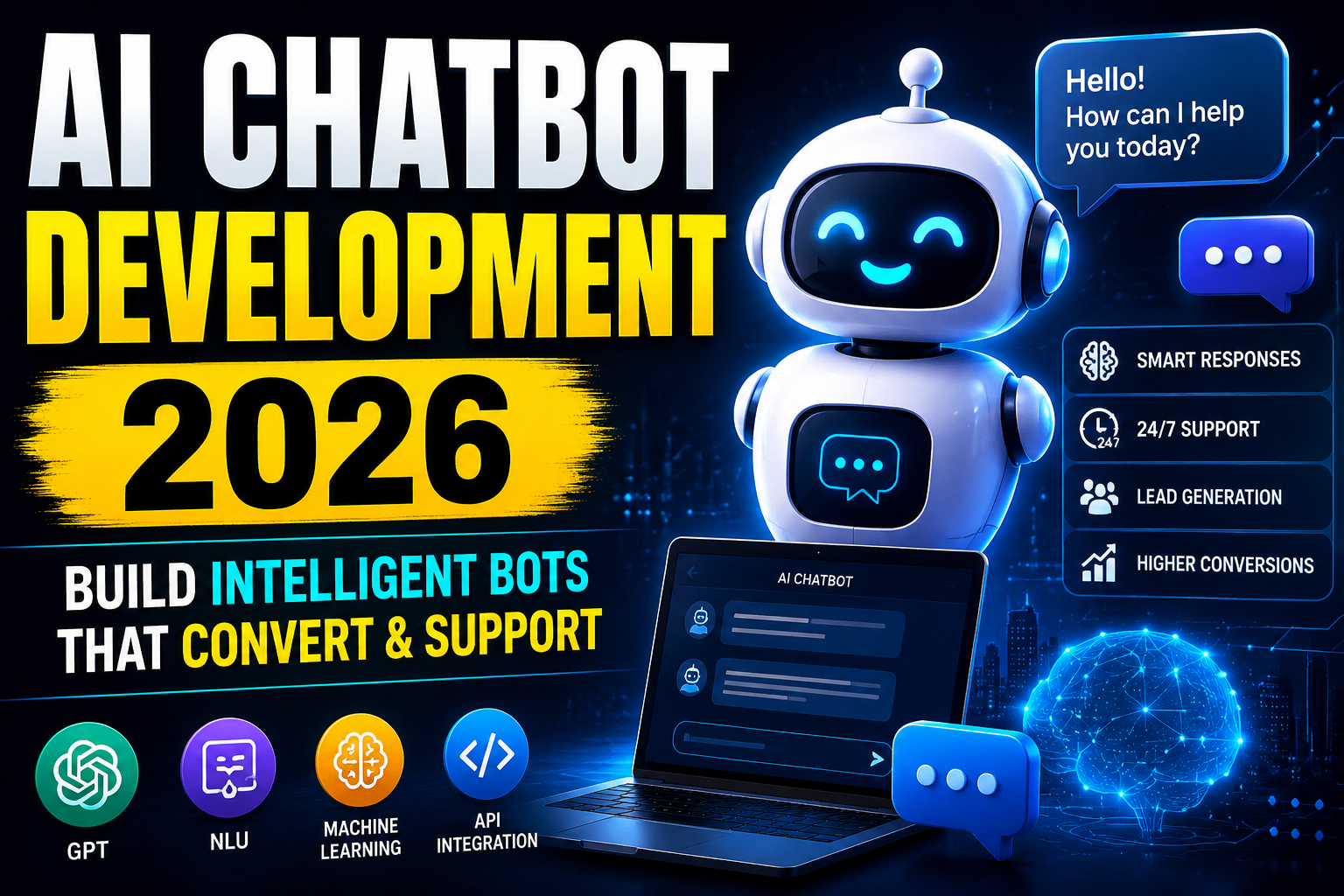
AI chatbot development 2026 has reached a level of sophistication that would have seemed like science fiction just five years ago. Modern AI chatbots powered by large language models can hold natural, context-aware conversations, understand complex queries, handle ambiguity gracefully, and deliver genuinely helpful responses — making them transformative tools for customer service, sales, and lead generation.
In 2026, an AI chatbot is no longer a frustrating phone tree disguised as a chat widget. It is an intelligent digital assistant that can understand what your customers actually mean, remember previous interactions, escalate to humans intelligently, and continuously improve its responses through machine learning.
Why Every Business Needs an AI Chatbot in 2026
Customer expectations have fundamentally shifted. Today’s customers expect instant responses — 24 hours a day, 7 days a week, across every channel they prefer to use. Meeting this expectation with human agents alone is prohibitively expensive for most businesses. AI chatbots make round-the-clock, high-quality customer engagement economically viable for businesses of every size.
Types of AI Chatbots in 2026
1. Customer Support Chatbots Handle customer inquiries, FAQs, order tracking, return processing, and account management — resolving the majority of routine support tickets without human involvement. When a query exceeds the chatbot’s capability, it performs a seamless handoff to a human agent — complete with full conversation context.
2. Lead Generation Chatbots Proactively engage website visitors, qualify leads through conversational questions, capture contact information, and schedule sales calls or demos — all automatically. A well-designed lead generation chatbot can increase website lead conversion rates by 30–40%.
3. Sales Assistant Chatbots Guide potential customers through product selection, answer detailed product questions, provide personalized recommendations based on stated preferences, and facilitate the purchase decision — operating as an always-available digital salesperson.
4. Internal HR & IT Chatbots Handle employee inquiries about HR policies, benefits, PTO balances, IT password resets, software access requests, and onboarding guidance — freeing HR and IT teams from repetitive administrative tasks.
Key Technologies in AI Chatbot Development
Natural Language Processing (NLP) NLP enables chatbots to understand the intent behind a message — not just the literal words. Modern NLP models can handle spelling errors, slang, ambiguous phrasing, and multi-intent queries with remarkable accuracy.
Large Language Models (LLMs) GPT-4, Claude, and Gemini-powered chatbots can generate contextually appropriate, nuanced responses to an enormous range of queries — going far beyond the rigid, scripted responses of traditional rule-based chatbots.
Retrieval-Augmented Generation (RAG) RAG-based chatbots connect LLMs to your specific business knowledge base — product documentation, FAQs, support articles, and policy documents — enabling accurate, grounded responses about your specific business rather than generic AI hallucinations.
Top Chatbot Development Platforms in 2026
| Platform | Best For |
|---|---|
| Botpress | Developer-focused, highly customizable |
| Tidio | SMB website and e-commerce chatbots |
| Intercom Fin | AI customer support for SaaS |
| Landbot | No-code conversational chatbot builder |
| ManyChat | WhatsApp and social media chatbots |
| Dialogflow (Google) | Enterprise NLP chatbot development |
CRM Integration for AI Chatbots
The most powerful chatbot implementations in 2026 are deeply integrated with CRM platforms. When a chatbot is connected to your CRM, it can greet returning customers by name, reference their purchase history, know their current support ticket status, and automatically create or update CRM records from every conversation — delivering a personalized experience that feels genuinely attentive rather than robotic.
Chatbot Best Practices for 2026
- Always disclose that users are interacting with an AI, not a human
- Design clear escalation paths to human agents for complex issues
- Train your chatbot continuously using real conversation data
- Personalize responses using CRM and customer data
- Test your chatbot extensively before deployment — including edge cases and adversarial inputs
- Monitor chatbot performance metrics: resolution rate, customer satisfaction (CSAT), escalation rate, and conversation completion rate
Conclusion
AI chatbot development 2026 represents one of the highest-ROI technology investments available to businesses today. An intelligently designed, well-integrated AI chatbot delivers 24/7 customer engagement, dramatically reduces support costs, captures leads while you sleep, and improves customer satisfaction scores. Build yours in 2026 — and give your business a digital team member that never takes a day off.