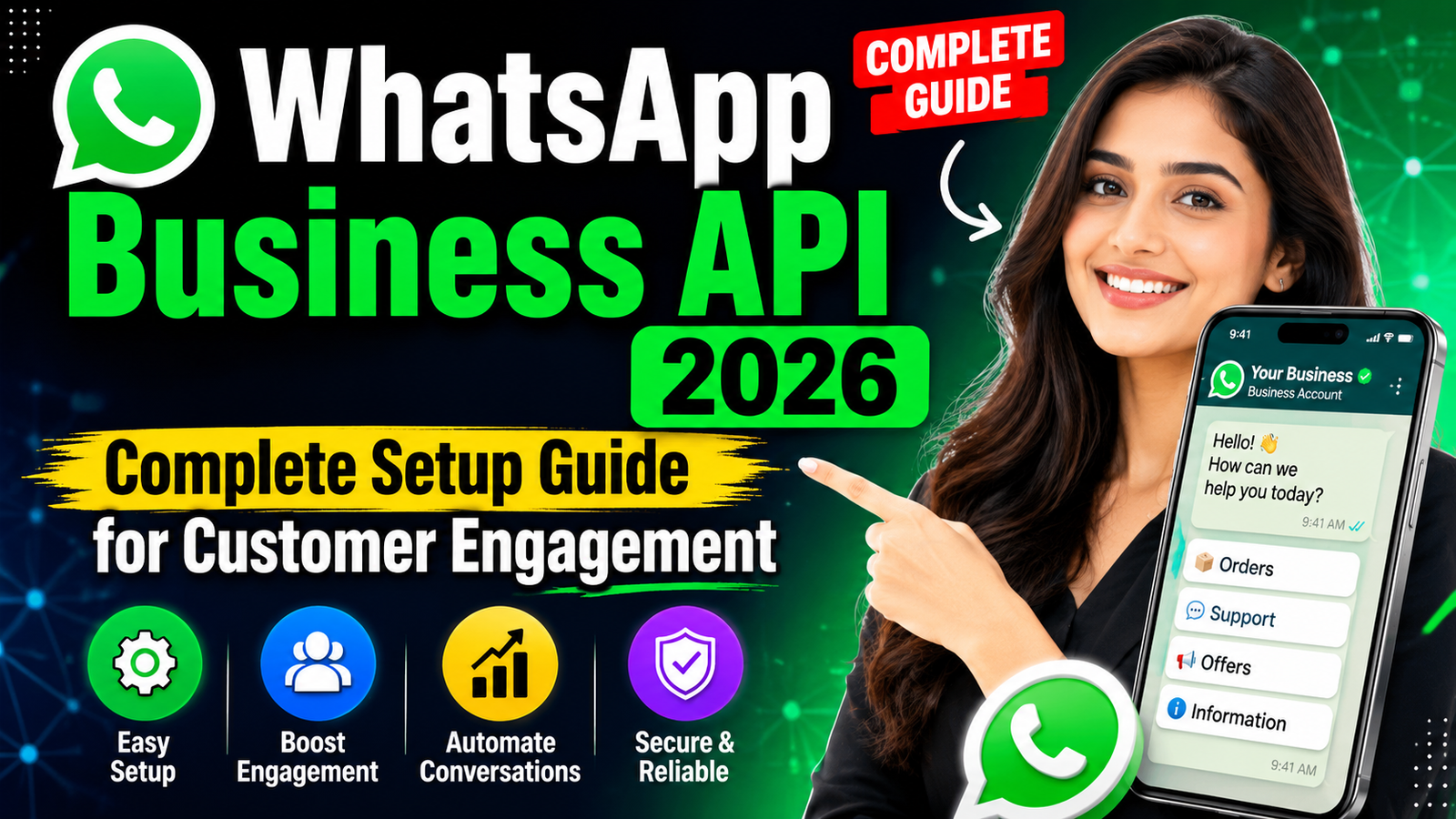
WhatsApp Business API 2026 is the most powerful customer communication channel available to businesses today. With over 2 billion active users globally and open rates exceeding 95% — compared to email’s average of 20-25% — WhatsApp has become the preferred channel for businesses that want their messages to actually be read, responded to, and acted upon.
In 2026, the WhatsApp Business API has matured significantly — offering richer message templates, more flexible conversation categories, improved analytics, and broader integration with CRM, ERP, and e-commerce platforms. Whether you are a small e-commerce brand or a multinational enterprise, WhatsApp Business API belongs in your communication stack.
WhatsApp Business API vs WhatsApp Business App
| Feature | WhatsApp Business App | WhatsApp Business API |
|---|---|---|
| Users | 1-2 devices | Unlimited agents |
| Automation | Limited | Full automation |
| CRM Integration | None | Full integration |
| Message Volume | Low | Unlimited |
| Chatbots | No | Yes |
| Analytics | Basic | Advanced |
| Best For | Very small businesses | SMBs to Enterprise |
Top Use Cases for WhatsApp Business API in 2026
1. Order & Delivery Notifications E-commerce businesses use WhatsApp API to send real-time order confirmations, payment receipts, shipping notifications, and delivery updates — achieving dramatically higher read rates than email.
2. Customer Support Automation AI-powered chatbots handle common support queries — order status, return requests, FAQs — automatically via WhatsApp, escalating complex issues to human agents with full conversation context.
3. Appointment Reminders Healthcare providers, salons, legal firms, and service businesses use WhatsApp API to send appointment reminders with 1-click confirm/reschedule buttons — dramatically reducing no-shows.
4. Abandoned Cart Recovery For e-commerce brands, a WhatsApp message to a customer who abandoned their cart — sent within 30 minutes — can recover 10-15% of lost sales, far outperforming email cart recovery campaigns.
5. Conversational Marketing Businesses run interactive WhatsApp campaigns — product launches, promotional offers, contests, and surveys — as two-way conversations rather than one-way broadcasts. This drives significantly higher engagement than traditional marketing channels.
6. OTP & Authentication WhatsApp OTP delivery has become a popular alternative to SMS OTPs in 2026, particularly in markets where WhatsApp penetration is higher than traditional SMS.
7. Lead Generation & Qualification Integrate a “Chat on WhatsApp” button on your website, ads, and social media — and use AI chatbots to qualify leads, answer product questions, and book sales meetings automatically.
How to Set Up WhatsApp Business API in 2026
Step 1: Apply for a WhatsApp Business Account through Meta’s Business Manager Step 2: Choose a WhatsApp Business Solution Provider (BSP) like Twilio, Vonage, or WATI Step 3: Verify your business phone number Step 4: Create and submit message templates for pre-approval Step 5: Integrate with your CRM or customer support platform via API Step 6: Build your chatbot flows and automation rules Step 7: Test thoroughly before going live Step 8: Monitor analytics and optimize message templates
Top WhatsApp Business API Providers in 2026
- Twilio — Most developer-friendly, global reach
- WATI — Best for SMBs, no-code chatbot builder
- Interakt — Popular in India, e-commerce focused
- 360Dialog — Cost-effective, direct Meta partner
- Vonage — Enterprise-grade with strong SLAs
WhatsApp Business API Pricing in 2026
WhatsApp uses a conversation-based pricing model — charging per 24-hour conversation window rather than per message. Conversation categories include marketing, utility, authentication, and service conversations — each with different pricing tiers. Costs vary by country and volume.
Conclusion
WhatsApp Business API 2026 is your highest-impact customer communication investment. With 95%+ open rates, rich media support, two-way conversational capabilities, and seamless CRM integration — WhatsApp API transforms how businesses engage, support, and retain customers. The brands using WhatsApp API strategically in 2026 are building customer relationships that competitors simply cannot replicate through email alone.