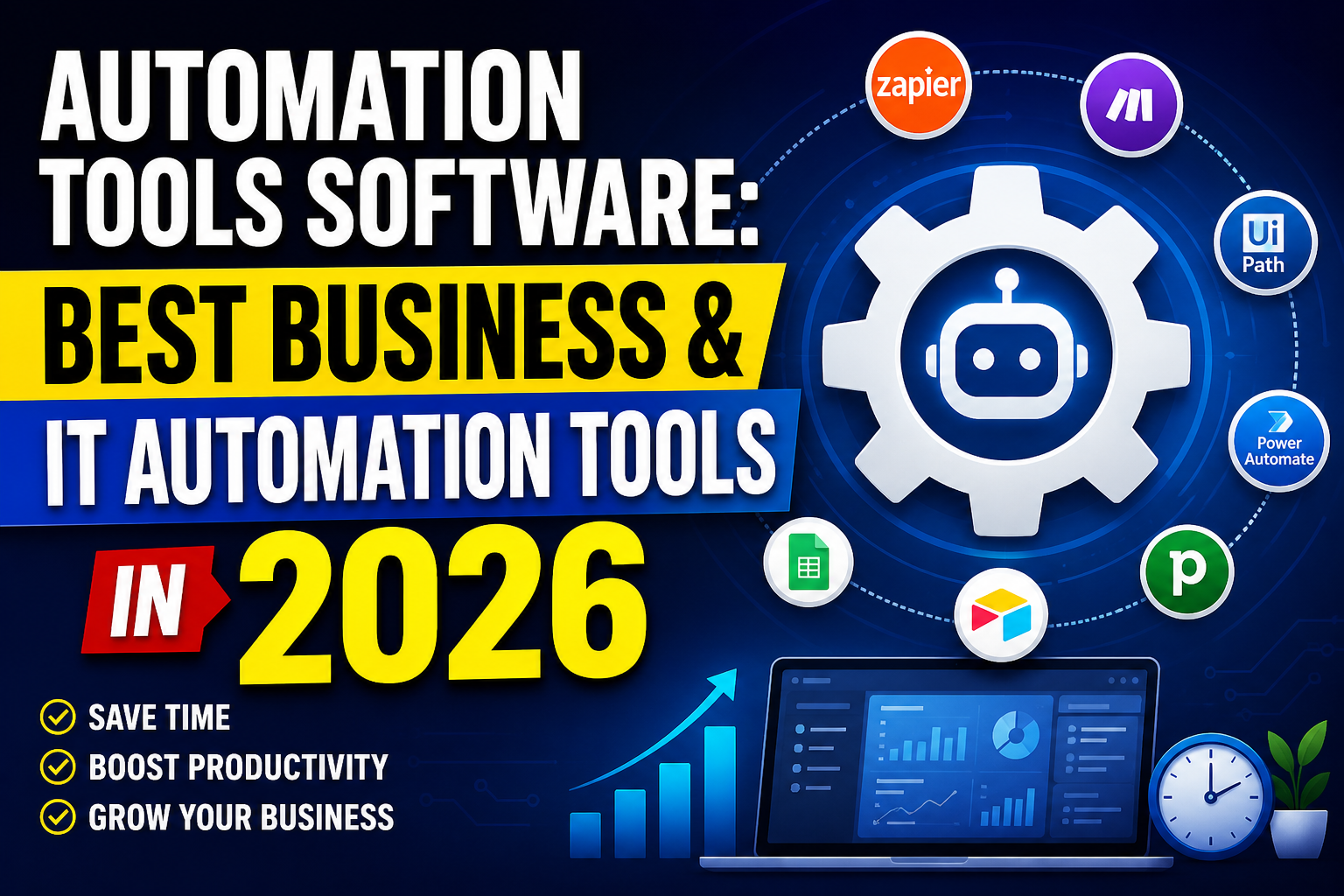
Automation tools software spans a broad landscape—from no-code workflow automation for business teams to robotic process automation (RPA) for enterprise IT and code-based automation for developers. Understanding which category of automated software tools fits your use case is the first step to selecting the right platform.
Categories of Automation Tools Software
No-Code Workflow Automation (iPaaS)
Integration Platform as a Service tools connect different software applications and automate data flows between them. Designed for business users without coding skills.
Top tools: Make.com (Integromat), Zapier, n8n, Tray.io
Best for: Connecting SaaS tools, automating data entry between platforms, triggering notifications
Robotic Process Automation (RPA)
RPA software mimics human actions on computer systems—clicking buttons, entering data, scraping screens, and navigating applications. Used for automating repetitive computer tasks that involve legacy systems without APIs.
Top tools: UiPath, Automation Anywhere, Blue Prism, Microsoft Power Automate Desktop
Best for: Enterprise back-office processes, legacy system integration, high-volume data entry
Business Process Management (BPM)
BPM platforms design, model, and automate end-to-end business processes with approval workflows, escalations, and compliance tracking.
Top tools: Pega, Appian, Nintex, Microsoft Power Automate
Best for: Complex approval workflows, compliance-driven processes, enterprise process governance
Marketing Automation
Automates marketing tasks—email campaigns, lead scoring, social media scheduling, and campaign tracking.
Top tools: HubSpot, Marketo, ActiveCampaign, Pardot
Best for: Lead nurturing, campaign management, customer lifecycle communication
IT Process Automation (ITPA)
Automates IT operations—server provisioning, incident response, patch management, and infrastructure monitoring.
Top tools: Ansible, Puppet, Chef, SaltStack, ServiceNow
Best for: DevOps, infrastructure management, IT service management
Test Automation
Automates software quality assurance—running test suites against applications to detect bugs before deployment.
Top tools: Selenium, Playwright, Cypress, Appium, Postman
Best for: Software development teams, QA departments, continuous integration pipelines
Best General Automation Tools Software in 2026
Make.com (No-Code Champion)
Make.com offers the most powerful visual automation for business users—connecting 1,500+ apps with complex conditional logic, data transformation, and multi-step workflows. More powerful than Zapier for complex automations. From $9/month.
Zapier (Ease of Use Leader)
Zapier connects 6,000+ apps with the simplest setup experience in automation. Best for quick, straightforward integrations between popular tools. From $19.99/month.
UiPath (RPA Leader)
UiPath is the market-leading RPA platform for enterprise desktop and web process automation. Strong AI integration, comprehensive developer tools, and enterprise governance. Community Edition free.
Microsoft Power Automate
Strong for Microsoft 365 ecosystem automation. Covers both cloud workflow automation (like Zapier) and desktop RPA. Included in many Microsoft 365 plans.
n8n (Open-Source Alternative)
Self-hostable open-source workflow automation with 350+ integrations. Popular with developers wanting Make.com/Zapier capabilities without per-operation pricing. Free self-hosted; Cloud from $24/month.
FAQ
What is automation tools software?
Automation tools software encompasses platforms that automate repetitive digital tasks—from no-code workflow automation connecting SaaS apps to robotic process automation mimicking human computer interactions, test automation validating software quality, and IT process automation managing infrastructure. The right category depends on your specific automation need.
What is the best automation software for small business?
Zapier and Make.com are the best automation tools for small businesses—offering no-code integration and workflow automation between 1,500–6,000+ popular apps. HubSpot covers marketing automation. For small businesses, these no-code tools deliver 80% of automation value without developer resources.
What is RPA software?
RPA (Robotic Process Automation) software automates repetitive computer tasks by mimicking human interactions—clicking, typing, reading screens, and navigating applications—without APIs. It’s used for automating legacy system processes, data entry, and back-office operations that can’t be automated through standard API-based integration.
Is automation software difficult to use?
Modern no-code automation tools like Zapier and Make.com are accessible to non-technical users with drag-and-drop interfaces and pre-built templates. RPA and BPM platforms have steeper learning curves and typically require technical or specialized expertise. Test automation and IT automation require developer knowledge.
Conclusion
The right automation tools software depends on your specific use case—no-code workflow automation for business process integration, RPA for legacy system tasks, or test automation for software quality. Start by identifying your highest-impact repetitive task and matching it to the appropriate automation category.
Need custom automation solutions for your business? Explore VBWebSol’s development services or contact us.