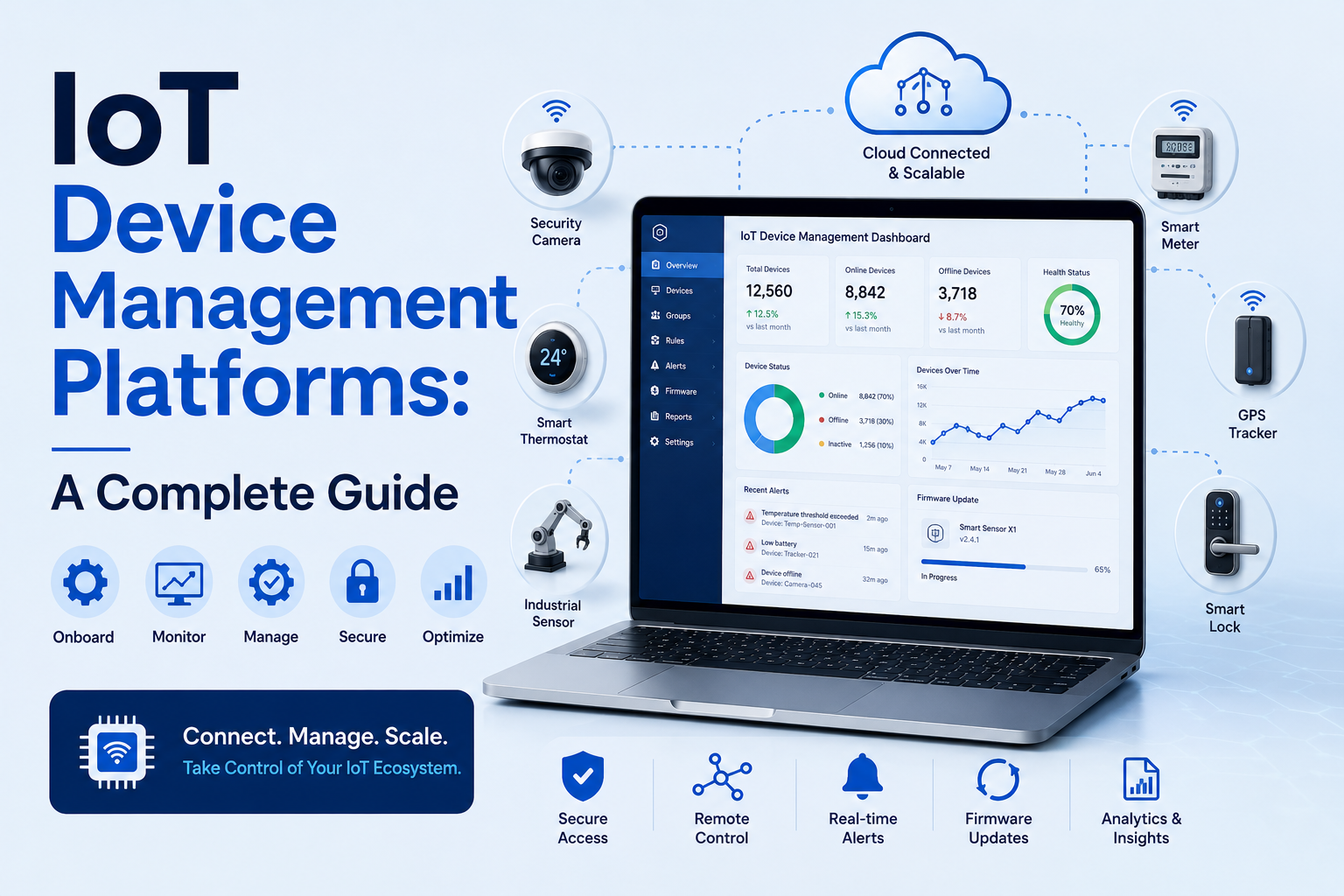
As businesses deploy Internet of Things (IoT) devices at scale — from industrial sensors to smart building systems to fleet tracking hardware — managing those devices manually quickly becomes impractical. IoT device management platforms provide the centralized infrastructure to provision, monitor, update, and secure potentially thousands or millions of connected devices remotely. This guide covers what IoT device management actually involves, compares leading platforms, and outlines key evaluation criteria.
What Is IoT Device Management?
IoT device management refers to the processes and tools used to onboard, monitor, configure, and maintain connected devices throughout their operational lifecycle — from initial provisioning through ongoing operation, software updates, and eventual decommissioning. At scale, this requires purpose-built platform infrastructure rather than manual, device-by-device management.
Core Capabilities of an IoT Device Management Platform
Device Provisioning and Onboarding
Securely registering new devices onto the platform, typically involving device authentication/certificate issuance and initial configuration, needs to work reliably at scale — manually onboarding thousands of devices individually isn’t practical for most deployments.
Remote Monitoring
Real-time visibility into device status, connectivity, battery/power levels (for battery-powered devices), and telemetry data, typically surfaced through dashboards and configurable alerting for anomalies or failures.
Over-the-Air (OTA) Updates
The ability to remotely push firmware and software updates to deployed devices is essential for both security patching and feature updates, particularly for devices deployed in hard-to-physically-access locations where manual update processes would be impractical or prohibitively expensive.
Device Security Management
Certificate lifecycle management, encrypted communication, and the ability to remotely revoke access for compromised or decommissioned devices are core security functions of a mature device management platform.
Data Ingestion and Routing
Most IoT platforms handle routing device telemetry data to downstream analytics, storage, or business application systems, often through configurable rules engines that filter and transform data before it reaches its destination.
Fleet Segmentation and Grouping
For large deployments, the ability to organize devices into logical groups (by location, device type, firmware version) supports targeted updates, monitoring, and reporting rather than treating the entire device fleet as a single undifferentiated pool.
Leading IoT Device Management Platforms
AWS IoT Core
AWS IoT Core offers comprehensive device management capability tightly integrated with the broader AWS ecosystem, making it a natural choice for organizations already using AWS for other infrastructure, with strong scalability for very large device fleets and extensive integration with AWS analytics and machine learning services.
Azure IoT Hub
Microsoft’s Azure IoT Hub offers comparable core device management capability within the Azure ecosystem, with particular strength in enterprise and industrial IoT scenarios given Microsoft’s broader enterprise software relationships and Azure’s industrial IoT-specific tooling.
Google Cloud IoT (and successors)
Google’s IoT platform offerings integrate with the broader Google Cloud data analytics and machine learning ecosystem, appealing particularly to organizations prioritizing advanced data analytics on top of device telemetry data.
Particle
Particle offers an integrated hardware-plus-platform approach, providing both IoT-ready hardware modules and the device management platform together, appealing particularly to product teams building connected hardware products who want a more turnkey solution than assembling infrastructure from a general cloud platform.
Balena
Balena focuses specifically on container-based device management, letting teams deploy and manage containerized applications across a fleet of Linux-based IoT devices, appealing to development teams who want to apply modern DevOps/container practices to edge device management.
Losant
Losant offers a more accessible, lower-code IoT platform aimed at teams that want strong device management and application-building capability without the deeper cloud infrastructure complexity of AWS or Azure’s broader platforms.
Choosing Between Major Cloud Providers vs. Specialized Platforms
Major Cloud Provider Platforms (AWS, Azure, Google Cloud)
Best suited for organizations already invested in a specific cloud ecosystem, needing to integrate device data with broader cloud analytics, storage, and application infrastructure, and managing large-scale deployments where the cloud providers’ proven scalability is valuable.
Specialized IoT Platforms (Particle, Balena, Losant)
Often better suited for product teams building a specific connected hardware product who want more turnkey device management without needing to assemble and configure broader cloud infrastructure themselves, trading some flexibility for faster time-to-deployment.
Key Considerations When Evaluating IoT Platforms
Scale Requirements
Confirm the platform’s proven scalability matches your actual or projected device fleet size — requirements for managing dozens of devices differ substantially from managing hundreds of thousands.
Connectivity Protocol Support
Different IoT use cases rely on different connectivity protocols (MQTT, CoAP, cellular, LoRaWAN, Bluetooth) — confirm the platform natively supports your specific device connectivity approach rather than requiring custom bridging work.
Security Certification and Compliance
For regulated industries (healthcare, industrial, critical infrastructure), confirm the platform meets relevant security certifications and compliance requirements specific to your sector.
Total Cost at Scale
IoT platform pricing often scales with device count and data volume — model your total cost at your actual projected fleet size and data volume, not just initial pilot-scale pricing, since costs can grow substantially at production scale.
Edge Computing Capability
For use cases requiring local data processing (reducing latency or bandwidth usage by processing data on the device or a local gateway rather than sending everything to the cloud), confirm the platform’s edge computing capability matches your specific requirements.
Common IoT Device Management Challenges
Device Fragmentation
Managing a heterogeneous fleet of devices from different manufacturers, with different capabilities and update mechanisms, adds significant management complexity compared to a homogeneous, single-vendor device fleet.
Long Device Lifecycles
IoT devices, particularly in industrial and infrastructure contexts, are often deployed for many years — requiring device management platforms and security practices designed for long-term maintainability, not just initial deployment.
Connectivity Reliability
Devices deployed in remote or challenging environments may have intermittent connectivity, requiring device management approaches that gracefully handle offline periods and reliably resume synchronization once connectivity returns.
Security at Scale
A large IoT deployment represents a significant attack surface, and security vulnerabilities in device firmware or communication protocols can be exploited at scale if not properly managed — making proactive security patching and monitoring a genuinely critical, not optional, part of IoT device management.
Frequently Asked Questions
What is the best IoT device management platform for a large enterprise deployment? AWS IoT Core and Azure IoT Hub are commonly chosen for large enterprise deployments, given their proven scalability and integration with broader cloud analytics and infrastructure, particularly for organizations already invested in one of those cloud ecosystems.
Do I need a specialized IoT platform, or can I build device management myself? For very small deployments, custom-built device management may be feasible, but for any deployment beyond a handful of devices, the security, scalability, and reliability requirements of proper device management generally make a purpose-built platform significantly more practical than custom development.
What’s the difference between AWS IoT Core and a specialized platform like Particle? AWS IoT Core provides broad, flexible infrastructure that integrates with the wider AWS ecosystem but requires more configuration and assembly, while Particle offers a more turnkey, hardware-plus-platform solution specifically aimed at product teams wanting faster time-to-deployment without assembling infrastructure themselves.
How important is over-the-air (OTA) update capability for IoT device management? Very important for most deployments — without reliable OTA update capability, security patching and feature updates for devices deployed in the field become impractical or prohibitively expensive, particularly for devices in hard-to-physically-access locations.
What connectivity protocols do IoT device management platforms typically support? Most major platforms support MQTT as a core protocol, with varying additional support for CoAP, cellular connectivity, LoRaWAN, and Bluetooth depending on the specific platform — confirming your device’s specific connectivity approach is supported natively is an important evaluation step before committing to a platform.
How does IoT device management platform pricing typically scale? Pricing usually scales with device count and/or data volume/message throughput, meaning costs that seem reasonable at small pilot scale can grow substantially at full production deployment scale — it’s important to model total cost at your actual projected fleet size rather than relying on pilot-scale cost estimates alone.