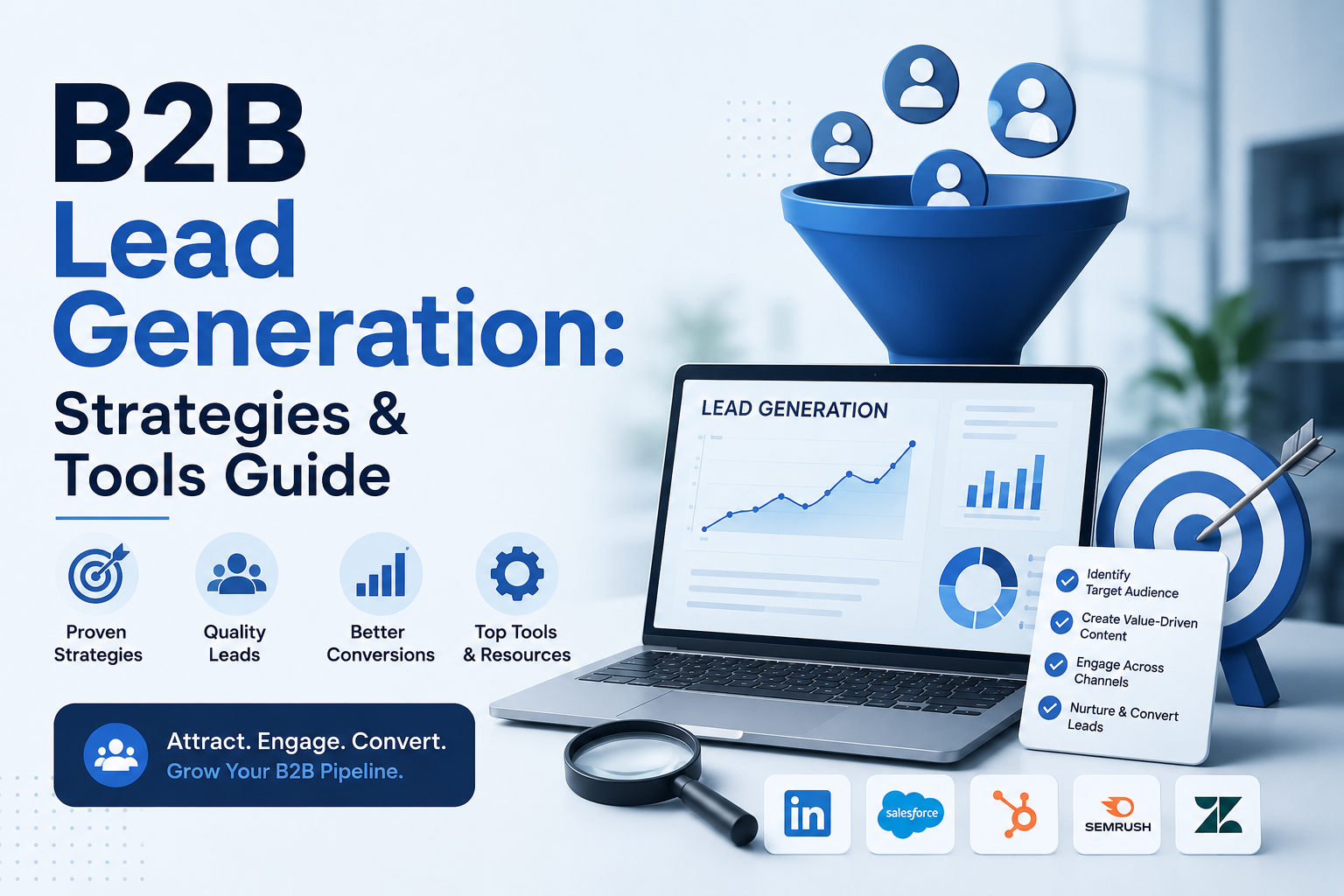
enerating a steady flow of qualified B2B leads is consistently ranked among the top challenges for marketing and sales teams — the buying process is longer, involves more stakeholders, and requires more trust-building than typical B2C purchases. This guide covers the core B2B lead generation strategies working in 2026, the tools that support them, and how to decide between building lead generation in-house versus outsourcing it.
Top-of-Funnel Lead Generation Strategies
Content Marketing and SEO
Publishing genuinely useful content that ranks for the searches your target buyers are already making remains one of the most durable, compounding lead generation channels — unlike paid ads, organic content continues generating leads long after publication, though it requires sustained investment before results compound meaningfully.
LinkedIn Outreach and Content
LinkedIn remains the dominant B2B social platform for both organic content (thought leadership posts that build awareness and credibility) and targeted outbound outreach to specific job titles, industries, and company sizes.
Webinars
Webinars combine lead capture (via registration) with genuine value delivery and direct engagement, making them a particularly effective format for generating higher-intent leads compared to passive content consumption — the act of registering and attending signals meaningfully higher interest than a blog post view.
Paid Search and Display Advertising
Google Ads and LinkedIn Ads remain core paid acquisition channels for B2B, with LinkedIn Ads offering more precise B2B targeting (job title, company size, industry) at a typically higher cost-per-click than Google Ads, which captures higher-intent, actively-searching traffic.
Cold Email and Cold Calling
Despite being among the oldest B2B lead generation tactics, targeted, well-researched cold outreach remains effective when done with genuine relevance and personalization — generic, high-volume cold outreach has become significantly less effective as inboxes and phone lines have become more saturated with low-quality outreach.
Referral and Partner Programs
Structured referral programs — incentivizing existing customers or partners to refer new business — often produce some of the highest-quality leads, since referred leads arrive with built-in trust from the referring party.
Building a Lead Generation Funnel
Top of Funnel: Awareness
Content, SEO, and broad-reach advertising introduce your brand to potential buyers who may not yet recognize they have the problem your product solves, or aren’t yet aware your specific solution exists.
Middle of Funnel: Consideration
Once a prospect recognizes their problem and is evaluating solutions, gated content (in-depth guides, comparison content, webinars) captures contact information in exchange for genuinely valuable information, moving them into your nurture and sales process.
Bottom of Funnel: Decision
High-intent content — case studies, ROI calculators, free trials, demo requests — targets prospects who are actively comparing specific vendors and ready to engage directly with sales.
Lead Capture Mechanics
Every stage needs a corresponding, appropriately-matched call-to-action and landing page — asking for a demo request from someone reading a top-of-funnel educational blog post creates friction mismatched to their actual intent level, while under-asking from a highly engaged, bottom-of-funnel visitor leaves conversion opportunity on the table.
Lead Qualification: Not All Leads Are Equal
MQL vs. SQL
Marketing Qualified Leads (MQLs) have shown enough engagement or fit criteria to be considered worth nurturing further, while Sales Qualified Leads (SQLs) have met a higher bar — typically including explicit buying intent signals — that justifies direct sales outreach. Clear, agreed-upon definitions between marketing and sales teams for what constitutes each stage prevents the common friction of sales rejecting “leads” that don’t actually meet a shared quality bar.
Lead Scoring
Assigning point values to specific behaviors (content downloads, pricing page visits, email engagement) and firmographic fit criteria (company size, industry, job title) allows automated prioritization of which leads deserve immediate sales attention versus continued nurturing.
Intent Data
Beyond first-party engagement signals, third-party intent data platforms track when target accounts are actively researching relevant topics across the broader web (not just your own site), providing an additional signal for prioritizing outbound outreach to accounts showing active buying signals elsewhere.
B2B Lead Generation Tools
Marketing Automation and CRM
HubSpot and Salesforce (with Marketing Cloud or Pardot) are commonly used to manage the full funnel — capturing leads, scoring engagement, and handing qualified leads to sales within a unified system.
Outbound Sales Engagement
Tools like Outreach and Salesloft support structured, multi-touch cold outreach sequences (email and calling) with tracking and automation for sales development reps running high-volume, personalized outbound campaigns.
Intent Data Platforms
Platforms like Bombora and 6sense provide account-level intent data, helping sales and marketing teams prioritize outreach to companies showing active research behavior around relevant topics.
LinkedIn Sales Navigator
LinkedIn’s dedicated sales prospecting tool provides advanced search and targeting capability for identifying and researching prospects matching specific ICP (ideal customer profile) criteria, along with tools for tracking engagement and managing outreach lists.
Landing Page and Form Builders
Unbounce and similar dedicated landing page tools support building and testing high-converting lead capture pages without requiring engineering resources for every campaign.
In-House vs. Outsourced B2B Lead Generation
Building In-House
An in-house lead generation function offers tighter alignment with your specific product, sales process, and company knowledge, along with full control over messaging and strategy — but requires dedicated headcount (content, SEO, paid media, SDR roles) and takes longer to reach full productivity, particularly for content-driven channels like SEO that compound slowly.
Outsourcing to Lead Generation Agencies/Consultants
Outsourced B2B lead generation services can provide faster time-to-execution, especially for outbound-heavy strategies (cold email, cold calling) where agencies bring established processes and tooling. The tradeoff is generally less deep product knowledge than an in-house team, and quality varies significantly between providers, making vendor vetting important before committing to a longer-term engagement.
Hybrid Approaches
Many B2B companies use a hybrid model — in-house content and brand-building (which benefits from deep product knowledge) combined with outsourced execution for specific high-volume, process-driven tactics like cold outbound, where external expertise and existing infrastructure can accelerate time-to-results.
Measuring B2B Lead Generation Performance
Key metrics to track across the funnel include: – Cost per lead (CPL) by channel, to understand which acquisition sources are most cost-efficient – MQL-to-SQL conversion rate, revealing whether marketing is generating genuinely qualified leads or high volume, low quality – SQL-to-customer conversion rate and overall sales cycle length, to understand pipeline health beyond just top-of-funnel volume – Customer acquisition cost (CAC) relative to customer lifetime value (LTV), the ultimate measure of whether lead generation spend is actually profitable
Common B2B Lead Generation Mistakes
- Focusing exclusively on lead volume without qualification, overwhelming sales with unqualified leads that damage sales team trust in marketing-sourced leads
- Neglecting lead nurturing for leads not immediately sales-ready, losing long-term pipeline value from prospects who aren’t ready to buy today but will be eventually
- Inconsistent MQL/SQL definitions between marketing and sales, creating ongoing friction and misaligned expectations about lead quality
- Over-relying on a single channel, creating vulnerability to algorithm changes, rising ad costs, or platform policy shifts that can suddenly disrupt lead flow
Frequently Asked Questions
What is the most effective B2B lead generation strategy? There’s no single universally most effective strategy — the right mix depends on your sales cycle length, average deal size, and target buyer research behavior. Content/SEO tends to be most effective for longer-term, compounding lead flow, while targeted outbound and paid advertising can generate faster, more immediate results.
What’s the difference between an MQL and an SQL? An MQL (Marketing Qualified Lead) has shown engagement or fit signals suggesting it’s worth nurturing, while an SQL (Sales Qualified Lead) has met a higher bar of explicit buying intent that justifies direct sales outreach — the specific criteria for each should be defined jointly by marketing and sales teams.
Is outsourced B2B lead generation worth it? It depends on your specific needs — outsourcing can accelerate execution for process-driven tactics like cold outbound, especially when you lack in-house infrastructure, but generally comes with less deep product knowledge than an in-house team, making careful vendor vetting important.
How long does it take to see results from B2B content marketing and SEO? Content and SEO-driven lead generation typically takes several months to a year to compound meaningfully, given the time required for content to rank and build organic authority, making it a longer-term investment compared to paid advertising’s more immediate (though ongoing-cost-dependent) results.
What tools do B2B sales teams use for cold outreach? Outreach and Salesloft are widely used sales engagement platforms for managing structured, multi-touch cold email and calling sequences, often paired with LinkedIn Sales Navigator for prospect research and targeting.
How do I know if my B2B lead generation is actually working? Track cost per lead by channel, MQL-to-SQL and SQL-to-customer conversion rates, and ultimately customer acquisition cost relative to customer lifetime value — lead volume alone is a misleading metric without corresponding qualification and conversion data.