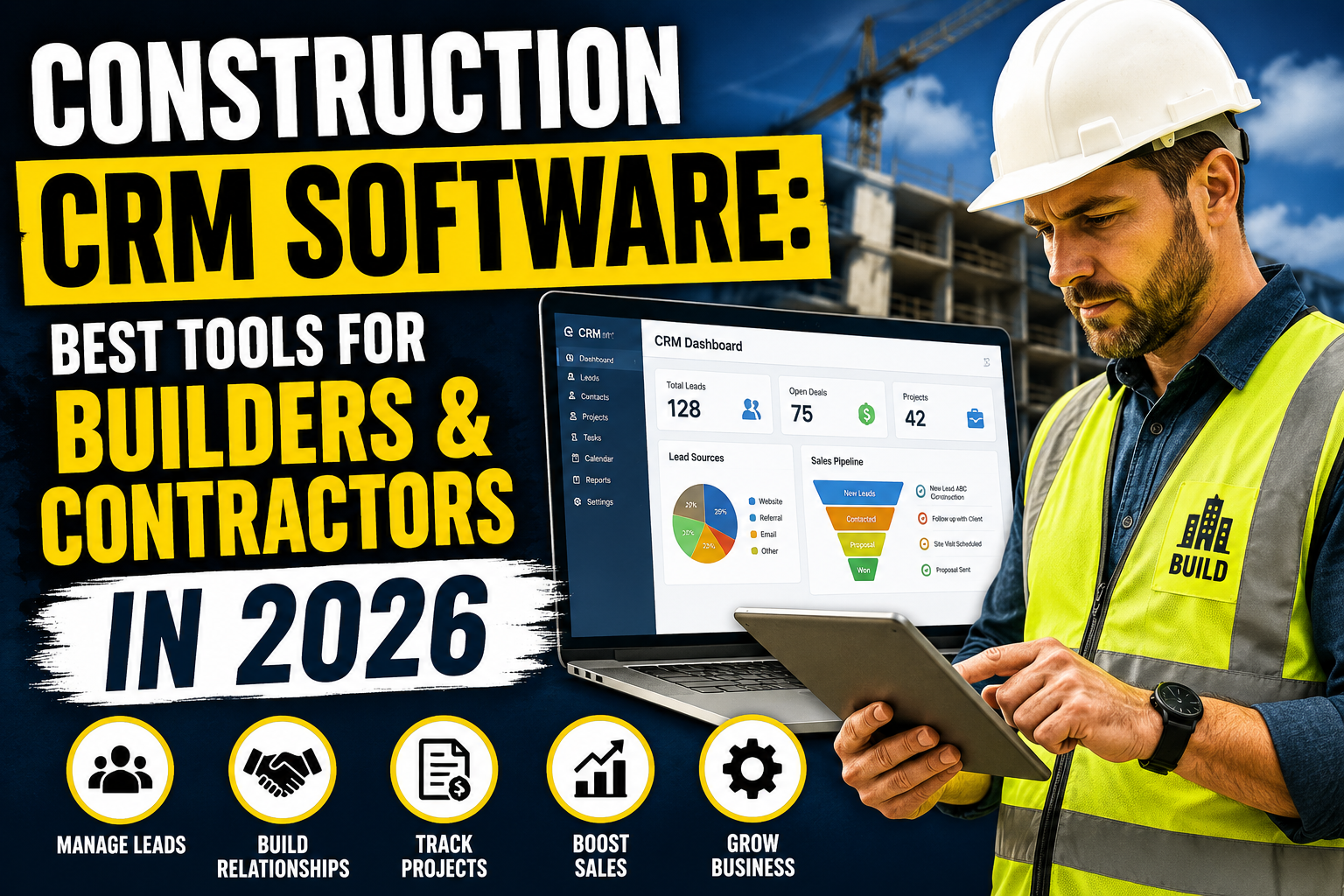
The construction industry is one of the most relationship-driven sectors in business. From managing subcontractors and suppliers to nurturing long-term clients, construction companies thrive or fail based on how well they manage relationships. That’s why construction CRM software has become an essential tool for builders, contractors, and project managers who want to grow their business while keeping operations organized.
In this comprehensive guide, we’ll explore what CRM software for the construction industry offers, how it differs from generic CRM tools, and which platforms are best suited for builders and contractors in 2026.
What Is Construction CRM Software?
CRM software for construction companies is a specialized customer relationship management platform designed to meet the unique needs of the building and contracting industry. Unlike standard CRMs, construction-focused platforms handle bid management, project pipelines, subcontractor coordination, and job site communication alongside traditional sales and contact management.
Whether you’re a general contractor managing multiple projects or a home builder tracking hundreds of leads, crm software for builders provides the workflows and integrations you need to stay competitive.
Why Construction Companies Need a Dedicated CRM
Construction businesses face unique challenges that generic CRM tools aren’t built to solve:
- Long sales cycles: Deals often take months or years to close, requiring nurturing at every stage.
- Complex project management: Multiple stakeholders—architects, engineers, subcontractors, clients—need coordinated communication.
- Bid and proposal tracking: Winning projects depends on fast, accurate, and professional estimates.
- Document management: Contracts, blueprints, permits, and change orders must be accessible and organized.
- Field-to-office connectivity: Teams working on-site need real-time access to project data.
A purpose-built construction company CRM addresses all these pain points within a single unified platform.
Key Features of the Best CRM Construction Software
1. Lead and Opportunity Management
Track every inquiry from initial contact through bid submission and project kickoff. The best crm construction software lets you assign leads to sales reps, set follow-up reminders, and visualize your entire pipeline at a glance.
2. Bid and Proposal Management
Create professional proposals and track bid status in real time. Know exactly which bids are pending, won, or lost, and analyze win rates by project type, region, or client segment.
3. Contact and Company Management
Maintain detailed records for clients, prospects, architects, engineers, and subcontractors. Log every interaction—calls, emails, site visits—for complete relationship history.
4. Project Pipeline Visualization
View your entire project portfolio on a Kanban board or Gantt chart. See which deals are in pre-construction, under contract, or in active build phases.
5. Document Storage and Sharing
Store contracts, blueprints, RFIs, and change orders directly in the CRM linked to each project and contact.
6. Mobile App for Field Teams
Field staff can access project data, log calls, and update statuses from any device, keeping office and site teams perfectly synchronized.
7. Email and Calendar Integration
Sync with Gmail, Outlook, and Google Calendar so every email and meeting is automatically logged against the relevant contact or project.
8. Reporting and Analytics
Track key metrics like bid-to-win ratio, average deal value, sales cycle length, and revenue forecasts to make data-driven business decisions.
Top Construction CRM Software Platforms in 2026
Buildertrend
Buildertrend is one of the most popular platforms combining project management with CRM functionality. It’s ideal for residential builders and remodelers who need seamless client communication, scheduling, and financial tracking in one place.
CoConstruct
CoConstruct is purpose-built for custom home builders and remodelers. It excels at client communication, budget management, and selection tracking, making it a favorite among boutique and luxury home builders.
Procore
Procore is an enterprise-grade construction management platform with robust CRM integrations. It’s best suited for large general contractors managing complex, multi-million-dollar projects with extensive compliance requirements.
HubSpot CRM (with Construction Add-ons)
HubSpot’s free CRM paired with construction-specific customizations offers a powerful, scalable solution for mid-size contractors who need strong marketing automation alongside deal tracking.
Salesforce Construction Cloud
Salesforce offers dedicated construction modules for enterprise companies needing deep integrations with ERP systems, financial platforms, and project management tools.
JobNimbus
JobNimbus is a popular choice for roofing and exterior contractors. It combines CRM, project management, and payment processing into an affordable, easy-to-use platform.
How to Choose the Right CRM Software for Construction
Define Your Business Size and Complexity
Small contractors may be well-served by affordable tools like JobNimbus or HubSpot, while enterprise firms need the scalability of Salesforce or Procore.
Prioritize Must-Have Features
List your non-negotiables: Is bid management critical? Do you need mobile access? Is subcontractor management a priority? Use this list to filter platforms.
Evaluate Integration Capabilities
Your CRM should integrate with your accounting software (QuickBooks, Sage), estimating tools, and project management platforms.
Consider Total Cost of Ownership
Factor in per-seat pricing, implementation costs, training, and ongoing support when comparing platforms.
Benefits of Implementing CRM Software for the Construction Industry
- Improved win rates: Companies using CRM software report up to 29% increase in sales win rates through better follow-up and pipeline management.
- Faster response times: Automated lead nurturing ensures no inquiry goes unanswered.
- Better client retention: Centralized communication history helps teams deliver personalized, consistent service.
- Streamlined operations: Eliminate spreadsheets and email chains with a single source of truth.
- Data-driven decisions: Real-time dashboards help leadership make faster, smarter strategic choices.
Custom CRM vs. Off-the-Shelf for Construction Companies
While off-the-shelf platforms offer quick deployment, many growing construction companies find they outgrow generic solutions. A custom CRM built specifically for your business can accommodate your unique workflows, integrate with proprietary systems, and scale without per-seat pricing constraints.
Custom construction CRM development allows you to build exactly the features your team uses daily—without paying for functionality you’ll never need.
Related Resources
Frequently Asked Questions
What is construction CRM software?
Construction CRM software is a specialized customer relationship management platform designed for builders, contractors, and construction companies. It includes features like bid tracking, project pipeline management, subcontractor coordination, and document storage alongside standard CRM capabilities like contact management and sales automation.
What is the best CRM for construction companies?
The best CRM for construction depends on company size and needs. Buildertrend and CoConstruct are popular for residential builders, Procore suits enterprise contractors, while HubSpot and Salesforce offer highly customizable options. Custom-built CRM solutions are ideal for businesses with unique workflows.
How much does construction CRM software cost?
Construction CRM costs vary widely. Entry-level tools like JobNimbus start around $25–$50/user/month. Enterprise platforms like Salesforce can exceed $150/user/month. Custom CRM development is a one-time investment that often delivers better ROI for growing businesses.
Can construction CRM software integrate with accounting tools?
Yes, most leading construction CRM platforms integrate with QuickBooks, Sage, Xero, and other accounting software. These integrations eliminate double data entry and keep financial and project data synchronized in real time.
Conclusion
The right construction CRM software transforms how your business manages relationships, bids, and projects. Whether you’re a small contractor or a large general contractor, investing in a CRM tailored to the construction industry will improve your win rates, client satisfaction, and overall efficiency.
Ready to build a CRM solution that fits your exact construction workflows? Explore VBWebSol’s custom CRM development services or contact us today for a free consultation.