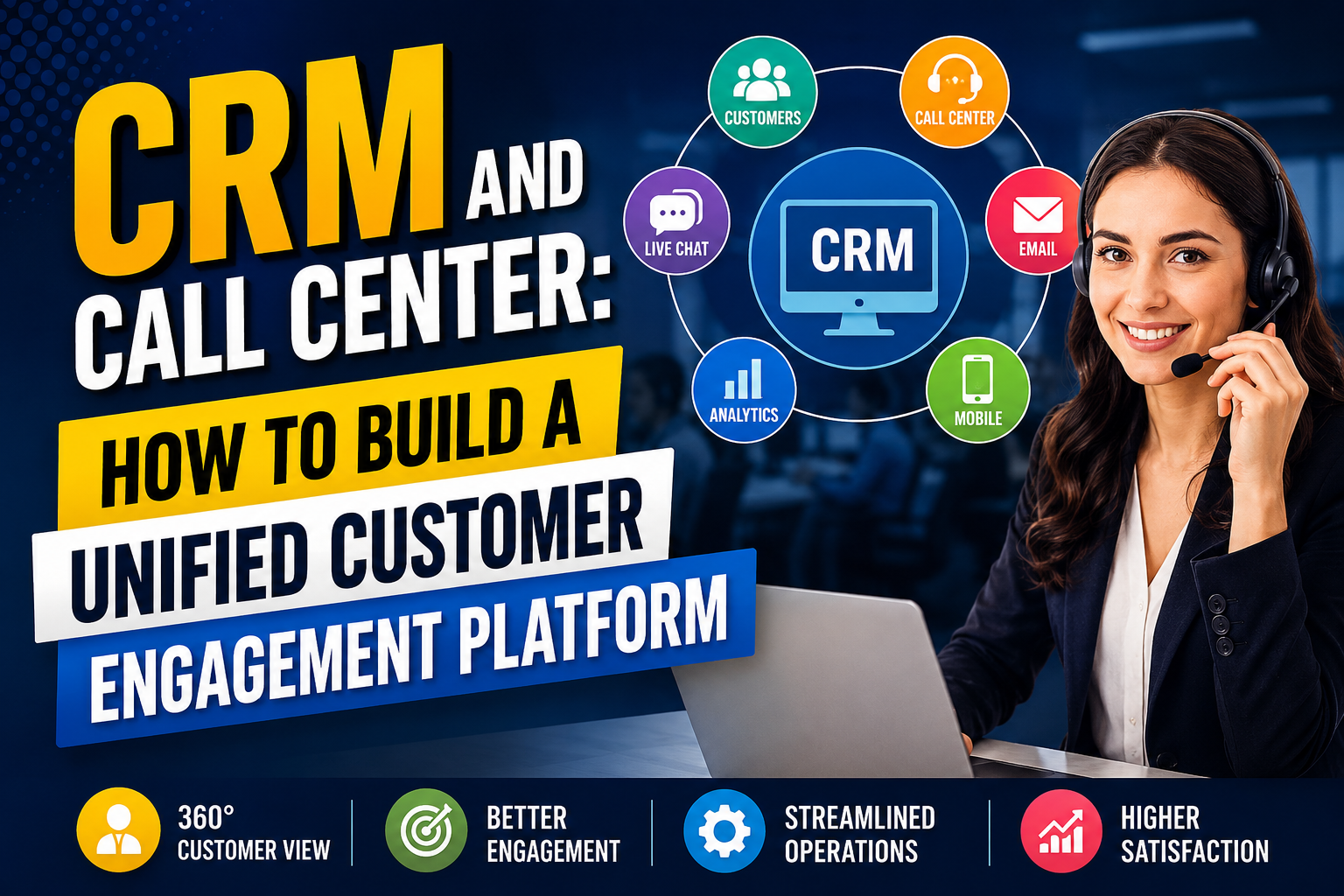
The convergence of CRM and call center technology into unified customer engagement platforms represents one of the most significant operational improvements available to businesses managing high-volume customer interactions. When relationship context, interaction history, and customer intelligence from the CRM are available in real time to call center agents — and when every call interaction is automatically captured back into the CRM — the quality of customer experiences improves dramatically while agent efficiency increases and management visibility deepens.
This guide explores how to build and optimise a unified CRM and call center operation — covering the strategic rationale, platform options, implementation approach,
and the key metrics that measure the business impact of CRM and call center integration.
The Strategic Case for Unified CRM and Call Center
The traditional separation of call center operations (focused on interaction volume and efficiency) from CRM operations (focused on relationship management and revenue) creates a costly operational disconnect. Call center agents have detailed customer knowledge locked in telephony systems that CRM users cannot access. CRM users have relationship context and customer history that call center agents never see. Customers experience this disconnect every time they call and must re-explain their situation to an agent who has no visibility into previous interactions.
Unifying CRM and call center operations — whether through integrated platforms or tight technical integration — resolves this disconnect. Agents have complete customer context before calls connect. Every interaction enriches the customer record. Managers can correlate call center performance with CRM outcomes (revenue, churn, satisfaction) rather than measuring each in isolation. This unified view enables genuinely customer-centric operations — treating every interaction as part of a continuous relationship rather than a discrete transaction.
Call Center as a CRM Touchpoint
In a unified CRM and call center model, every call is treated as a CRM activity — logged, categorised, and linked to the customer record automatically. This call history becomes a valuable component of the customer profile,
enabling: more personalised handling of repeat callers, identification of customers who have called multiple times about the same issue (indicating a systemic problem requiring resolution),
correlation between call centre interactions and customer retention/expansion outcomes,
and coaching opportunities where call transcripts and outcomes are reviewed in the context of the complete customer relationship.
Platform Options for Unified CRM and Call Center
Three architectural approaches serve different organisational contexts. Single-platform solutions: Platforms like Salesforce Service Cloud + Einstein Conversation Insights, HubSpot Service Hub + Calling, and Freshdesk + Freshcaller provide CRM and call center capabilities within a single vendor’s ecosystem. These offer the simplest integration and unified data model but may have limitations in call center feature depth for complex contact centre requirements. Best-of-breed with deep integration: Enterprise contact centre platforms (Five9, Genesys Cloud, NICE CXone, Avaya) with certified CRM integrations (Salesforce, Dynamics 365, HubSpot). These provide enterprise contact centre depth alongside strong CRM connectivity through pre-built, vendor-maintained connectors.
Custom integration architectures: For organisations with specific requirements not served by standard connectors — legacy phone systems, proprietary CRM configurations,
or unique workflow requirements — custom integration development through APIs provides the flexibility to build precisely the unified experience required. This approach has higher upfront cost but enables capabilities that standard integrations cannot provide. VBWebSol has extensive experience developing custom CRM and call center integrations for organisations across industries,
building the specific unified workflows that standard platform integrations cannot deliver.
Measuring Success: CRM and Call Center KPIs
A unified CRM and call center operation should be measured against KPIs from both domains, plus integration-specific metrics that reflect the value of unification. Call center KPIs: Average Handle Time (AHT),
First Call Resolution (FCR), Customer Satisfaction Score (CSAT), Abandon Rate, and Service Level (percentage of calls answered within target time). CRM KPIs: CRM record completeness rate (percentage of calls with complete activity records), CRM update timeliness (time between call completion and CRM record update),
and data quality scores for call-related fields.
Integration success KPIs: Screen pop match rate (percentage of inbound calls successfully matched to existing CRM records), manual data entry time saved per agent per shift,
first-call resolution improvement post-integration, and call-driven revenue attribution (deals influenced or created by call center interactions, tracked in CRM). Establishing pre-integration baselines for these metrics and tracking them monthly post-integration provides the data to demonstrate ROI and identify optimisation opportunities. Businesses that measure these metrics systematically consistently report significant improvements: 15-25% reductions in AHT, 10-20% improvements in FCR,
and substantial improvements in CRM data quality.
Frequently Asked Questions
How do I integrate my call center with CRM?
The integration approach depends on your infrastructure. cloud-native stacks, use a pre-built connector between your contact centre platform (Five9, Genesys, NICE) and your CRM (Salesforce, HubSpot, Dynamics). Microsoft-invested organisations,
Dynamics 365 Customer Service includes native call center capabilities. custom requirements, build API-based integration using your contact centre’s API alongside your CRM’s API. Always start with the highest-impact capabilities: screen pop and automatic call logging — these two capabilities alone deliver the majority of the productivity and data quality benefits.
Does HubSpot have call center functionality?
HubSpot Service Hub includes calling capabilities — agents can make and receive calls directly from HubSpot, with automatic logging,
call recording, and activity association. For small to mid-size service teams,
HubSpot’s built-in calling is often sufficient without a separate contact centre platform. For large contact centres requiring ACD, IVR, workforce management, and advanced analytics,
HubSpot partners with providers like Aircall, JustCall, and Talkdesk for deeper integration.
What are the benefits of integrating CRM with a call center?
Key benefits: 15-30% reduction in average handle time from screen pop (eliminating manual CRM lookup), improved first-call resolution from complete customer context,
automatic call logging eliminating manual data entry, management visibility into call-driven revenue and customer outcomes,
better customer experience from agents who recognise callers and have their history,
and improved coaching through call recording linked to CRM outcome data.
Can I use Salesforce as a call center CRM?
Yes — Salesforce Service Cloud with Salesforce Voice (powered by Twilio) provides comprehensive call center functionality within Salesforce. Alternatively,
Salesforce integrates with leading contact centre platforms (Five9, Genesys, NICE, Avaya) through certified AppExchange connectors. For organisations already using Salesforce CRM,
extending to Salesforce Voice is the lowest-friction path to unified CRM and call center operations.
Conclusion
Building a unified CRM and call center operation is a transformational investment in customer experience quality and operational excellence. By selecting the right integration architecture for your infrastructure,
configuring the high-impact capabilities first, and measuring performance systematically against pre-integration baselines,
you build a customer engagement foundation that drives measurable improvements in satisfaction, efficiency, and revenue outcomes.
Related Articles
Ready to grow your business with the right technology? Explore VBWebSol’s Custom CRM Software Solutions or contact our expert team for a free consultation. With over 12 years of IT expertise in Ahmedabad,
we help businesses across India and globally implement solutions that deliver real, measurable results.