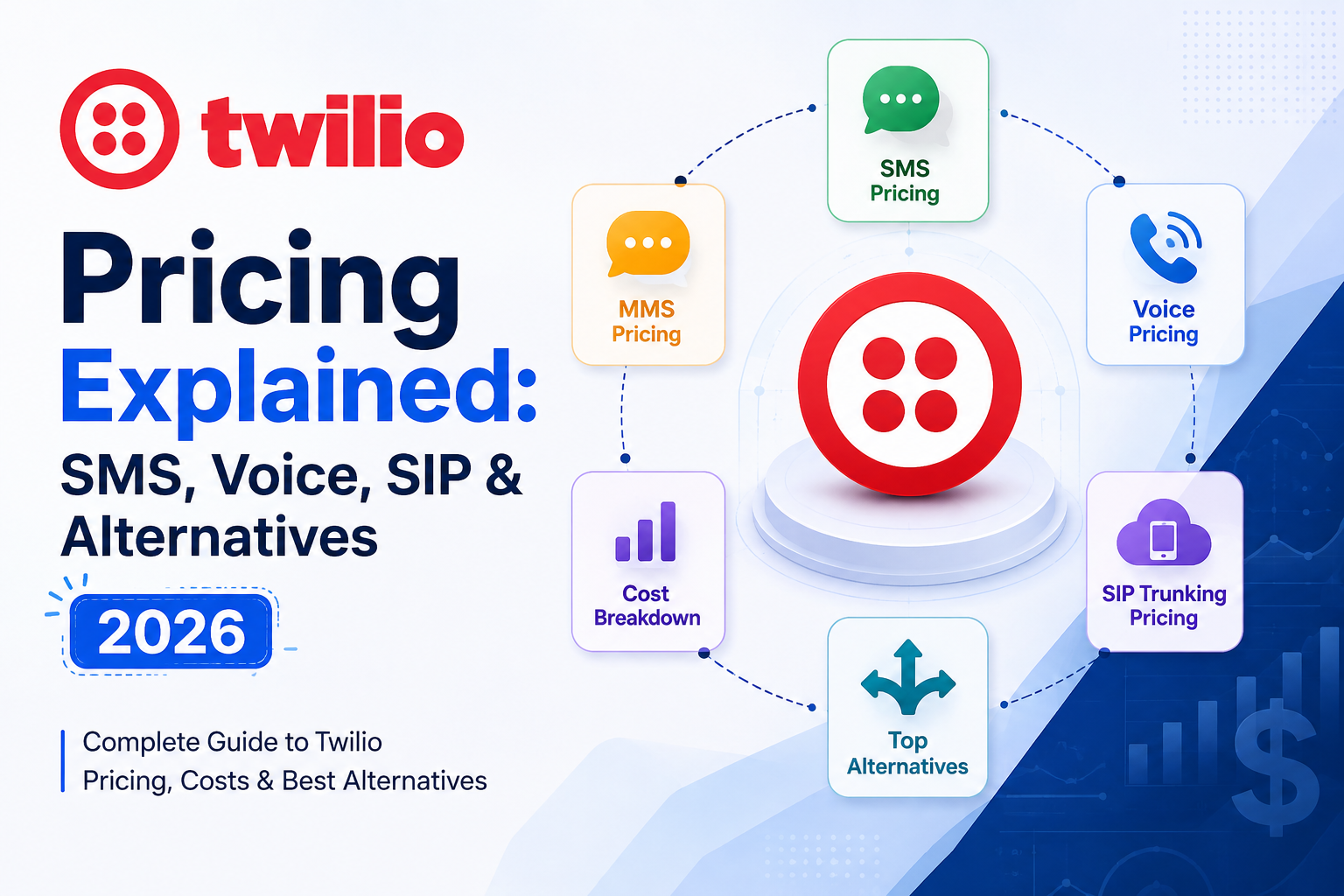
Twilio remains one of the most widely used cloud communications platforms, powering SMS, voice calling, video, and messaging for businesses ranging from early-stage startups to global enterprises. But its pricing structure — usage-based, broken into dozens of individual line items, and varying by country — is notoriously hard to estimate in advance. This guide breaks down exactly how Twilio pricing works across its core products, what actually drives your monthly bill, and how it compares to leading alternatives.
How Twilio Pricing Works (The Basics)
Twilio uses consumption-based, pay-as-you-go pricing across nearly all of its products. There’s no traditional flat monthly subscription for most use cases — instead, you’re billed per message sent, per minute of call time, per phone number provisioned, and per API call for many auxiliary services. This model is flexible and scales down cleanly for low-volume use cases, but it also means your total cost depends heavily on your specific usage pattern, destination countries, and which products you combine.
Key cost drivers to understand before estimating your bill:
- Volume — price per unit (SMS, minute, etc.) usually decreases at higher tiers, but the base rate applies until you hit volume thresholds
- Geography — sending an SMS or making a call to different countries carries wildly different per-unit costs due to local carrier fees
- Number type — local numbers, toll-free numbers, and short codes each have different provisioning and usage costs
- Product combination — using Twilio Segment, Flex, or Studio alongside core messaging/voice adds separate charges on top
Twilio SMS Pricing
SMS pricing in the U.S. and Canada typically starts at a low per-segment rate (a “segment” being up to 160 characters of a standard SMS), with outbound and inbound messages priced separately. International SMS rates vary substantially by destination — sending to some countries costs several times more than U.S. domestic rates due to local carrier surcharges.
Additional SMS-related costs to budget for:
- Phone number rental — a recurring monthly fee per number, separate from per-message costs
- Carrier fees — U.S. carriers (AT&T, Verizon, T-Mobile) apply their own per-message surcharges on top of Twilio’s base rate, particularly for A2P (application-to-person) traffic
- 10DLC registration — U.S. businesses sending SMS via long code numbers are required to register their brand and campaign for A2P 10DLC compliance, which carries its own one-time and recurring fees
Twilio Voice Pricing
Voice calling is priced per minute, with separate rates for inbound and outbound calls, and further differentiated by whether the call is to a landline, mobile number, or toll-free number. International calling rates vary by destination country, similarly to SMS.
Additional voice-related costs include:
- Recording — call recording carries a per-minute storage and processing charge if enabled
- Transcription — automated call transcription is billed separately per minute of audio processed
- Conferencing — multi-party calls (via the Conference API) are billed per participant-minute
Twilio SIP Trunking Pricing
Twilio’s Elastic SIP Trunking product allows businesses to connect their existing phone systems (PBX) to the Twilio network, typically at a lower per-minute rate than standard voice API calls for high-volume use cases. Pricing is structured around per-minute termination and origination rates, plus number provisioning fees, and is generally most cost-effective for businesses with an existing on-premises or cloud PBX that want to route calls through Twilio’s carrier network rather than building a full contact center on the Voice API.
Twilio Flex Pricing
Flex, Twilio’s programmable contact center platform, uses per-active-user, per-hour pricing rather than the pure consumption model used by core messaging and voice. This makes cost estimation somewhat more predictable for contact centers with known agent headcounts, though the underlying SMS/voice usage generated by Flex agents is still billed separately at standard Twilio rates.
Twilio Segment Pricing
Segment, Twilio’s customer data platform, uses a different pricing model entirely — based on Monthly Tracked Users (MTUs) rather than message or call volume. Pricing tiers scale with the number of unique users tracked across your connected sources each month, with a free tier available for very low-volume use cases and custom enterprise pricing for large-scale deployments.
Twilio Autopilot and Studio
Twilio Studio (visual workflow builder) pricing is typically usage-based per execution, layered on top of the underlying SMS/voice costs those workflows trigger. Autopilot (Twilio’s conversational AI/IVR product) has its own per-session pricing structure, in addition to the voice or messaging minutes/segments consumed during each conversation.
How to Estimate Your Total Twilio Bill
Because Twilio pricing is fragmented across so many line items, a realistic estimate needs to account for:
- Base usage costs — SMS segments or voice minutes at your expected volume and destination mix
- Number rental fees — monthly cost per phone number, multiplied by how many numbers you provision
- Compliance fees — 10DLC registration for SMS, or similar regulatory costs in other countries
- Add-on features — recording, transcription, Studio flows, Autopilot sessions
- Carrier surcharges — often overlooked, these can meaningfully increase the effective cost per message beyond Twilio’s advertised base rate
Twilio publishes current rates in its online pricing calculator by product and country, which is the most reliable way to model costs for your specific use case rather than relying on general benchmarks, since rates are updated periodically.
Twilio Competitors and Alternatives
Twilio isn’t the only cloud communications platform, and depending on your use case, alternatives may offer better pricing or simpler billing structures.
Vonage (formerly Nexmo)
Vonage’s communications APIs offer competitive per-message and per-minute pricing, particularly for international SMS in certain regions, and are often considered a direct Twilio alternative for core messaging and voice use cases.
MessageBird (Bird)
Bird offers omnichannel messaging (SMS, WhatsApp, email) with pricing that’s often positioned as more predictable than Twilio’s fragmented line-item structure, and is popular with businesses that prioritize WhatsApp Business API integration.
Plivo
Plivo is frequently cited as a lower-cost alternative for high-volume SMS and voice use cases, with a simpler pricing page and often lower base rates than Twilio for comparable services — though with a smaller ecosystem of add-on products.
AWS SNS / Amazon Pinpoint
For businesses already deeply invested in AWS infrastructure, Amazon’s SNS (for SMS) and Pinpoint (for broader messaging campaigns) can offer cost advantages through existing AWS billing relationships and volume discounts, though the developer experience is generally considered less polished than Twilio’s.
Sinch
Sinch offers a broad communications API suite similar to Twilio’s, with particular strength in certain international markets, and is often evaluated by businesses with significant cross-border messaging or calling volume.
Twilio Pricing vs. Alternatives: What Actually Matters
When comparing Twilio to competitors, per-unit price comparisons can be misleading if you only look at the headline SMS or voice-minute rate. The more important factors are usually:
- Total cost including surcharges and fees — not just the advertised base rate
- Reliability and deliverability — a cheaper platform with worse deliverability rates can cost more in lost conversions than it saves in per-message fees
- Developer experience and documentation quality — implementation and maintenance time has a real cost, even if it doesn’t show up on the invoice
- Global coverage — if your use case spans many countries, coverage and local compliance support matter more than domestic U.S. pricing
Frequently Asked Questions
How much does Twilio cost per month? There’s no fixed monthly cost — Twilio bills based on actual usage (messages sent, minutes used, numbers provisioned). A low-volume startup might spend under $50/month, while an enterprise contact center can spend tens of thousands of dollars monthly depending on call and message volume.
Is Twilio expensive compared to competitors? Twilio’s base per-unit rates are often comparable to or slightly higher than alternatives like Plivo or Vonage, but its pricing includes a broader ecosystem of tools (Studio, Segment, Flex) that can reduce the need for separate third-party services, which can offset the higher unit cost for some businesses.
What is Twilio Elastic SIP Trunking used for? It’s used to connect an existing phone system (PBX) to Twilio’s carrier network for making and receiving calls, typically at a lower per-minute cost than the standard Voice API for high-volume calling, without requiring a full migration to Twilio’s contact center tools.
Do I need 10DLC registration to send SMS with Twilio? Yes, if you’re sending application-to-person (A2P) SMS to U.S. numbers using a long code (standard 10-digit number), U.S. carriers require brand and campaign registration under the 10DLC framework, which involves separate registration fees from Twilio’s per-message rates.
What’s the cheapest Twilio alternative? Plivo is frequently cited as one of the lower-cost options for high-volume SMS and voice, though “cheapest” depends heavily on destination countries and specific use case — it’s worth requesting quotes from multiple providers for your actual expected volume rather than relying on general price comparisons.
Does Twilio offer a free tier? Twilio offers free trial credit for new accounts to test the platform, and Segment specifically offers a free tier for low-volume tracked users, but core SMS and voice products don’t have an ongoing free tier for production use beyond the initial trial credit.