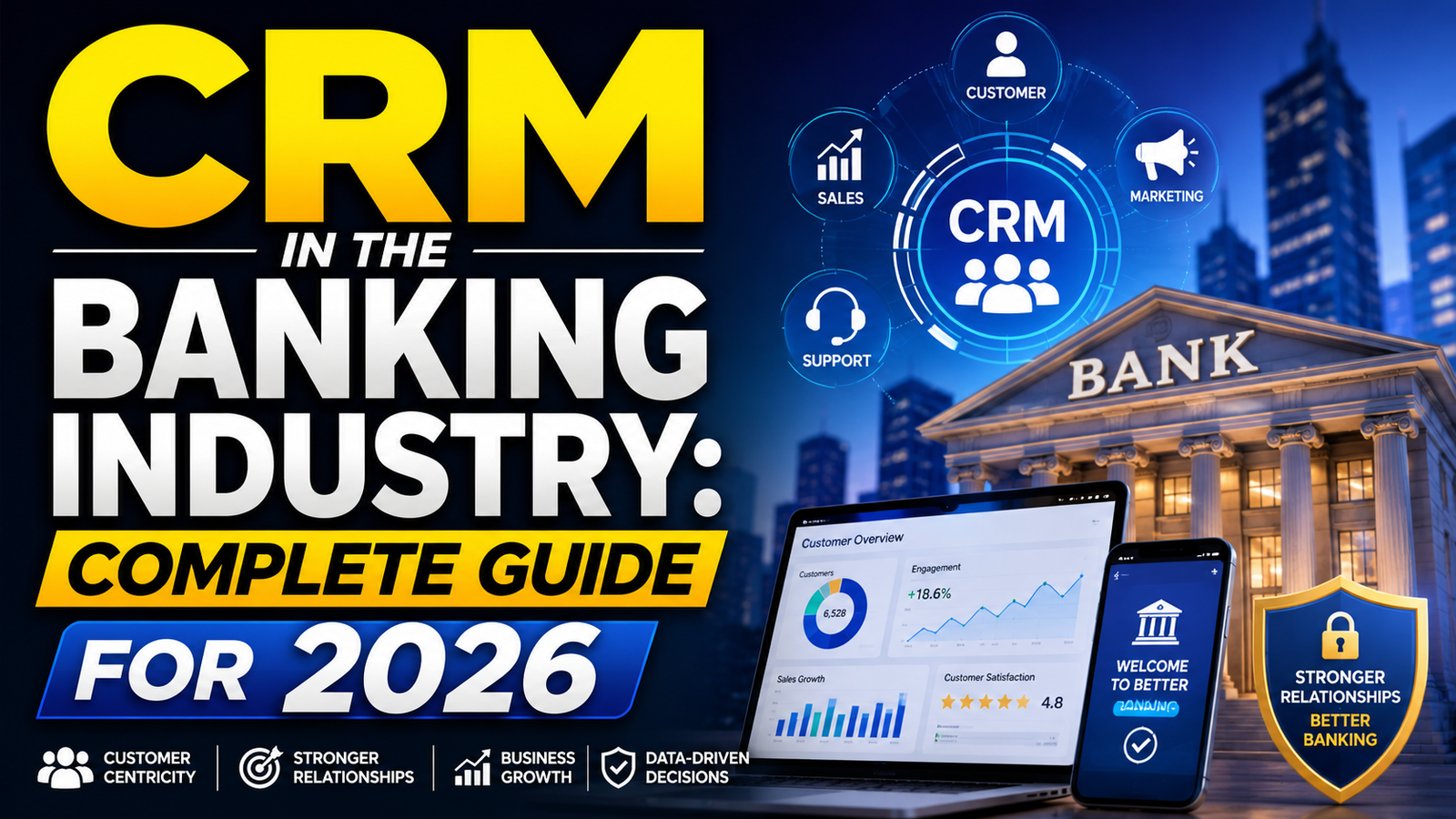
CRM in the banking industry has evolved from simple contact management into a sophisticated customer intelligence and engagement platform that enables banks to deliver the personalised, relationship-driven service that retains customers, deepens product relationships, and drives sustainable profitability. In an era of digital disruption — where challenger banks, fintech platforms, and big tech companies are competing directly for banking customers with superior digital experiences — the quality of customer relationship management has become a primary competitive differentiator for traditional banks.
This comprehensive guide covers the role of CRM in banking, the specific use cases that deliver the most value, the compliance and security requirements that banking CRM must meet, and the leading platforms serving the financial services sector in 2026.
Why Banks Need CRM
Banks are fundamentally relationship businesses — the depth and breadth of a customer’s relationship with their bank (number of products held, length of tenure, deposit balances, borrowing relationships) directly determines customer lifetime value. Yet many banks still manage these relationships with fragmented systems that prevent branch staff, relationship managers, and digital channels from operating with a unified view of the customer. CRM in banking creates the single customer view that enables genuinely personalised service: when a customer calls about their mortgage, the service agent can see their complete product portfolio, recent interactions across all channels, life events, and relationship health at a glance.
Cross-selling and product deepening — the practice of increasing the number of banking products each customer holds — is the primary revenue driver for CRM investment in retail banking. Research consistently shows that customers holding more products with a bank have higher satisfaction scores, higher retention rates, and higher lifetime value. CRM analytics that identify customers who are likely to need specific products based on their life stage, account behaviour, and demographic profile — and trigger timely, relevant offers through the right channel — drive meaningful improvements in cross-sell conversion rates without the customer dissatisfaction associated with undifferentiated mass marketing.
Digital and Physical Channel Integration
Modern banking CRM must integrate digital and physical channel interactions in a unified customer view. When a customer researches mortgage rates on the bank’s website, applies for a credit card through the mobile app, and then visits a branch for investment advice, these interactions should all be visible in the same CRM record, providing any bank employee with a complete picture of the customer’s recent engagement. This omnichannel view is the technical foundation of consistent, personalised service — without it, customers experience the frustration of being treated as strangers in each channel despite their long relationship with the bank.
Key CRM Use Cases in Banking
Retail banking: Lead management for new product applications, life event-triggered cross-sell campaigns (mortgage pre-approval offer when a customer reaches a savings milestone, investment account offer when retirement age approaches),
complaint management with SLA tracking and regulatory reporting, and branch staff productivity tools that surface personalised conversation starters for each customer visit. Commercial banking: Relationship manager productivity tools for managing complex multi-product relationships with business clients, deal pipeline management for business loans and treasury mandates,
KYC workflow management and periodic review scheduling, and revenue analytics by relationship manager and client segment.
Private banking and wealth management: Client portfolio management with investment goal tracking,
estate and succession planning workflow support, relationship mapping for high-net-worth family relationships, and client communication management ensuring regular high-quality touchpoints. Mortgage and lending: Pipeline management for loan applications,
automated communication workflows keeping applicants informed of progress,
document collection management, and post-closing relationship management for future refinancing and cross-sell opportunities.
Compliance Requirements for Banking CRM
Banking CRM must meet the most stringent compliance requirements of any industry. GDPR (EU): Explicit consent for marketing communications, data subject access rights, right to erasure, data minimisation,
and comprehensive audit trails for all data processing activities. AML/KYC: Customer risk assessment workflows, periodic customer due diligence review scheduling, suspicious activity flagging, and beneficial ownership documentation management. MiFID II (EU financial services): Investment suitability assessment documentation, advice recording,
and client categorisation management. Data localisation: Many jurisdictions require that banking customer data remain within national borders — CRM deployment architecture must support these data residency requirements.
Banking CRM implementations must include: role-based access controls limiting data access to authorised personnel with legitimate business need,
comprehensive audit logging of all data access and modifications, encryption at rest and in transit meeting banking industry standards,
and regular penetration testing to identify security vulnerabilities. CRM vendors serving the banking industry must hold relevant certifications — SOC 2 Type II, ISO 27001, and (in the US) Federal Financial Institutions Examination Council (FFIEC) guidance compliance. Evaluate vendors’ banking industry certifications and contractual security commitments as carefully as their product features.
Top CRM Platforms for Banking
Salesforce Financial Services Cloud: The market leader for banking CRM, providing a financial services-specific data model (households, financial accounts, financial goals), pre-built banking compliance workflows, and deep integration with the broader Salesforce ecosystem. Used by leading retail banks, insurance companies, and wealth management firms globally. Custom enterprise pricing. Microsoft Dynamics 365 for Financial Services: Strong alternative for banks invested in the Microsoft ecosystem, with pre-built banking industry templates, Azure cloud security credentials, and deep integration with Microsoft 365.
nCino: Cloud banking platform built on Salesforce, combining CRM with loan origination, credit analysis,
and treasury management for commercial banks. The leading solution for commercial banking relationship management. Oracle Banking CRM: Enterprise banking CRM favoured by large retail banks,
particularly in the Middle East and Asia-Pacific. Backbase Engagement Banking: CRM and digital banking experience platform popular with banks digitally transforming their customer engagement. Custom banking CRM: For banks with specific compliance requirements, legacy system integration complexities,
or unique service models,
custom CRM development on approved banking cloud infrastructure provides maximum control over data handling and workflow design.
Frequently Asked Questions
What is CRM in banking?
CRM in banking is customer relationship management software deployed in financial institutions to manage customer profiles, product relationships, interaction histories,
and engagement across all channels. Banking CRM enables personalised service, cross-sell opportunity identification, complaint management,
and AML/KYC compliance workflows. It creates the single customer view that allows any bank employee to provide contextual,
informed service regardless of which channel the customer used previously.
How does CRM improve customer retention in banking?
CRM improves banking customer retention by enabling proactive relationship management — identifying customers at risk of leaving (low engagement, product complaint history,
competitive rate shopping) and triggering retention interventions before customers defect. Personalised service based on complete customer context improves satisfaction. Life event-triggered communications (birthday, anniversary, product maturity) demonstrate that the bank values the individual relationship. Systematic service recovery for complaints, tracked in CRM,
prevents service failures from becoming relationship endings.
What compliance features should banking CRM include?
Banking CRM compliance features must include: GDPR consent management and data subject rights workflows, AML customer risk assessment and periodic review scheduling, KYC document management and verification tracking,
MiFID II suitability assessment documentation (for investment services),
comprehensive audit logs for all data access and modifications, role-based access controls, data residency options for local data storage requirements, and breach notification workflow support. Evaluate vendors’ banking industry compliance certifications before making a platform selection.
What is Salesforce Financial Services Cloud?
Salesforce Financial Services Cloud is Salesforce’s banking and financial services industry edition,
providing a pre-configured data model for financial institutions — including Household (grouping related individual customers), Financial Account (tracking banking products),
Financial Goal (tracking customer financial objectives), and Referral (managing lead and cross-sell referrals). It includes pre-built compliance workflows, an action plan framework for structured client engagement,
and deep integration with Salesforce’s broader platform for marketing automation, service management, and analytics.
Conclusion
CRM in the banking industry is a strategic capability that directly drives customer retention, product deepening,
and competitive differentiation. By implementing a platform that provides a genuine single customer view,
meets the stringent compliance requirements of financial services, and enables the personalised engagement that builds lasting loyalty,
banks of all sizes can build the relationship management capabilities that sustain profitable growth in an increasingly competitive market.
Related Articles
- CRM System for Banking Industry
- CRM Banking: Strategies and Platforms
- Banking and CRM Integration Guide
Ready to grow your business with the right technology? Explore VBWebSol’s Custom CRM Software Solutions or contact our expert team for a free consultation. With over 12 years of IT expertise in Ahmedabad,
we help businesses across India and globally implement solutions that deliver real, measurable results.