
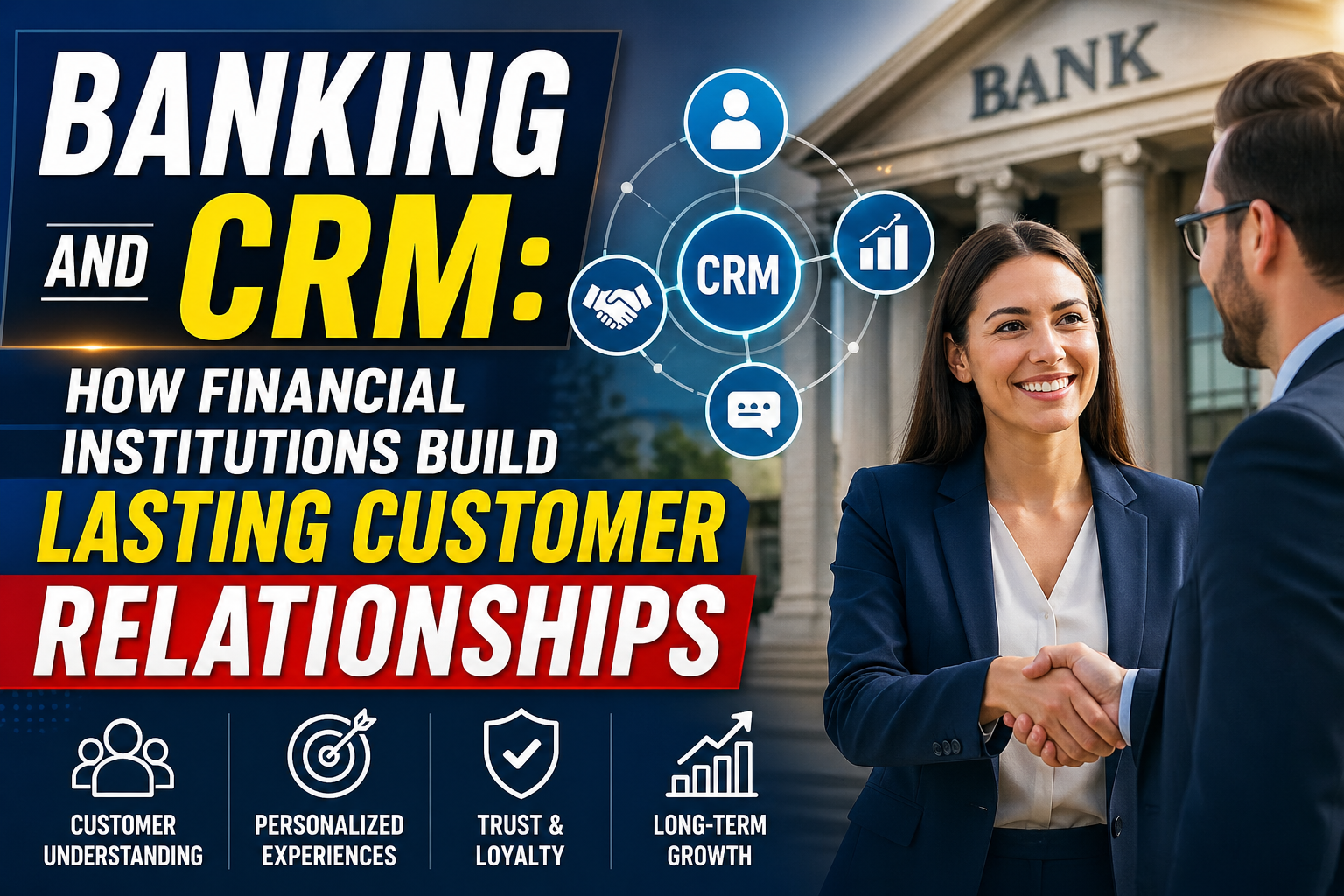
The relationship between banking and CRM is one of the most natural alignments in enterprise technology — banking is fundamentally a relationship business, and CRM is fundamentally a relationship management tool. Yet the full potential of this alignment is realised only when financial institutions move beyond treating CRM as a contact database to using it as the strategic platform that orchestrates every customer interaction, informs every product decision, and enables the genuinely personalised banking experience that builds lifetime customer loyalty.
This guide explores the evolving relationship between banking and CRM — how leading financial institutions are using CRM capabilities to differentiate their customer experience, drive revenue growth,
and build the resilient customer relationships that sustain long-term profitability in an increasingly competitive financial services landscape.
The Evolution of Banking CRM
Banking CRM has evolved through three distinct phases. Phase 1 — Contact management (1990s-2000s): Basic customer databases storing contact information and simple interaction logs. Limited integration with banking systems, primarily used for marketing list management and call centre support. Value was modest: better contact information organisation, but minimal impact on customer experience or relationship depth. Phase 2 — Process management (2000s-2015): CRM as a workflow management tool — structuring sales processes for retail banking, automating complaint management,
and providing relationship managers with activity tracking. Better integration with banking products. Value was significant: more consistent processes,
better management visibility, improved campaign targeting.
Phase 3 — Intelligence and personalisation (2015-present): AI-powered CRM that analyses customer data to generate personalised insights, next-best-action recommendations, and predictive churn scores. Full omnichannel integration bringing digital behaviour, transaction patterns,
and human interaction history into a unified customer intelligence platform. Real-time decisioning that responds to customer behaviour signals instantly. This phase represents a fundamental transformation in what CRM can do for banks — moving from relationship recording to relationship intelligence that actively guides every customer engagement decision.
The Digital Banking Challenge
Digital banking has simultaneously enabled more customer interactions (through mobile apps and internet banking) and reduced the human touchpoints where relationship-building traditionally occurred. Customers who previously visited branches regularly now interact primarily through digital channels — channels that are efficient but relationship-thin. Banking CRM addresses this challenge by connecting digital interaction data with the complete customer relationship record,
enabling human touchpoints (when they do occur) to be deeply informed and personalised, and enabling digital interactions to be personalised based on the full relationship context that the CRM provides.
How Leading Banks Use CRM
Leading retail banks use CRM to power several high-value capabilities. Life event management: Tracking customer life events — marriage, childbirth, first home purchase, business start,
retirement — and triggering relevant, timely product conversations at the moment when customers have the greatest need and highest receptivity. CRM analytics that identify life event signals from transaction patterns (baby-related purchases indicating new parenthood,
large savings accumulation suggesting property purchase preparation) enable proactive engagement before customers go to market. Digital-physical journey orchestration: Connecting a customer’s digital research behaviour with their next branch visit — so the banker who greets them knows which products they researched and can continue the conversation intelligently rather than starting from zero.
Commercial banks use CRM for: business development pipeline management for new relationship acquisition, account planning for existing client relationships,
deal structuring and coordination for complex multi-product client needs, and periodic relationship review scheduling. Private banks use CRM for: comprehensive wealth relationship management covering investment portfolios, estate planning, and philanthropic giving; family relationship mapping for multi-generational wealth relationships; and highly personalised communication management ensuring senior bankers maintain regular,
high-quality contact with their client portfolios.
Banking CRM and Digital Transformation
CRM is a central component of banking digital transformation — the strategic initiative to modernise banking’s technology infrastructure, processes, and customer experience for the digital-first era. In the digital transformation context, CRM serves three roles. First,
as the customer data hub that consolidates customer intelligence from digital and physical channels, creating the unified customer view that enables consistent,
personalised digital experiences. Second,
as the personalisation engine that drives relevant content, offers, and communications across digital banking platforms — connecting the digital banking front-end with the customer intelligence in the CRM to create genuinely personalised digital experiences.
Third, as the operational efficiency enabler that automates relationship management tasks at scale — managing the relationship maintenance activities (periodic reviews, anniversary communications, product maturity alerts) for thousands of customers that would be impossible to execute manually. Banks with mature CRM banking capabilities consistently demonstrate superior digital transformation outcomes — higher digital adoption rates, better digital customer satisfaction scores,
and more successful digital product launches — because they have the customer intelligence foundation that makes digital personalisation credible and effective.
Frequently Asked Questions
Why is CRM important for banks?
CRM is important for banks because it enables personalised, consistent service across all channels,
identifies cross-sell opportunities based on customer intelligence,
supports proactive retention management, ensures regulatory compliance through structured workflows,
and provides management with the visibility to make data-driven decisions about customer strategy. Banks with mature CRM capabilities consistently outperform peers on customer retention, revenue per customer,
and customer satisfaction metrics.
How does CRM help banks with digital transformation?
CRM helps banking digital transformation by consolidating customer data from all digital and physical touchpoints into a unified customer view,
powering personalisation in digital banking channels, automating relationship management tasks at scale, enabling seamless digital-physical channel coordination,
and providing the customer intelligence foundation that makes digital product launches more targeted and effective. CRM is typically one of the foundational platform investments in banking digital transformation programmes.
What is the future of CRM in banking?
The future of CRM in banking is characterised by: greater AI automation of relationship management tasks (AI-generated next-best-action recommendations, automated client communication drafts),
real-time CRM that responds to customer behaviour signals instantly rather than in batch cycles, deeper integration between CRM and digital banking platforms enabling personalised digital experiences,
and open banking data integration that enriches customer profiles with multi-bank financial data (where customer consent permits). These trends will make banking CRM simultaneously more intelligent, more automated, and more impactful.
Can small banks benefit from CRM?
Yes — small banks and credit unions often derive even greater relative benefit from CRM than large institutions, because the relationship-focused community banking model is directly supported by CRM capabilities. Knowing every customer’s complete relationship history, life events,
and product needs enables the personalised service that community banks have traditionally delivered based on banker memory — now extended to all customers regardless of which staff member they interact with. Affordable CRM options (HubSpot, Zoho CRM, Salesforce Starter) make modern CRM accessible to community banks with modest technology budgets.
Conclusion
The relationship between banking and CRM is fundamental — each enables the other to achieve its full potential. CRM provides the customer intelligence foundation that makes banking relationships deeper and more valuable; banking relationships generate the rich customer data that makes CRM more intelligent and impactful. By investing in the right CRM platform,
integrating it comprehensively with banking systems and digital channels, and building a culture of data-driven relationship management,
financial institutions can build the customer loyalty and revenue performance that sustains long-term profitability.
Related Articles
Ready to grow your business with the right technology? Explore VBWebSol’s Custom CRM Software Solutions or contact our expert team for a free consultation. With over 12 years of IT expertise in Ahmedabad,
we help businesses across India and globally implement solutions that deliver real, measurable results.