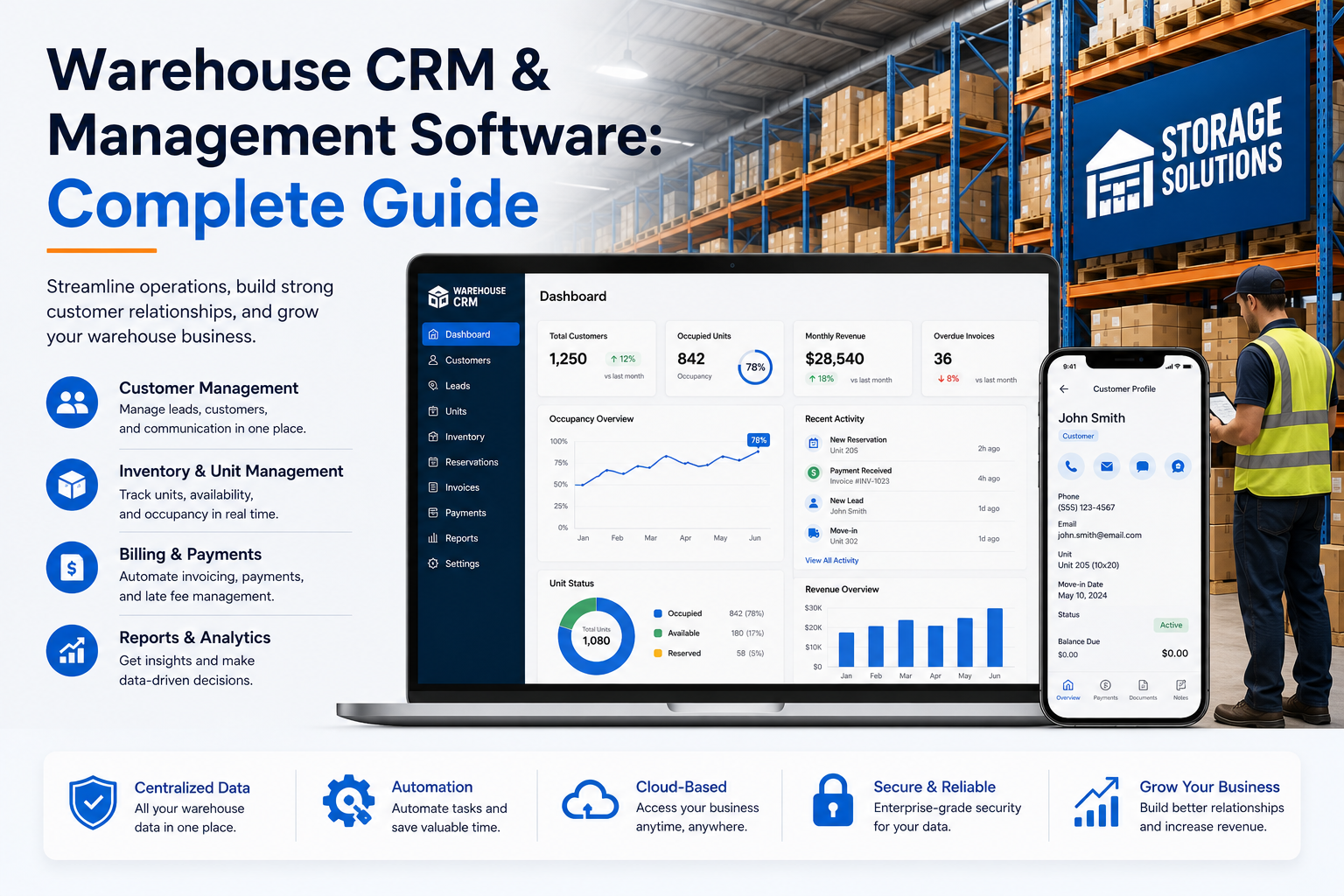
Warehouse CRM and distribution operations sit at an unusual intersection of customer relationship management, inventory control, and logistics coordination — a “warehouse CRM” in practice usually means CRM functionality tightly integrated with (or built into) a warehouse management system (WMS), rather than a standalone customer-relationship tool. This guide covers what warehouse-focused businesses actually need from their CRM and operational software, and how to think about the relationship between CRM and warehouse management systems.
Understanding the Warehouse CRM Category
CRM Needs Specific to Warehouse and Distribution Businesses
Businesses running warehouse and distribution operations — third-party logistics (3PL) providers, wholesale distributors, and fulfillment companies — need customer relationship tools that account for: – Client-specific service level agreements (SLAs) — different clients often have different fulfillment speed, accuracy, and reporting requirements that need to be tracked and monitored – Order and shipment visibility tied to customer accounts — customers (particularly B2B clients of 3PL providers) expect visibility into their inventory levels and shipment status, tightly linked to the underlying warehouse operational data – Billing complexity — warehouse businesses, especially 3PLs, often bill clients based on complex combinations of storage space, pick/pack activity, and shipping volume, requiring CRM/billing integration that goes beyond standard subscription billing models
The Relationship Between CRM and Warehouse Management Systems (WMS)
A Warehouse Management System handles the operational core — inventory tracking, pick/pack/ship workflows, and warehouse floor logistics. A CRM layered on top (or integrated within a combined platform) manages the client relationship side — account management, service level tracking, and client communication. For many warehouse and distribution businesses, especially 3PLs serving multiple clients, tight integration between these two systems is essential, since client-facing relationship management is fundamentally dependent on accurate, real-time operational data.
Key Features for Warehouse-Focused CRM/Management Software

Real-Time Inventory Visibility
Both internal warehouse staff and (for 3PLs) client-facing portals need real-time visibility into inventory levels, locations, and status — inaccurate or delayed inventory data undermines both internal operations and client trust.
Order Management Integration
Seamless flow from order receipt through picking, packing, and shipping, with status updates automatically reflected in whatever customer-facing or account management interface clients and internal sales/account teams use.
Client Portal and Reporting
For 3PL and distribution businesses serving external clients, a dedicated client portal providing self-service visibility into inventory, order status, and performance reporting significantly reduces the manual reporting burden on account management staff while improving client satisfaction.
SLA and Performance Tracking
Automated tracking of key performance metrics against contracted SLAs — order accuracy, fulfillment speed, inventory accuracy — supporting both proactive issue identification and the reporting clients often require as part of their contract terms.
Complex Billing Support
Given the variable, activity-based billing models common in warehouse and 3PL businesses (storage fees, pick/pack fees, shipping markup), billing functionality needs to support this complexity natively rather than forcing workarounds designed for simpler subscription-based billing.
Leading Warehouse Management and CRM-Adjacent Platforms
NetSuite WMS
NetSuite’s warehouse management functionality, integrated with its broader ERP and CRM capability, offers a unified platform for businesses wanting warehouse operations, financial management, and customer relationship data in a single connected system.
Fishbowl
Fishbowl offers inventory and warehouse management with QuickBooks integration, popular among small to mid-sized distribution and warehouse businesses that want strong inventory control without the complexity and cost of a full enterprise ERP/WMS.
3PL Central (Extensiv)
Extensiv (formerly 3PL Central) is purpose-built specifically for third-party logistics providers, combining warehouse management with client-facing billing and reporting capability designed around the specific operational and client relationship needs of the 3PL business model.
Cin7
Cin7 combines inventory management, order management, and warehouse operations with integration to major e-commerce and accounting platforms, appealing to distribution and wholesale businesses managing inventory across multiple sales channels.
SAP Extended Warehouse Management (EWM)
For larger, enterprise-scale warehouse operations, SAP EWM offers deep, highly configurable warehouse management capability integrated within the broader SAP ERP ecosystem, typically chosen by large distribution and manufacturing organizations with complex, high-volume warehouse operations.
CRM Considerations Specific to Distribution and Wholesale Businesses
Beyond pure warehouse operations, wholesale distribution businesses often need CRM capability for: – B2B account management — tracking relationships with retail or business customers, including custom pricing agreements, credit terms, and order history specific to each account – Sales rep territory and account management — for distributors with field sales teams, standard CRM pipeline and territory management functionality remains relevant alongside the warehouse-specific operational integration – Reorder and replenishment automation — CRM/ERP integration that can flag or automate reorder suggestions based on customer purchase patterns and current inventory levels
Choosing Between an Integrated Platform vs. Best-of-Breed Tools
Integrated Platforms (NetSuite, SAP)
Offer unified data across warehouse operations, financials, and customer relationships, reducing integration complexity at the cost of generally higher implementation cost and complexity, typically better suited to larger organizations with the resources for a substantial implementation project.
Best-of-Breed Combination (Dedicated WMS + Separate CRM)
Some businesses choose a dedicated warehouse management system paired with a separate CRM (Salesforce, HubSpot), connected via integration — offering more flexibility to choose the best tool for each specific function, at the cost of ongoing integration maintenance between systems.
Implementation Considerations
Data Migration and Inventory Accuracy
Migrating existing inventory and client account data into a new warehouse management/CRM system requires careful validation — inventory data inaccuracies at go-live can cause significant operational disruption, making a thorough physical inventory count and reconciliation process an important part of implementation planning.
Client Communication During Transition
For 3PL and distribution businesses with active client relationships, proactive communication about system transitions — particularly any temporary changes to client portal access or reporting — helps maintain client trust during the implementation period.
Staff Training on New Workflows
Warehouse floor staff, account management teams, and billing staff often need role-specific training on new system workflows, since warehouse management system implementations frequently change established operational processes significantly.
Frequently Asked Questions
What is a warehouse CRM, exactly? “Warehouse CRM” typically refers to customer/client relationship management functionality tightly integrated with warehouse operational software (a WMS), particularly important for 3PL and distribution businesses that need client-facing visibility into warehouse operations, rather than a standalone traditional sales CRM.
Do I need a separate CRM and warehouse management system, or an integrated platform? It depends on your business complexity and resources — integrated platforms like NetSuite reduce integration overhead but come with higher implementation cost and complexity, while a best-of-breed combination of a dedicated WMS and separate CRM offers more flexibility at the cost of ongoing integration maintenance.
What software do most 3PL companies use? Extensiv (formerly 3PL Central) is specifically purpose-built for third-party logistics providers and widely used in that industry, given its client-facing billing and reporting capability designed around 3PL-specific operational and relationship needs.
Can Fishbowl or Cin7 handle CRM functionality, or just inventory? Both platforms primarily focus on inventory and warehouse/order management, with some customer account and order history tracking, but they generally aren’t full-featured sales CRMs — businesses needing robust sales pipeline management alongside inventory control often integrate these tools with a dedicated CRM like Salesforce or HubSpot.
How does billing work for 3PL and warehouse businesses in these platforms? Purpose-built 3PL platforms like Extensiv support complex, activity-based billing models (storage fees, pick/pack fees, shipping markup) natively, which is an important differentiator from general CRM or accounting software not designed around these specific warehouse-industry billing structures.
What’s the biggest implementation risk for warehouse management software? Inventory data accuracy at go-live is one of the most significant risks — inaccurate migrated inventory data can cause substantial operational disruption, making a thorough physical inventory reconciliation process before cutover an important part of implementation planning.