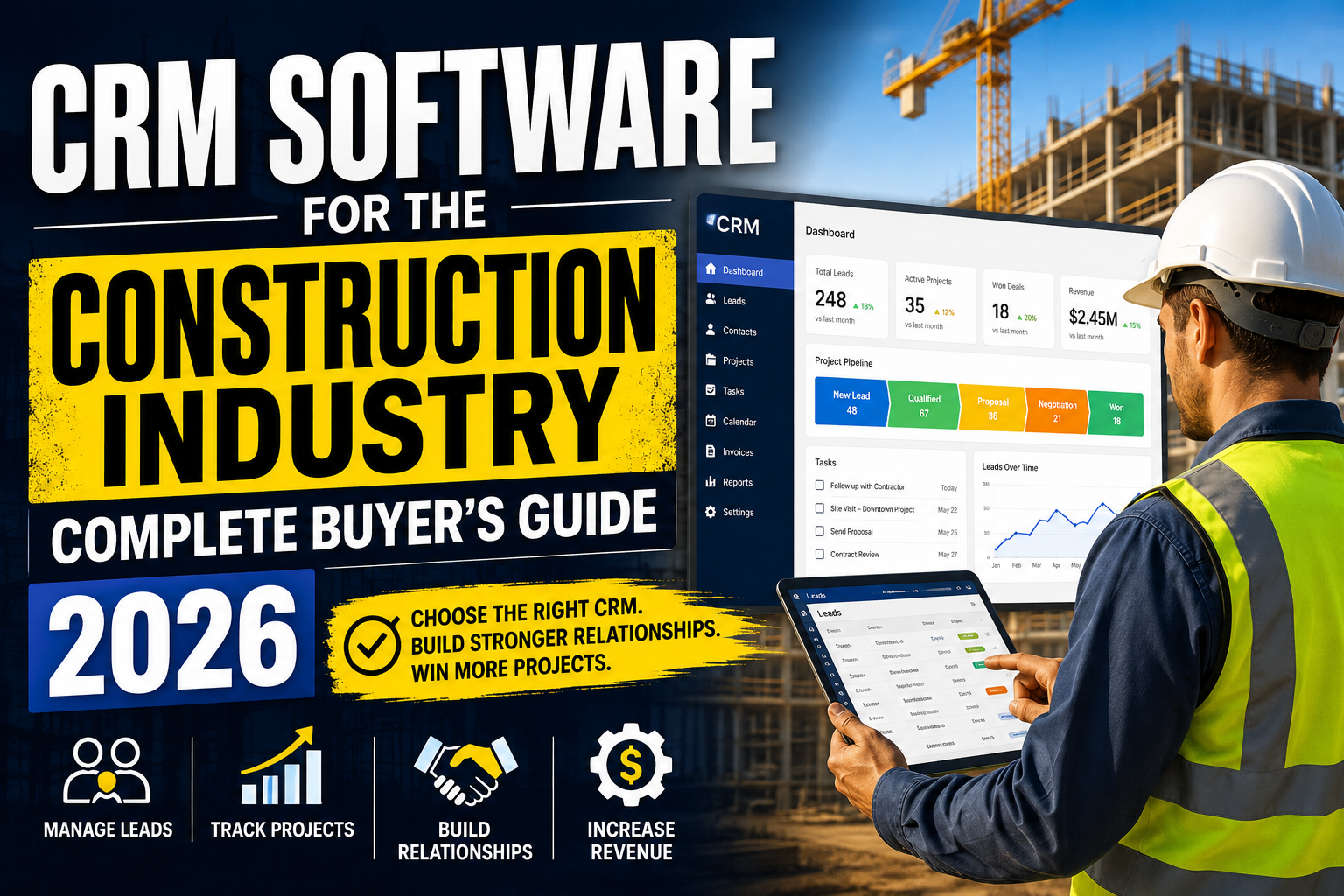
Choosing CRM software for the construction industry is a significant decision that affects how your business wins projects, manages client relationships, and grows revenue. Unlike generic CRM platforms, construction-focused systems must accommodate the industry’s unique dynamics: long bid cycles, multi-stakeholder projects, subcontractor networks, and compliance requirements.
This buyer’s guide helps construction industry professionals—from general contractors and specialty subcontractors to home builders and civil engineering firms—make an informed CRM selection decision.
What Makes Construction Industry CRM Different?
Standard business CRM platforms are built around typical B2B sales cycles. Construction is fundamentally different:
- Multi-year relationships: A client relationship may span decades with projects awarded years apart.
- Bid-based revenue: Construction revenue flows through competitive bidding, not traditional sales funnels.
- Project-centric data: Each project involves dozens of stakeholders, documents, and milestones.
- Subcontractor ecosystem: Managing relationships with subs is as important as managing client relationships.
- Geographic complexity: Multi-region or international contractors need region-based data segmentation.
- Compliance requirements: Certifications, bonding, insurance, and licensing data must be tracked for subs and clients.
The best CRM software for the construction industry addresses these requirements rather than forcing construction workflows into a generic sales template.
Essential Features in Construction Industry CRM Software
Bid Management Module
Track every bid from initial RFQ receipt through proposal submission, clarification period, and award decision. The bid module should capture bid amount, estimated margin, scope summary, competition, and decision timeline—providing a complete bid history for every client and project type.
Win/Loss Analysis
Understanding why you win and lose bids is critical for improving close rates. Your CRM should capture loss reasons, competitor names, and client feedback to inform bidding strategy going forward.
Client Relationship Hierarchy
Construction involves complex stakeholder networks. Your CRM needs to represent relationships between owners, developers, architects, general contractors, and subcontractors—not just simple contact-to-company links.
Project History and Revenue Tracking
See every project delivered for each client, with contract values, delivery dates, and satisfaction notes. This history is invaluable for relationship-based selling and reference conversations.
Subcontractor Database
Maintain a searchable database of subcontractors categorized by trade, geography, certification, and performance history. When assembling bid teams, quickly identify and contact the right subs.
Integration with Estimating Software
Leading construction estimating tools (Bluebeam, PlanSwift, Sage Estimating, ProEst) should integrate with your CRM so bid data flows automatically between estimating and client management.
Compliance Tracking
Track insurance certificates, bonding limits, safety records, and licenses for both clients and subcontractors with automatic alerts when certifications approach expiration.
CRM Software Options for the Construction Industry
Purpose-Built Construction CRM Platforms
Buildertrend: Best for residential home builders and remodelers. Combines CRM with project management, client portal, scheduling, and financial tracking in one platform. Strong mobile app for field teams.
CoConstruct: Focused on custom home builders and remodelers. Exceptional client communication tools, selection management, and budget tracking alongside CRM functionality.
eSUB: Designed for specialty subcontractors, with project management, labor tracking, and client management tailored to the sub’s perspective.
General CRM Platforms Adapted for Construction
Salesforce Construction Cloud: Enterprise-grade for large GCs. Requires significant configuration but delivers unmatched power and integration flexibility.
HubSpot CRM: Strong choice for mid-size contractors. Excellent marketing automation for nurturing long-term relationships between projects. Free tier with powerful upgrade options.
Microsoft Dynamics 365: Appealing for construction firms in the Microsoft ecosystem with Project Operations integration for end-to-end project lifecycle management.
Custom Construction CRM
For firms with proprietary estimating methodologies, specialized subcontractor management workflows, or specific ERP integration needs, custom CRM software for the construction industry delivers the best fit. Custom systems can incorporate construction-specific data models, workflow automation tailored to your bid process, and seamless integration with your existing software stack.
CRM Cost Considerations for Construction Companies
| Option | Cost Range | Best For |
|---|---|---|
| Buildertrend | From $199/month | Residential builders |
| HubSpot CRM | Free – $800+/month | Mid-size contractors |
| Salesforce | $75–$300+/user/month | Enterprise GCs |
| Custom CRM | $30,000–$200,000 (one-time) | Complex/unique workflows |
Related Resources
Frequently Asked Questions
What CRM software is best for the construction industry?
The best CRM for the construction industry depends on your segment. Buildertrend and CoConstruct lead for residential builders. Procore and Salesforce Construction Cloud suit large general contractors. HubSpot CRM offers excellent flexibility for mid-size firms. Custom CRM development is the best option for businesses with unique workflows or integration requirements.
Does construction industry CRM software manage subcontractors?
The best construction CRM platforms include subcontractor management features such as categorized sub databases, insurance certificate tracking, performance history, and contact management. Purpose-built platforms like eSUB and custom CRM solutions offer the most comprehensive subcontractor management capabilities.
How does CRM software improve bid win rates in construction?
Construction CRM improves bid win rates by ensuring systematic follow-up at every decision point, providing relationship history that enables personalized proposals, tracking win/loss data to identify patterns, and alerting teams when key decision dates approach. Companies using CRM typically see 15–30% improvement in bid win rates within the first year.
Can construction CRM integrate with accounting software?
Yes—most construction CRM platforms integrate with popular accounting tools including QuickBooks, Sage, and Xero. These integrations sync project revenue data, client billing status, and financial performance metrics between the CRM and accounting system, eliminating double data entry.
Conclusion
The right CRM software for the construction industry transforms your business development operation from reactive to systematic. By tracking every bid, logging every client interaction, and providing the data to make smarter decisions, construction CRM is the competitive differentiator that separates growing firms from stagnating ones.
Looking for a CRM built specifically for your construction business? Explore VBWebSol’s custom CRM development or contact us for a free consultation.