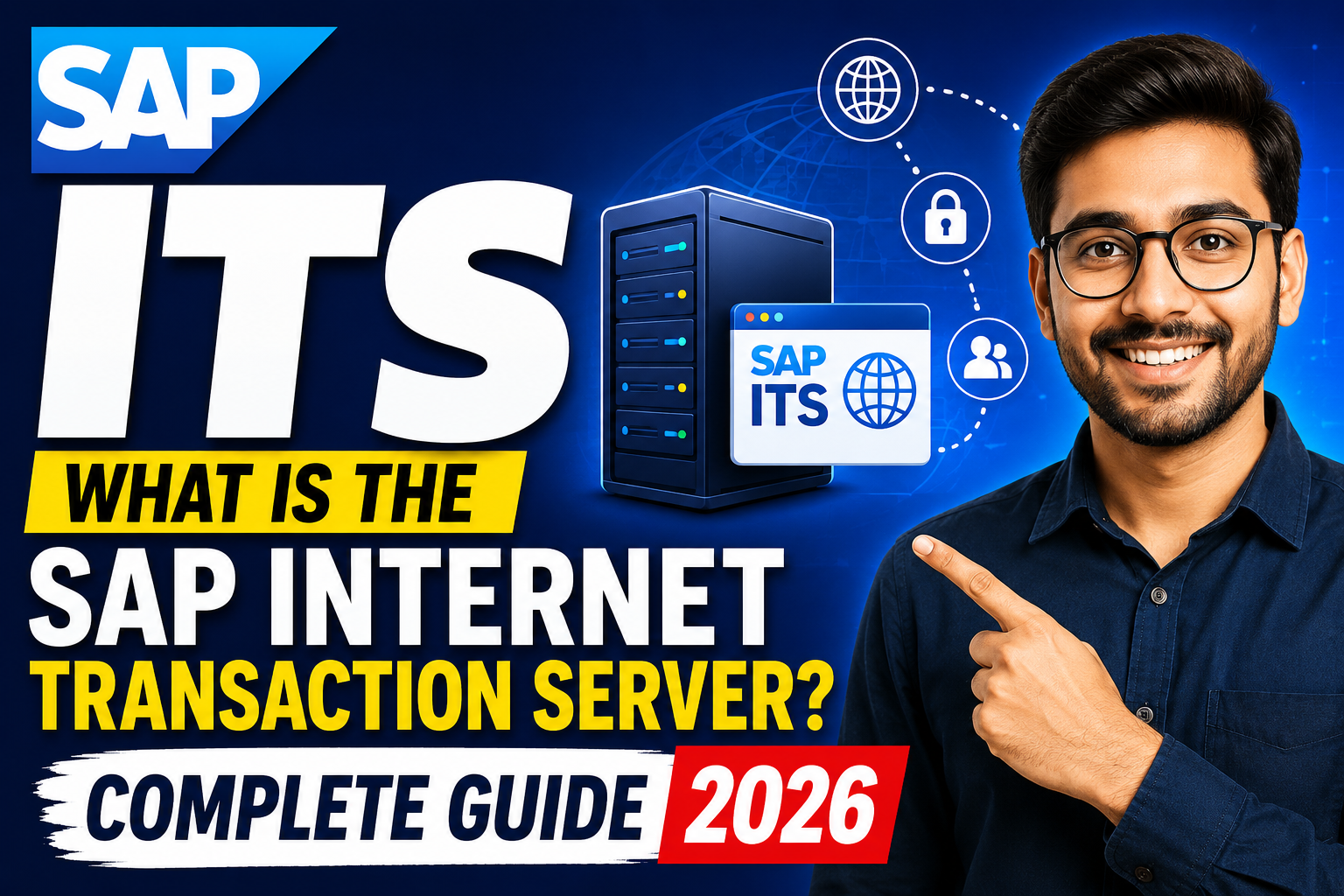
The SAP ITS (Internet Transaction Server) is a component of the SAP technical landscape that enables SAP applications to be accessed via a web browser. Understanding SAP ITS is essential for SAP administrators, developers, and architects working with SAP R/3, ECC, or organizations planning S/4HANA migrations.
What Is SAP ITS?
SAP ITS stands for Internet Transaction Server. It is a SAP middleware component that acts as a bridge between SAP’s ABAP application server and web browsers, enabling users to access SAP transactions through standard HTTP/HTTPS without installing the SAP GUI desktop client.
SAP ITS was introduced in the late 1990s and has undergone significant evolution. The most widely used version is the “Integrated ITS” (introduced in SAP Web AS 6.40), which is embedded directly within the SAP NetWeaver Application Server ABAP—eliminating the need for a separate standalone ITS installation.
SAP ITS Architecture
Standalone ITS (Legacy)
The original SAP ITS consisted of two servers: the AGate (Application Gate) and the WGate (Web Gate). The WGate resided in the DMZ as an HTTP server, while the AGate communicated with the SAP backend via RFC connections. This two-tier architecture is now largely deprecated.
Integrated ITS (Current)
The Integrated ITS is embedded within the SAP NetWeaver AS ABAP kernel, eliminating the separate AGate/WGate architecture. It processes HTTP/HTTPS requests directly within the application server, simplifying the technical landscape and improving performance.
How SAP ITS Works
When a user accesses an SAP application via a web browser:
- The browser sends an HTTP request to the SAP server
- The ITS receives the request and identifies the target SAP transaction or service
- The ITS invokes the ABAP transaction or BSP (Business Server Page) application
- ABAP generates the response, which ITS converts to HTML using web templates
- The formatted HTML page is return to the user’s browser
This process happens transparently, allowing standard SAP transactions (running in ABAP) to access in a web browser without modification—a powerful capability call “web-enabling” legacy SAP transactions.
SAP ITS Services
SAP ITS enables various web-accessible services:
IACs (Internet Application Components)
IACs are SAP-delivered web applications built on top of standard SAP transactions using ITS technology. Examples include Employee Self-Service (ESS) and Manager Self-Service (MSS) in older SAP HR landscapes.
WebGUI
The SAP WebGUI allows users to run standard SAP GUI transactions in a web browser using ITS. It renders the SAP Dynpro interface in HTML, providing browser-based access to any SAP transaction without the desktop SAP GUI client.
BSP (Business Server Pages)
BSP is a SAP-proprietary web development framework use alongside ITS to build custom web applications within the SAP ecosystem.
SAP ITS in Modern SAP Landscapes
S/4HANA and SAP Fiori
In modern S/4HANA environments, SAP ITS and WebGUI are gradually being replace SAP Fiori—a modern UX framework built on HTML5, OData, and SAPUI5. SAP Fiori provides a responsive, intuitive interface for SAP transactions on desktop, tablet, and mobile devices.
However, SAP ITS and WebGUI remain relevant for organizations running SAP ECC (ERP Central Component) or for transitioning to S/4HANA where specific transactions haven’t yet been Fiori-enable.
SAP NetWeaver Integration
ITS remains an integral component of SAP NetWeaver AS ABAP, used in Web Dynpro ABAP applications, portal iViews, and various SAP service delivery mechanisms.
Configuring and Administering SAP ITS
Transaction SICF
Transaction SICF (HTTP Service Hierarchy) is the primary tool for administering ITS services in the SAP system. It displays all active and inactive HTTP services and allows administrators to activate, deactivate, and configure web services.
Transaction SMICM
Transaction SMICM (Internet Communication Manager Monitor) monitors the ICM—the component that handles HTTP/HTTPS connections for the Integrated ITS. It displays connection status, request logs, and performance metrics.
Profile Parameters
ITS behavior is control through SAP profile parameters including icm/host_name_full, icm/server_port, and various ms/server_port settings that control port assignments and connection handling.
Common SAP ITS Use Cases
- Employee Self-Service portals for HR transactions
- Supplier portals for vendor collaboration
- Customer-facing web applications built on SAP data
- Mobile access to SAP transactions without GUI clients
- WebGUI access for remote workers without VPN-dependent SAP GUI
- Integration testing of ABAP web services and BSP applications
SAP ITS and ERP Development
For organizations building or extending SAP-connected applications, understanding ITS and the SAP web service layer is essential. Custom ERP and CRM integrations with SAP often rely on ITS-exposed services or OData APIs for data exchange.
Related Resources
Frequently Asked Questions
What is SAP ITS?
SAP ITS (Internet Transaction Server) is a middleware component that enables SAP ABAP applications to access via web browsers. The Integrated ITS, embedded in SAP NetWeaver AS ABAP, processes HTTP/HTTPS requests and renders SAP transactions as HTML pages—enabling browser-based SAP access without the SAP GUI desktop client.
Is SAP ITS still use in 2026?
SAP ITS and WebGUI are still use in organizations running SAP ECC and in S/4HANA environments where Fiori hasn’t fully replace legacy transaction access. While SAP Fiori is the strategic UX direction for S/4HANA, ITS remains relevant for WebGUI access, portal integration, and legacy IAC applications.
What is the difference between SAP ITS and SAP Fiori?
SAP ITS is older middleware that web-enables traditional ABAP Dynpro transactions by converting them to HTML. SAP Fiori is a modern UX framework built on HTML5, SAPUI5, and OData that provides purpose-design, responsive apps for specific business processes. Fiori is the strategic replacement for ITS-base access in S/4HANA.
What is WebGUI in SAP?
SAP WebGUI is an ITS-based capability that renders standard SAP GUI (Dynpro) screens in a web browser. It allows users to run any SAP transaction without installing the SAP GUI client by accessing the system via HTTPS. WebGUI is commonly use for remote access and thin-client environments.
Conclusion
SAP ITS has been a foundational technology for web-enabling SAP applications for over two decades. While SAP Fiori represents the future of SAP user experience, ITS and WebGUI remain relevant for ECC environments and transitional S/4HANA landscapes where complete Fiori adoption is still in progress.
Planning an SAP integration or custom ERP development project? Explore VBWebSol’s ERP services or contact our team for expert guidance.