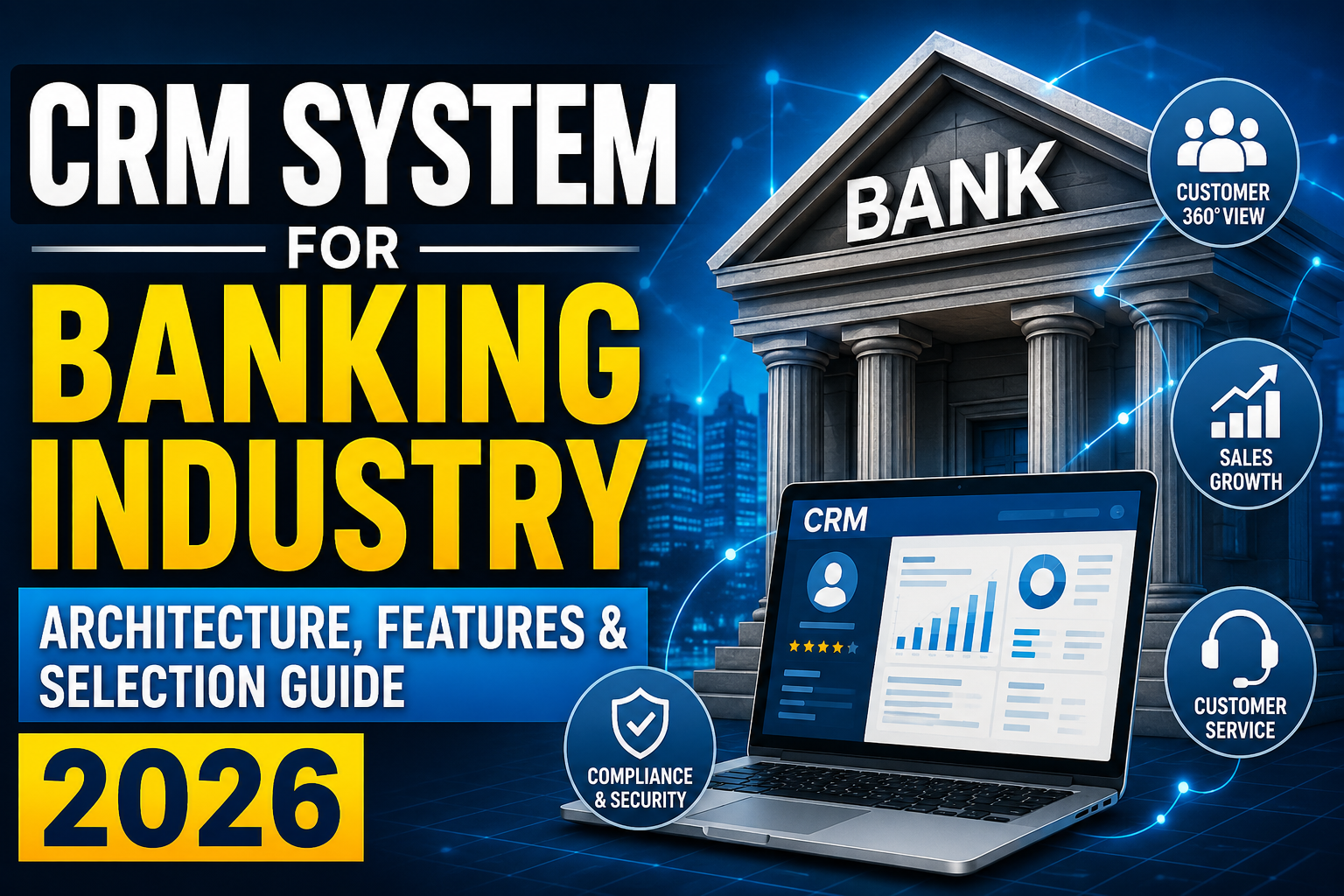
Selecting the right CRM system for the banking industry requires navigating requirements that are simultaneously more complex and more consequential than in most other sectors. The regulatory environment — spanning GDPR, AML/KYC, MiFID II, and local banking legislation — imposes strict data management, compliance workflow, and audit trail requirements. The customer data complexity — multi-product relationships across households, businesses, and complex ownership structures — demands a data model purpose-built for financial services. And the integration requirements — connecting CRM with core banking systems, digital banking platforms, and compliance tools — demand a robust, secure integration architecture.
This guide provides a technical and functional framework for selecting and implementing a CRM system for banking — covering the architecture principles, m
ust-have features, compliance requirements, integration considerations,
and platform recommendations that inform a sound banking CRM investment decision.
Banking CRM Architecture Principles
A banking CRM architecture must satisfy three foundational requirements simultaneously. Data consolidation: The CRM must serve as the true system of record for customer relationship data — consolidating profile information, product holdings, interaction history,
and relationship intelligence from all channels and systems into a single, authoritative customer view. Achieving this requires bidirectional integration with core banking systems (for product and transaction data), digital banking platforms (for self-service interaction data),
and communication systems (for email, chat, and call interaction data).
Regulatory compliance by design: Banking CRM must embed compliance workflows into the core system architecture rather than treating them as add-ons. AML risk assessment, KYC periodic review scheduling,
GDPR consent tracking, and MiFID II suitability documentation should be native system features with mandatory workflow enforcement — not optional modules that can be bypassed. Security architecture: Banking CRM handles some of the most sensitive personal and financial data in existence. The security architecture must include: encryption at rest and in transit, role-based access controls, comprehensive audit logging,
network segmentation, and regular penetration testing — all meeting banking regulatory standards.
Core Banking System Integration
The most critical technical integration for banking CRM is the connection to the core banking system (CBS). The CBS holds the authoritative record of customer product holdings, balances,
and transaction history — data that is essential for a meaningful CRM customer view but typically accessible only through the CBS’s integration layer. Banking CRM implementations must establish reliable,
real-time or near-real-time data synchronisation from the CBS, handling the technical complexity of legacy CBS architectures that were designed decades before modern APIs were common.
Must-Have Features for Banking CRM
Banking CRM requirements go beyond standard CRM capabilities in several important areas. 360-degree customer view: A unified customer profile showing all products, balances, transactions, interactions,
and relationship metrics in a single interface. The quality and completeness of this view — how many data sources are integrated,
how current the data is, and how intuitively it is presented — is the primary measure of a banking CRM system’s value to frontline staff. Household and relationship management: Financial services CRM must model the relationships between individual customers — spouses, family members, business partners — and their shared financial relationships. Salesforce Financial Services Cloud’s Household model is the best-in-class implementation of this requirement.
Product and account management: CRM visibility into all accounts and products held by a customer, with balance, status, maturity date, and next review date for each. This product coverage view is essential for identifying cross-sell opportunities and for understanding the complete customer relationship for service enquiries. Compliance workflow automation: Built-in workflows for KYC periodic review, AML risk assessment, complaints handling with regulatory reporting,
GDPR consent management, and MiFID II suitability assessment. These workflows must be enforceable — with system controls preventing staff from bypassing required compliance steps.
Selection Criteria for Banking CRM
Banking CRM platform selection should evaluate eight criteria. Financial services data model: Does the platform have a native data model for financial services entities (households, financial accounts, financial goals, KYC records)? Compliance workflow depth: Does it provide native,
enforceable compliance workflows for your regulatory requirements? Core banking integration: What integration capabilities exist for connecting with your specific core banking system? Security certifications: Does it hold the security certifications required by your regulators and risk management framework?
Deployment options: Can it be deployed in compliance with your data residency requirements (on-premises, private cloud, or specific geographic cloud regions)? Scalability: Can it handle your customer volume and interaction frequency without performance degradation? Total cost of ownership: Including licensing, implementation, integration development,
and ongoing administration. Vendor banking expertise: Does the vendor have deep banking industry experience, a strong banking customer reference base, and an active product roadmap addressing banking-specific requirements? Weight these criteria based on your institution’s specific risk profile,
regulatory environment, and technical infrastructure.
Frequently Asked Questions
What CRM systems do banks use?
Large commercial and investment banks predominantly use Salesforce Financial Services Cloud or Microsoft Dynamics 365 for Financial Services. Community banks and credit unions often use purpose-built banking CRM platforms like Salesforce with financial services configuration, Bankpoint, or nCino. Regional banks may use customised versions of standard CRM platforms or purpose-built banking software. The right choice depends on bank size, complexity,
existing technology infrastructure, and regulatory environment.
How does CRM integrate with core banking systems?
CRM integration with core banking systems typically uses one of three approaches: direct API integration (calling CBS APIs to retrieve customer and product data in real time), middleware/ESB integration (routing data through an enterprise service bus or integration platform like MuleSoft),
or batch synchronisation (nightly extraction of customer and product data from CBS to populate CRM). Direct API integration provides the most current data; batch synchronisation is more common with legacy CBS systems that lack modern APIs. Banking CRM implementations routinely involve significant integration engineering effort.
What is the difference between banking CRM and standard CRM?
Banking CRM differs from standard CRM in: data model (financial services-specific entities like households, financial accounts, and regulatory profiles),
compliance features (built-in AML/KYC workflows,
GDPR consent management, MiFID II documentation), security architecture (banking-grade security certifications and deployment options), integration requirements (core banking system, financial product systems, digital banking platforms),
and regulatory reporting capabilities. Standard CRM platforms can be configured for banking
use cases but require significant customisation to meet these requirements.
How much does a banking CRM system cost?
Banking CRM systems range significantly in cost. Salesforce Financial Services Cloud: custom enterprise pricing, typically $150-300/user/month for mid-market banks. Microsoft Dynamics 365 for Financial Services: $65-210/user/month depending on modules. nCino: custom enterprise pricing typically in the range of $200-500/user/month for the full commercial banking platform. Implementation costs typically equal 2-5x the first-year licensing cost for complex banking deployments with
core banking integration and compliance workflow configuration.
Conclusion
Selecting and implementing the right CRM system for the banking industry is a foundational technology decision with direct implications for customer experience quality, compliance risk, and operational efficiency. By evaluating platforms against the banking-specific requirements outlined in this guide — financial services data model, compliance workflow depth, security architecture,
and integration capability — and investing appropriately in implementation and adoption,
banks can build the relationship management infrastructure that drives customer loyalty and sustainable profitability.
Related Articles
Ready to grow your business with the right technology? Explore VBWebSol’s Custom CRM Software Solutions or contact our expert team for a free consultation. With over 12 years of IT expertise in Ahmedabad,
we help businesses across India and globally implement solutions that deliver real, measurable results.