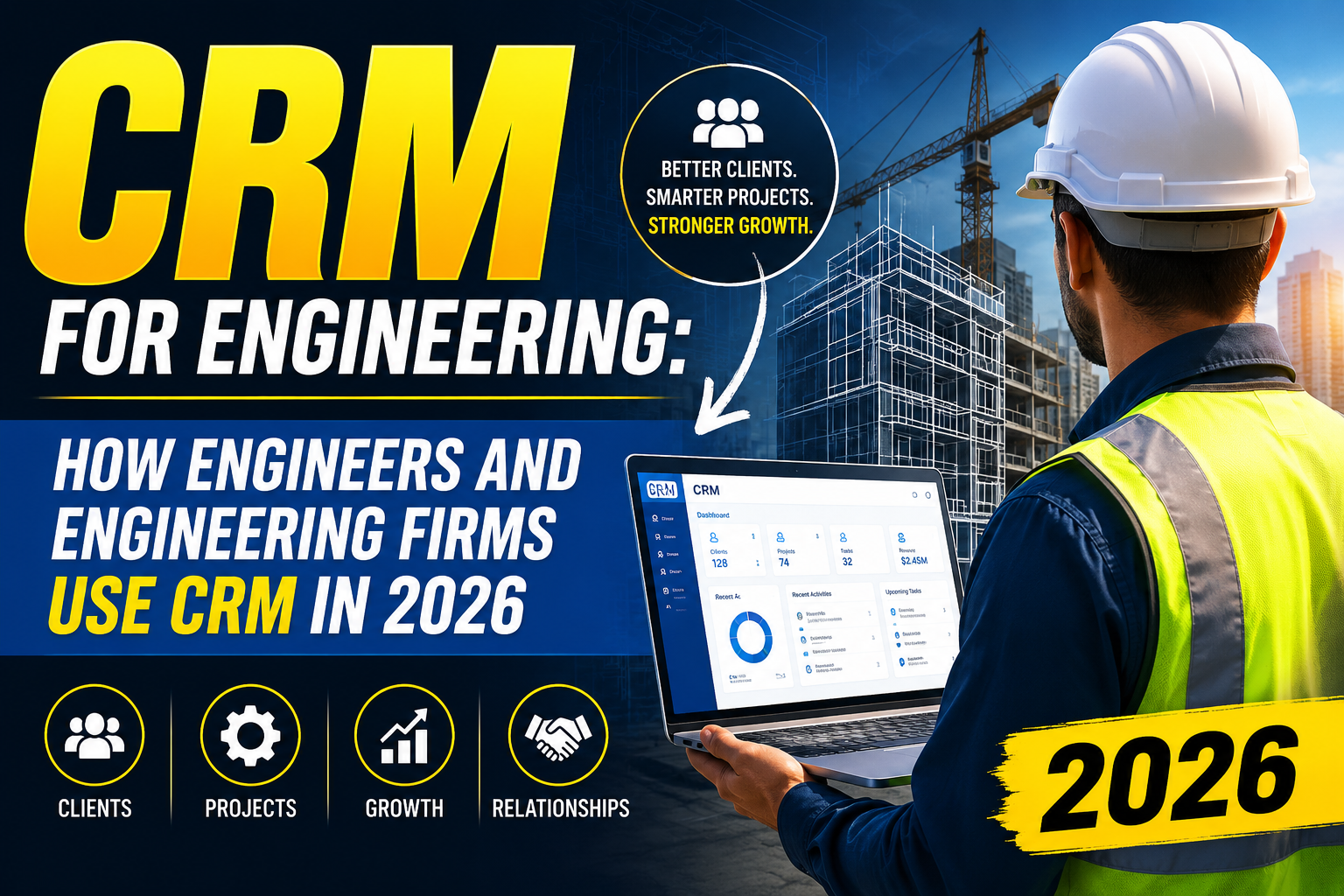
CRM in engineering spans two distinct but related contexts: the use of CRM by engineering consulting and design firms to manage client relationships and business development, and the use of CRM in technical sales and engineering-led companies where engineers play a direct role in the customer relationship. Both contexts have unique requirements that distinguish engineering CRM from generic sales CRM — longer business development cycles, technical complexity in client conversations, project-centric relationship structures, and the need to track technical qualifications, certifications, and project experience alongside relationship history.
This guide covers both dimensions of CRM in engineering — how engineering firms use CRM for business development and how technical companies use CRM to support engineering-involved sales and customer management — with platform recommendations and implementation advice for each context.
CRM for Engineering Consulting Firms
Engineering consulting firms — civil, structural, mechanical, electrical, environmental, and multi-discipline practices — manage long-cycle, relationship-driven business development processes that span months to years before a project opportunity matures. CRM for these firms must support: opportunity pipeline management with long-horizon tracking (prospects in early relationship-building can be tracked for 1-3 years before a specific project arises), proposal management (including the firm’s portfolio of project experience, staff credentials, and awards that form the basis of competitive proposals), client account management (tracking all relationships across a client organisation, from senior executives to project-level contacts), and subcontractor/consultant partner management.
The most impactful CRM capability for engineering consulting firms is proposal efficiency — the ability to quickly assemble compelling proposals and SOQs (Statements of Qualifications) from a well-maintained database of project experience and staff credentials. Firms that invest in maintaining a CRM-based project experience library and staff credential database consistently produce better proposals faster than those assembling project experience from scattered documents. This proposal quality and speed advantage directly improves bid success rates in competitive tender processes.
Project Experience Management
Engineering firms’ most valuable marketing asset is their portfolio of relevant project experience. A CRM system that maintains a searchable database of completed and current projects — categorised by sector, location, project type, contract value, technical challenges, and client — enables marketing teams to identify and retrieve relevant experience in minutes rather than hours. Staff biography management that allows each professional to maintain their own updated profile, integrated with the project experience database, creates a dynamic credentials library that is always current and complete.
CRM for Technical Sales and Engineering Companies
For companies selling technical products or solutions — industrial equipment, software platforms, engineering services, or complex B2B technology — engineers often play a critical role in the sales process. Pre-sales engineers, solutions architects, and technical account managers engage directly with customer technical teams during the evaluation and implementation phases. CRM systems for these contexts must support: technical qualification tracking (logging technical discussions, requirements gathered, and evaluation criteria), engineering resource allocation to sales opportunities, and handoff management between sales and engineering delivery teams.
CRM integration with engineering and project management tools — connecting sales opportunity data with capacity planning, resource allocation, and project delivery systems — is particularly valuable for engineering companies. When an opportunity advances to contract, the CRM should automatically trigger resource planning workflows that allocate engineering capacity to the project, create project delivery records, and initiate the customer onboarding process. This CRM-to-delivery integration eliminates the manual coordination that creates delays and errors in the critical transition from sales to delivery.
Top CRM Platforms for Engineering Contexts
Unanet CRM for AEC: The leading dedicated CRM for architecture, engineering, and construction firms. AEC-specific data model including project experience management, SOQ generation, staff profile management, and business intelligence optimised for engineering firm business development. Strong integration with Deltek and other engineering project management platforms. Deltek Vantagepoint: Comprehensive ERP and CRM for project-based firms — combines client relationship management with project management, resource planning, and financial management in a single platform. Most widely deployed among established engineering firms.
Salesforce Sales Cloud with AEC customisation: Preferred by larger engineering firms seeking enterprise-grade CRM with maximum customisation capability. Requires AEC-specific configuration work but provides the most sophisticated platform for complex, multi-entity engineering firm management. HubSpot CRM: Popular with smaller engineering firms and technical sales companies for its ease of use, free starting tier, and strong email marketing tools. Requires customisation for AEC-specific workflows. Microsoft Dynamics 365: Strong for engineering companies already invested in Microsoft 365, with project operations modules that bridge sales and delivery workflows. Custom CRM for engineering: Firms with highly unique BD processes or specific integration requirements with engineering software often achieve the best results from purpose-built CRM development.
Frequently Asked Questions
What CRM do engineering firms use?
Unanet CRM for AEC (formerly Cosential) and Deltek Vision/Vantagepoint are the most widely used CRM platforms among architecture and engineering firms. Salesforce with AEC customisation is preferred by larger firms. HubSpot is popular among smaller engineering practices and technical sales companies. Microsoft Dynamics 365 is used by engineering companies heavily invested in the Microsoft ecosystem.
How does CRM help engineers win more project work?
CRM helps engineers win more project work by enabling systematic relationship development with key clients and prospects (ensuring regular, value-adding contact even when no active projects are in pursuit), providing pipeline visibility that supports better go/no-go decisions, and streamlining proposal production through maintained project experience and staff credential databases. Firms with systematic CRM-supported BD processes consistently achieve 15-25% higher proposal win rates.
Can CRM integrate with engineering project management software?
Yes — leading CRM platforms integrate with engineering project management tools including Deltek Vision, Primavera P6, Microsoft Project, and Procore. These integrations connect sales opportunity data with project planning systems, enabling resource allocation when opportunities are won and providing project status visibility within the CRM for account management purposes. Custom integration development is available for firms using proprietary or less common project management systems.
What is the ROI of CRM for an engineering firm?
CRM ROI for engineering firms comes from: improved proposal win rates (15-25% improvement from better relationship intelligence and faster proposal production), reduced proposal preparation time (30-50% reduction from maintained content libraries), improved client retention from systematic relationship management, and better resource utilisation from pipeline visibility enabling proactive capacity planning. Most engineerings firms see positive CRM ROI within 12-18 months of full adoption.
Conclusion
CRMs in engineering — whether for business development in consulting practices or technical sales in engineering product companies — delivers measurable competitive advantages when implemented with the right platform and genuine adoption commitment. By choosing a CRMs that understands engineering workflows, maintaining the data quality that makes relationship intelligence actionable, and driving adoption through demonstrated personal value to engineers and BD professionals, you build a business development capability that wins more work and retains more clients.
Related Articles
Ready to grow your business with the right technology? Explore VBWebSol’s Custom CRM Software Solutions or contact our expert team for a free consultation. With over 12 years of IT expertise in Ahmedabad, we help businesses across India and globally implement solutions that deliver real, measurable results.