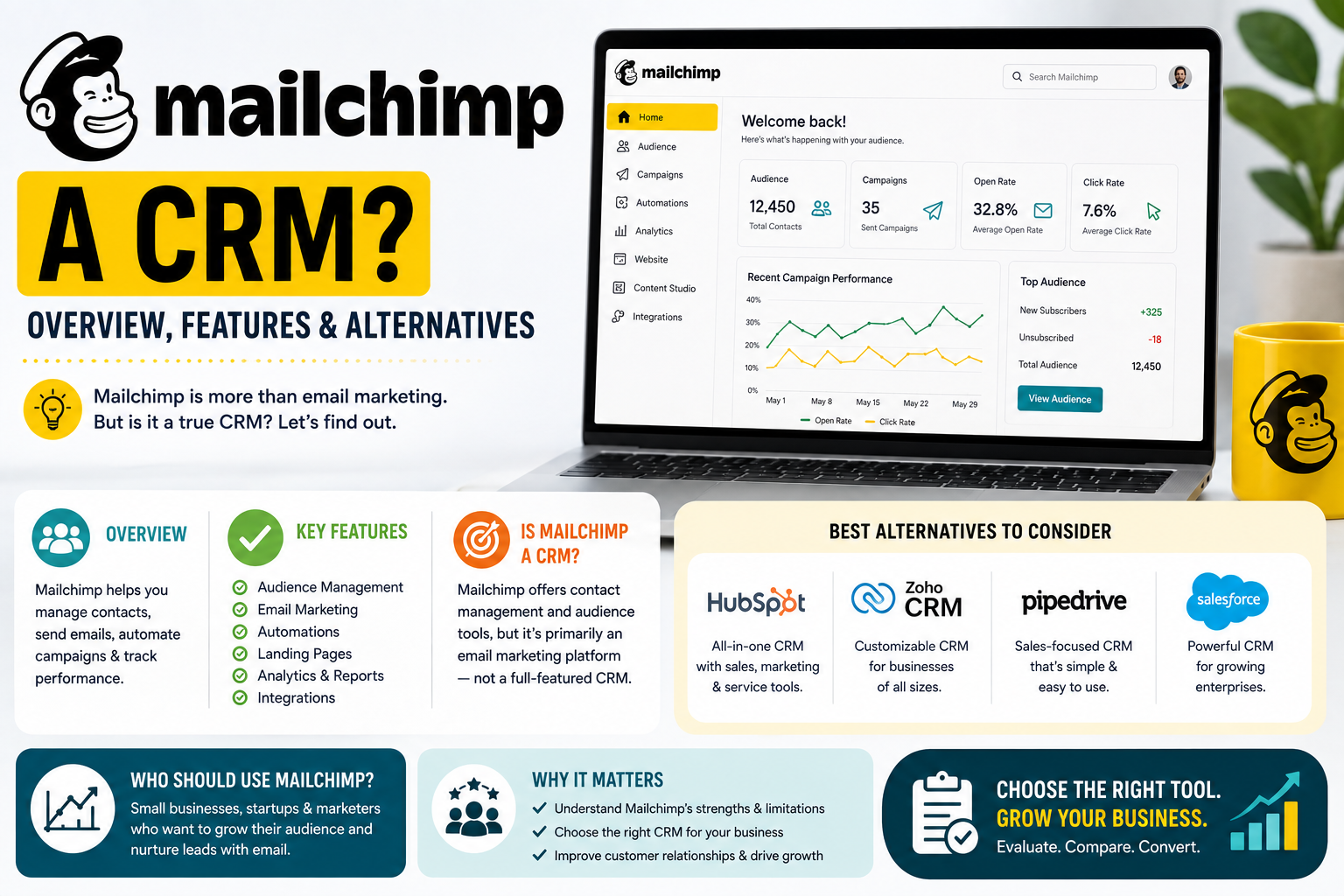
Is Mailchimp a CRM? Overview, Features & Alternatives
Mailchimp started in 2001 as a straightforward email marketing tool and has since expanded into audience management, automation, and light CRM-adjacent functionality. This has left a common question unanswered for many small business owners: is Mailchimp actually a CRM, or just an email tool with contact management bolted on? This guide breaks down what Mailchimp actually does, where it fits (and doesn’t) as a CRM replacement, and when you need something more purpose-built.
What Mailchimp Actually Is
At its core, Mailchimp remains primarily an email marketing and marketing automation platform. It has expanded over the years to include: – Audience/contact management — storing subscriber data, tags, and basic custom fields – Customer journey automation — behavior-triggered email sequences based on signup, purchase, or engagement activity – Basic CRM-style features — contact activity timelines, simple deal/pipeline tracking in its more advanced tiers, and integration with e-commerce platforms for purchase history – Landing pages and forms — built-in tools for lead capture that feed directly into audience segments
Is Mailchimp a CRM? The Short Answer
Mailchimp offers CRM-adjacent functionality — contact history, basic pipeline tracking in higher tiers, and audience segmentation — but it isn’t a full CRM in the way Salesforce, HubSpot, or Pipedrive are. Its core architecture and strength remain firmly rooted in email marketing and automation, not deal management, sales pipeline reporting, or the depth of customization a dedicated CRM offers for complex B2B sales processes.
For a solo entrepreneur or very small business whose primary need is organized email marketing with some basic contact tracking, Mailchimp’s built-in functionality may be entirely sufficient without needing a separate CRM. For a growing sales team managing complex, multi-stage deals with several team members collaborating on the same accounts, Mailchimp’s pipeline features typically fall short of what a purpose-built CRM provides.
What Mailchimp Does Well
Email Marketing and Automation
This remains Mailchimp’s core strength — an intuitive drag-and-drop email builder, strong deliverability reputation, and a mature automation builder for customer journeys triggered by subscriber behavior.
E-commerce Integration
Mailchimp’s integrations with Shopify, WooCommerce, and other e-commerce platforms allow purchase history and behavior data to flow directly into audience segmentation and automated post-purchase or abandoned cart sequences.
Accessible Pricing for Small Businesses
Mailchimp’s free tier and lower-cost paid plans make it accessible to solo entrepreneurs and small businesses that don’t need — or can’t yet justify the cost of — a dedicated marketing automation or CRM platform.
Simple Setup
Compared to configuring a full CRM’s sales pipeline and automation logic, Mailchimp’s setup process is generally faster and more approachable for non-technical users.
Where Mailchimp Falls Short as a CRM
Limited Deal/Pipeline Management
Mailchimp’s pipeline tracking, available on higher tiers, is considerably less robust than dedicated CRM pipeline tools — limited customization of deal stages, weaker reporting on sales velocity and forecasting, and less support for complex multi-stakeholder B2B sales processes.
Weaker Sales Team Collaboration Features
CRMs built for sales teams offer role-based permissions, activity assignment, and collaborative account management that Mailchimp’s contact-centric, marketing-first architecture doesn’t fully replicate.
Less Robust Reporting for Sales Metrics
Dedicated CRMs offer sales-specific reporting — win rate by rep, sales cycle length, pipeline velocity — that goes well beyond what Mailchimp’s marketing-oriented reporting tools are built to surface.
Limited Third-Party CRM-Style Integrations
While Mailchimp integrates well with e-commerce and some marketing tools, it has a smaller ecosystem of sales-specific integrations (dialers, sales engagement tools, advanced lead scoring platforms) compared to established CRMs like Salesforce or HubSpot.
Mailchimp’s Customer Journey Feature
Mailchimp’s “Customer Journey” builder is its most CRM-adjacent capability — a visual automation tool that triggers personalized email (and in some plans, SMS) sequences based on subscriber behavior, purchase activity, or custom event triggers. This functions similarly to nurture automation in dedicated marketing platforms, and for businesses whose primary need is behavior-triggered email marketing rather than full sales pipeline management, it may cover most of what they’d otherwise look to a separate marketing automation platform for.
Mailchimp Free Plan Limitations
Mailchimp’s free tier is commonly used by very small businesses and solo entrepreneurs getting started, but it comes with meaningful limitations — contact count caps, limited automation functionality, reduced send volume, and no access to more advanced segmentation and reporting features available on paid tiers. Businesses should factor in likely near-term growth when evaluating whether the free tier will remain viable for more than the first few months.
When to Pair Mailchimp With a Dedicated CRM
Many businesses use Mailchimp specifically for email marketing while running a separate CRM (HubSpot, Pipedrive, Salesforce) for sales pipeline and deal management, connecting the two through native integrations or a middleware tool like Zapier. This combination lets each tool focus on what it does best — Mailchimp for email execution and campaign performance, the CRM for sales relationship and pipeline management — rather than forcing one platform to do both jobs adequately but not exceptionally.
Mailchimp Alternatives for Businesses Needing More CRM Depth
HubSpot
HubSpot combines genuinely robust CRM functionality with marketing automation in a single platform, making it a common upgrade path for businesses that have outgrown Mailchimp’s pipeline limitations but still want integrated marketing and sales tools.
ActiveCampaign
ActiveCampaign offers more sophisticated automation and a built-in CRM with more sales-pipeline depth than Mailchimp, while remaining more accessible in complexity and cost than a full enterprise CRM platform.
Klaviyo (for E-commerce)
For e-commerce-specific businesses, Klaviyo offers deeper native integration with e-commerce platforms and more advanced behavioral segmentation than Mailchimp, though like Mailchimp, it remains primarily a marketing automation tool rather than a full sales CRM.
Frequently Asked Questions
Is Mailchimp a CRM system? Not fully — Mailchimp offers CRM-adjacent features like contact history and basic pipeline tracking on higher tiers, but its core strength and architecture remain focused on email marketing and automation rather than full sales pipeline management.
Can I use Mailchimp instead of a CRM for my small business? For a solo entrepreneur or very small business primarily focused on email marketing with simple contact tracking, Mailchimp alone may be sufficient. Businesses managing more complex, multi-stage sales processes with a team typically need a dedicated CRM’s deeper pipeline and collaboration features.
What does Mailchimp mean as a company/product? Mailchimp is a marketing automation and email marketing platform, originally launched as a standalone email marketing tool and later expanded to include audience management, automation, landing pages, and limited CRM functionality. It’s now owned by Intuit.
Does Mailchimp have a free plan? Yes, Mailchimp offers a free tier with contact count and feature limitations, commonly used by small businesses and solo entrepreneurs getting started with email marketing before scaling into paid plans.
What’s the difference between Mailchimp and a marketing automation platform like ActiveCampaign? ActiveCampaign generally offers more sophisticated automation logic and stronger built-in CRM/pipeline features than Mailchimp, while Mailchimp remains particularly strong for straightforward email marketing and e-commerce integration at an accessible price point.
Should I connect Mailchimp to a separate CRM? For businesses that need robust sales pipeline management alongside email marketing, connecting Mailchimp to a dedicated CRM (via native integration or a tool like Zapier) is a common and effective approach, letting each platform handle the function it’s built for rather than relying on Mailchimp’s more limited pipeline tools alone.