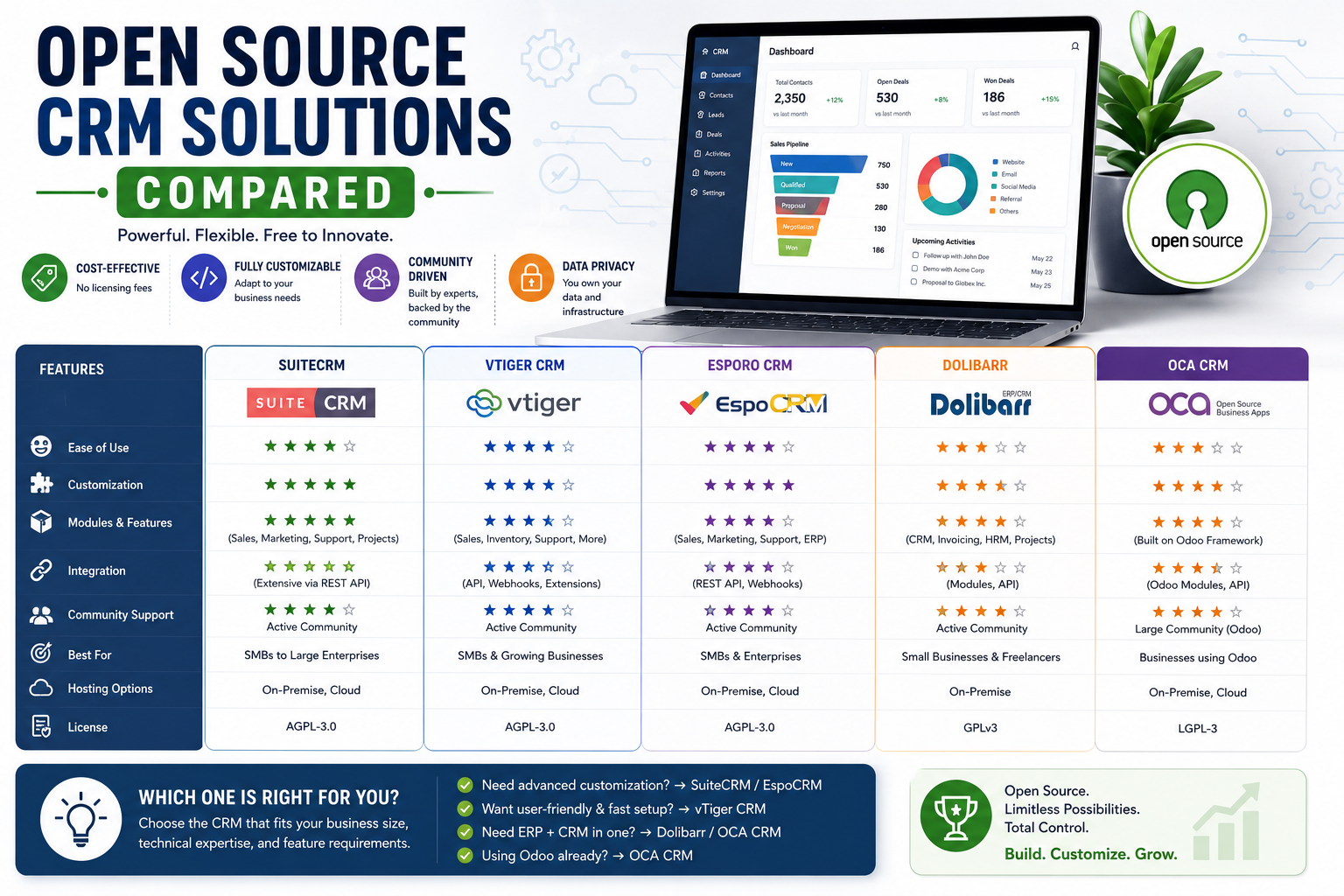
Open Source CRM Solutions Compared
Not every business wants to pay ongoing per-user SaaS fees for a CRM, and some have data residency, customization, or compliance requirements that push toward self-hosting. Open source CRM platforms offer a middle path between building entirely from scratch and committing to a closed SaaS platform — giving you full source-code access, self-hosting control, and no per-user licensing fees, in exchange for taking on your own hosting, maintenance, and (usually) implementation effort.
This guide compares the leading open source CRM options and helps you decide whether self-hosting makes sense for your organization.
Why Choose an Open Source CRM?
No Per-User Licensing Costs
The most immediate appeal is cost — open source CRMs eliminate the recurring per-seat fees that make platforms like Salesforce expensive at scale, replacing them with hosting infrastructure costs and (typically) internal or contracted development time instead.
Full Data Ownership and Control
For organizations with strict data residency requirements, regulatory compliance needs, or simply a preference against storing customer data on a third-party vendor’s servers, self-hosting an open source CRM keeps data entirely within infrastructure you control.
Deep Customization
Because you have access to the full source code, open source CRMs support customization depth that even “highly configurable” SaaS platforms can’t match — you can modify core application logic, not just configure exposed settings.
The Tradeoffs
Open source doesn’t mean free of cost — it shifts cost from license fees to infrastructure and engineering time. Self-hosting requires ongoing maintenance: security patching, uptime monitoring, backups, and scaling considerations that a SaaS vendor would otherwise handle for you.
Leading Open Source CRM Platforms
SuiteCRM
SuiteCRM is one of the most established and actively maintained open source CRM platforms, originally forked from SugarCRM’s open source community edition. It offers a comprehensive feature set comparable to mid-tier commercial CRMs — sales pipeline, marketing campaigns, customer support case management, and reporting — with a large community contributing plugins and extensions. It’s a strong choice for organizations wanting a mature, full-featured platform without building core CRM functionality from scratch.
EspoCRM
EspoCRM is a lighter-weight, more modern open source CRM with a cleaner codebase and a well-documented REST API, making it a popular choice for teams planning significant custom development on top of the base platform. Its interface is generally considered more modern than SuiteCRM’s, though its plugin/extension ecosystem is smaller.
Twenty
Twenty is a newer open source CRM built with a modern tech stack (TypeScript, GraphQL), designed specifically to appeal to engineering-led teams that want a clean, well-architected codebase to build on rather than working around a decade-old legacy structure. It’s less feature-complete out of the box than SuiteCRM but offers a notably better developer experience for teams planning deep customization.
Odoo CRM
Odoo CRM is part of the broader Odoo open source business application suite, which includes accounting, inventory, and e-commerce modules alongside CRM — a strong option for businesses wanting an integrated open source ERP/CRM combination rather than a standalone CRM tool. Odoo offers both a self-hosted community edition and a paid hosted enterprise edition, giving flexibility in how much infrastructure management you take on directly.
Vtiger CRM
Vtiger offers both an open source community edition and a commercial cloud-hosted version, providing a reasonably full-featured CRM with sales, marketing, and support modules. The open source community edition has historically received less active development attention compared to the commercial product, which is worth confirming if long-term active maintenance is a priority.
Feature Comparison
| Platform | Best For | Customization Depth | Ecosystem Maturity |
| SuiteCRM | Full-featured, mature deployment | High | Large, established |
| EspoCRM | Custom development on clean codebase | High | Moderate |
| Twenty | Engineering-led teams, modern stack | Very high | Growing, newer |
| Odoo CRM | Integrated ERP + CRM needs | High | Large (Odoo ecosystem) |
| Vtiger | Simpler full-featured deployment | Moderate | Moderate |
Self-Hosting Requirements to Plan For
Infrastructure
Open source CRMs need to be deployed on a server (cloud VM, dedicated hosting, or on-premises), with database, web server, and application runtime configuration — typically requiring at least basic DevOps capability, even for a straightforward deployment.
Security Maintenance
Self-hosted software requires proactive security patching. Unlike a SaaS platform where the vendor handles security updates transparently, self-hosted open source CRM security is entirely your organization’s responsibility, and delayed patching creates real exposure.
Backups and Disaster Recovery
A self-hosted CRM holding critical customer data needs a robust, tested backup strategy — this doesn’t come automatically the way it does with most SaaS platforms, and needs to be explicitly built and maintained.
Scaling Considerations
As your data volume and user count grow, self-hosted infrastructure needs to scale accordingly — database performance tuning, server resource allocation, and potentially infrastructure architecture changes that a SaaS platform would otherwise abstract away entirely.
When Open Source Makes Sense (and When It Doesn’t)
Good Fit
- Organizations with in-house technical/DevOps capability to manage self-hosted infrastructure
- Businesses with specific data residency or compliance requirements that favor self-hosting
- Teams planning deep, ongoing custom development that would be difficult or expensive to achieve through a SaaS platform’s configuration options
- Cost-sensitive organizations at a scale where per-user SaaS licensing has become a significant expense
Poor Fit
- Small teams without any technical/DevOps resources, where the maintenance burden outweighs the licensing savings
- Organizations wanting to move fast with minimal setup — SaaS platforms are almost always faster to get running than a self-hosted deployment
- Businesses that value having a vendor accountable for uptime, security, and support, rather than bearing that responsibility internally
Migration Considerations
Moving from a SaaS CRM to a self-hosted open source platform (or vice versa) involves: – Data export and import — most SaaS CRMs support data export, but field mapping to a different platform’s data model typically requires manual reconciliation – Custom workflow rebuilding — automation rules, email templates, and custom fields generally need to be recreated rather than directly imported – User retraining — different platforms have different interfaces and workflows, requiring some retraining regardless of technical similarity in underlying capability – Integration reconfiguration — any connected tools (email, calendar, marketing automation) need to be reconnected to the new platform
Frequently Asked Questions
Is open source CRM really free? The software license itself is free, but hosting infrastructure, setup, ongoing maintenance, and any custom development still carry real cost — for most organizations, “free” refers to the absence of per-user licensing fees, not the total cost of ownership.
What’s the best open source CRM for a small business? SuiteCRM or Vtiger are commonly chosen by small businesses wanting a fuller feature set without extensive custom development, though the DevOps capability required to self-host should be honestly assessed before committing, since a small team without technical resources may find a SaaS platform more practical despite the licensing cost.
Is SuiteCRM still actively maintained? Yes, SuiteCRM has an active development community and regular release cycle, making it one of the more reliably maintained options in the open source CRM category as of 2026.
Can I customize an open source CRM as much as I want? In principle yes, since you have full source code access, though practical customization depth still depends on your team’s development capability and the underlying codebase’s architecture — platforms like Twenty and EspoCRM are generally considered easier to customize cleanly than older, more monolithic codebases.
Do open source CRMs offer customer support? Community-maintained open source CRMs typically rely on community forums and documentation rather than dedicated vendor support, though several platforms (including Odoo and SuiteCRM) offer paid commercial support or hosted enterprise editions with formal support included.
Is Odoo CRM good for businesses that also need accounting or inventory software? Yes, Odoo’s strength is specifically its integrated suite — CRM, accounting, inventory, and e-commerce modules that share the same underlying data, which can meaningfully reduce integration complexity compared to running separate best-of-breed tools for each function.