Lead Nurturing Guide: Email Sequences & Drip Campaigns
Most leads aren’t ready to buy the moment they enter your funnel. Lead nurturing is the process of building trust and moving prospects toward a purchase decision through targeted, sequenced communication — primarily email, but often supported by retargeting ads, sales outreach, and content delivery. Done well, nurturing shortens sales cycles and increases close rates; done poorly, it reads as generic spam that damages sender reputation and brand trust.
This guide covers what lead nurturing actually is, how it differs from a basic drip campaign, and how to build sequences that convert.
What Is Lead Nurturing?
Lead nurturing is the ongoing process of developing relationships with prospects at every stage of the buyer’s journey, providing relevant information and value based on where they are in their decision-making process — rather than pushing a single generic sales pitch to everyone at once.
Effective nurturing is built on three principles:
- Segmentation — different leads need different messaging based on their interests, behavior, and funnel stage
- Timing — the right message needs to arrive at the right point in the buyer’s journey, not on a rigid, one-size-fits-all schedule
- Value-first content — nurture sequences that only ever ask for the sale tend to underperform sequences that lead with genuinely useful information
Drip Campaign vs. Nurture Campaign: What’s the Difference?
These terms are often used interchangeably, but there’s a meaningful distinction:
A drip campaign is a pre-scheduled series of emails sent at fixed intervals to everyone who enters it, regardless of how they behave along the way. It’s simpler to set up but less responsive to individual lead behavior.
A nurture campaign is behavior-triggered and adaptive — the sequence branches based on what the lead actually does (opens an email, clicks a specific link, visits a pricing page), delivering more relevant follow-up content rather than a fixed, linear sequence.
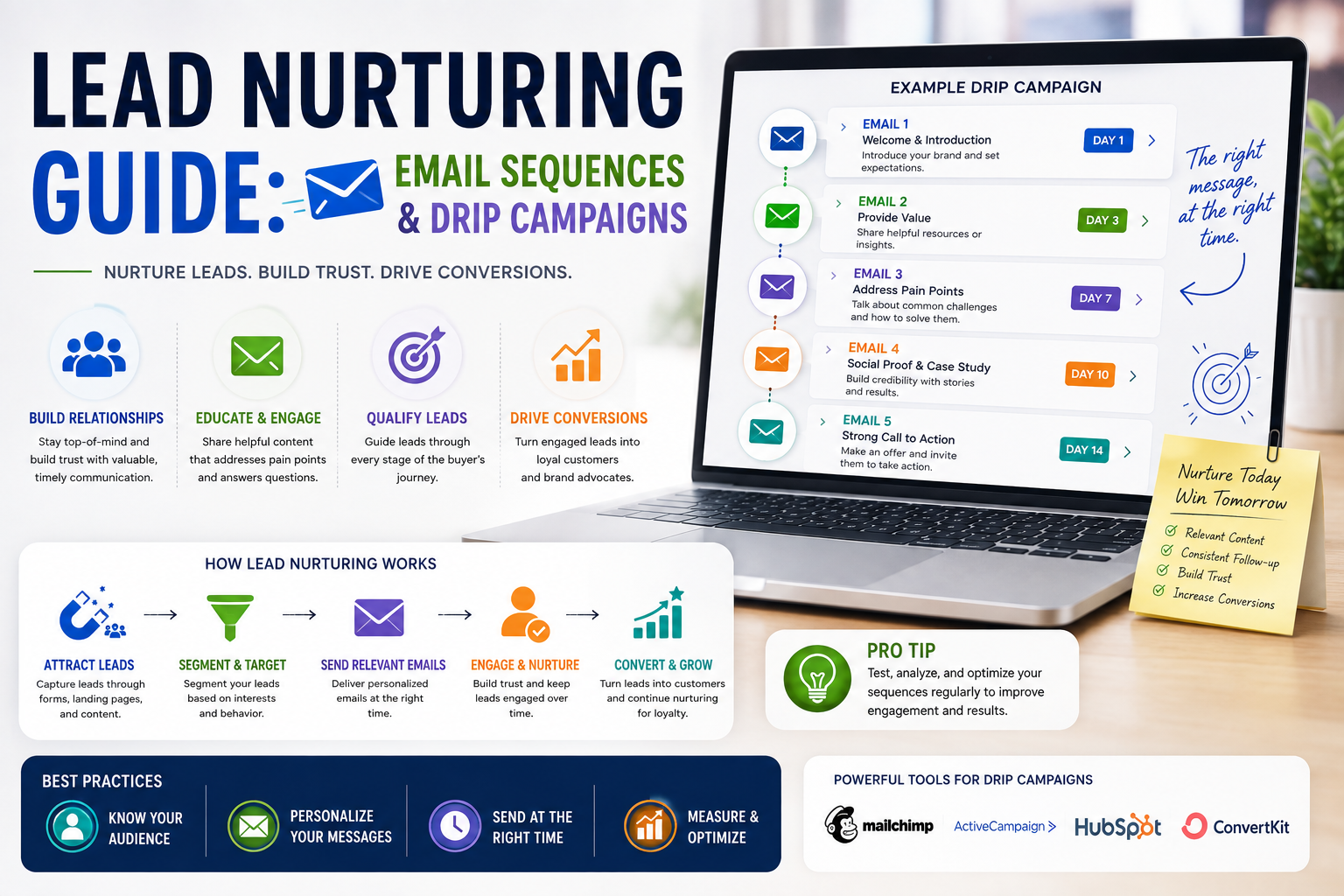
In practice, most modern marketing automation platforms (HubSpot, Mailchimp, ActiveCampaign) support both models, and many effective nurture programs combine elements of both — a baseline drip cadence with behavioral branches layered on top.
The Buyer’s Journey: Mapping Content to Funnel Stage
Effective nurture sequences map content to where the lead actually is in their decision process:
Top of Funnel (Awareness)
The lead has identified a problem but hasn’t necessarily connected it to your specific solution yet. Content here should be educational — blog posts, guides, and industry insights that build trust without a hard sales push.
Middle of Funnel (Consideration)
The lead is actively evaluating solutions. This is where comparison content, case studies, and more detailed product information become effective — the lead is ready for more specific information about how your solution solves their problem.
Bottom of Funnel (Decision)
The lead is close to a purchase decision. Content here should address remaining objections directly — pricing transparency, ROI calculators, free trials, demos, and social proof from similar customers.
Post-Purchase (Retention and Expansion)
Nurturing doesn’t stop at the sale. Onboarding sequences, feature education, and upsell/cross-sell nurture tracks keep existing customers engaged and reduce churn.
Building an Effective Email Nurture Sequence
Step 1: Define Clear Segments
Before writing a single email, define who’s actually entering this sequence and why. A lead who downloaded a beginner’s guide has different needs than one who requested a pricing page — treating them identically wastes the opportunity for relevant messaging.
Step 2: Set a Realistic Cadence
Overly aggressive email frequency drives unsubscribes; too sparse a cadence loses momentum and lets leads forget about you. A common starting cadence is 1 email every 3-5 days for the first two weeks, then tapering to weekly or biweekly for longer sequences — though this should be tested and adjusted based on your specific audience’s engagement patterns.
Step 3: Write for One Goal Per Email
Each email in the sequence should have a single clear objective — read a specific article, watch a demo video, book a call. Multiple competing calls-to-action in a single email reduce the click-through rate for all of them.
Step 4: Build in Behavioral Branches
Rather than a single linear path, build branch points based on engagement: leads who click through to pricing content should shift into a more sales-focused branch, while leads who remain unengaged after several emails might shift into a lower-frequency re-engagement track instead of continuing on the standard cadence.
Step 5: Include a Clear, Low-Friction Next Step
Every email should make it obvious what to do next — a single clear call-to-action, not a menu of options that creates decision paralysis.
Step 6: Test and Iterate
A/B test subject lines, send times, and content format systematically rather than making one-off changes based on intuition. Small, consistent testing over time compounds into meaningfully better performance.
Lead Scoring: Prioritizing Who Gets Sales Attention
Lead nurturing works best paired with a lead scoring system that quantifies engagement — points assigned for email opens, link clicks, website visits, and content downloads — so sales teams can prioritize outreach to the most engaged, highest-intent leads rather than treating every nurtured lead equally. Most marketing automation platforms include built-in lead scoring functionality that can trigger automatic sales notifications once a lead crosses a defined engagement threshold.
Cold Leads: Re-Engagement Strategies
Not every lead engages with a nurture sequence, and cold leads shouldn’t simply be abandoned or endlessly re-sent the same content. Effective cold lead re-engagement typically involves:
- A distinct “win-back” sequence with different messaging and offer framing than the initial nurture track
- A clear final email giving the lead an easy way to opt in to continued communication or opt out cleanly, which improves list health and sender reputation
- List hygiene — regularly removing genuinely unengaged contacts protects email deliverability for your entire program, since high bounce and low engagement rates can hurt sender reputation across all your campaigns
Common Lead Nurturing Mistakes
- Treating all leads identically regardless of source, funnel stage, or demonstrated interest
- Overloading each email with multiple competing CTAs, diluting the intended action
- Ignoring behavioral signals and running a purely linear, time-based drip regardless of engagement
- Sending too frequently, damaging both deliverability and brand perception
- No clear handoff to sales once a lead reaches high engagement, leaving hot leads to continue through an automated sequence rather than getting timely human follow-up
- Never testing or updating sequences, letting nurture content go stale as your product, market, or messaging evolves
Tools Commonly Used for Lead Nurturing
- HubSpot — combines CRM, email automation, and lead scoring in a single platform, widely used for B2B nurture programs
- Mailchimp — offers customer journey and automation tools, popular for small to mid-sized businesses building their first structured nurture sequences
- ActiveCampaign — known for its granular automation and behavioral branching capability, popular among marketers who want more customization than simpler email tools offer
- Marketo (Adobe) — an enterprise-focused marketing automation platform commonly used for complex, multi-channel B2B nurture programs at larger organizations
Frequently Asked Questions
What is the difference between a drip campaign and a nurture campaign? A drip campaign sends a fixed, pre-scheduled sequence of emails to everyone regardless of behavior, while a nurture campaign adapts based on how the lead engages — branching into different paths depending on opens, clicks, and other behavioral signals.
How many emails should be in a lead nurture sequence? There’s no universal number — it depends on your sales cycle length and audience. B2B sequences targeting a longer sales cycle often run 6-12+ emails over several weeks or months, while simpler B2C nurture sequences might be shorter and more compressed. The right length is best determined through testing engagement drop-off points specific to your audience.
What is a good open rate for a lead nurture email? Benchmark open rates vary significantly by industry, but a well-targeted nurture sequence to an engaged, opted-in list generally performs meaningfully better than a cold email campaign, since recipients have already expressed some interest. Rather than relying on generic industry benchmarks, tracking your own sequence’s performance over time is the more reliable way to judge whether a specific nurture program is working.
Should lead nurturing be fully automated, or does it need manual sales involvement? Effective nurturing typically combines both — automation handles the early-stage, higher-volume top-of-funnel engagement, while sales reps step in manually once lead scoring signals indicate a high-intent, sales-ready lead, rather than leaving the entire process automated end to end.
What’s the best tool for lead nurturing, HubSpot or Mailchimp? HubSpot generally offers more sophisticated CRM integration and lead scoring, making it a stronger fit for B2B sales teams that need tight sales-marketing alignment. Mailchimp is often a more accessible, lower-cost starting point for smaller businesses primarily focused on email-based nurturing without deep CRM requirements.
How do I re-engage cold leads who stopped responding to nurture emails? A dedicated win-back sequence with distinct messaging — rather than simply repeating the original nurture content — combined with a clear opt-in/opt-out prompt, is the standard approach. Regularly removing genuinely unengaged contacts from your list also protects overall email deliverability.