Industry-Specific CRM: Telecom, Hospitality, Retail & E-commerce
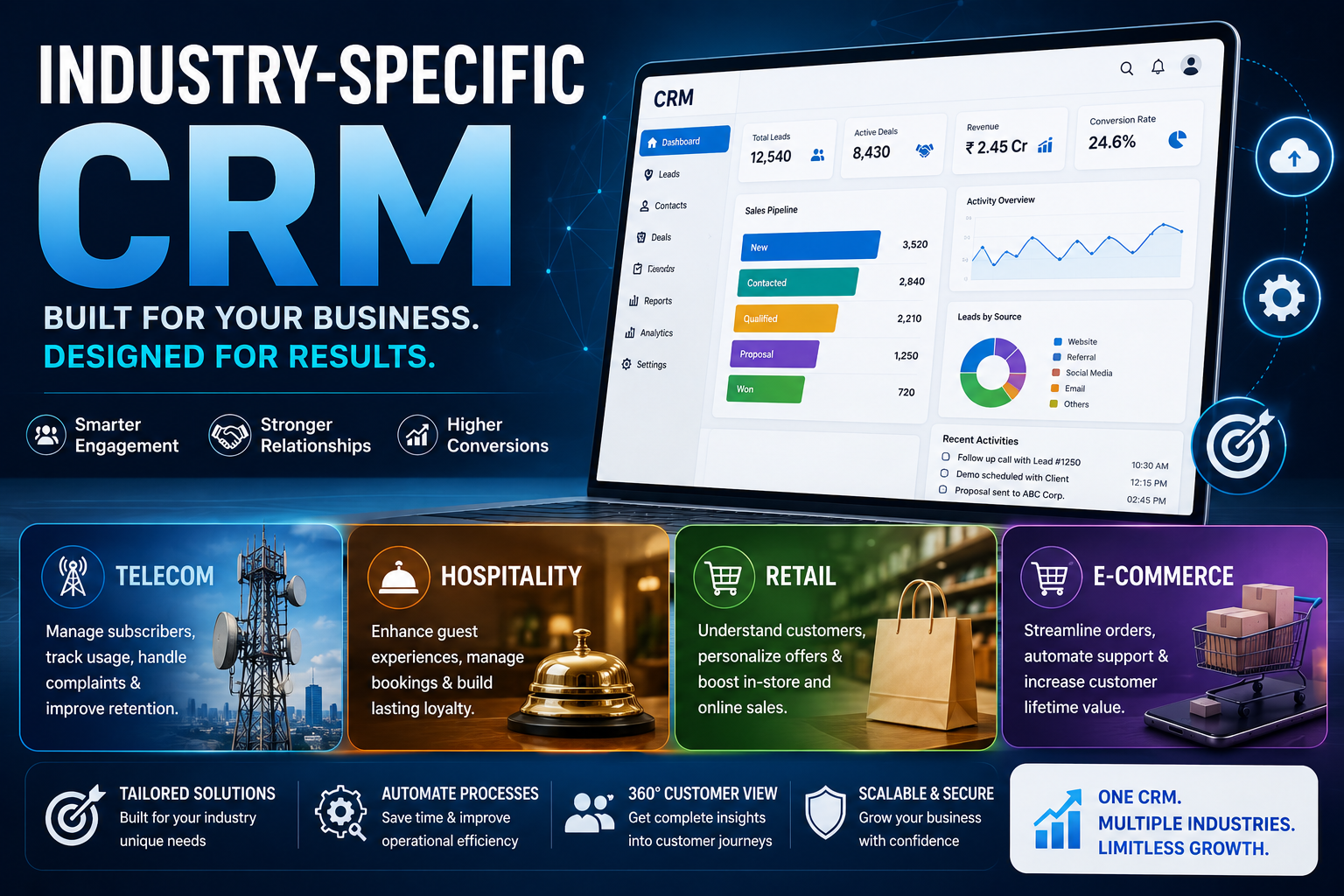
A generic CRM built for a horizontal “sell anything to anyone” use case often falls short once an industry has specialized workflows, compliance requirements, or customer interaction patterns that don’t map cleanly to a standard sales pipeline. Telecom, hospitality, retail, and e-commerce businesses each have distinct operational realities that shape what “customer relationship management” actually needs to look like in practice.
This guide breaks down CRM requirements and leading platform options across these four industries.
CRM in the Telecom Industry
Why Telecom Needs Specialized CRM Capability
Telecom companies manage an unusually complex customer relationship: subscription billing, service provisioning, network usage data, support ticketing, and churn risk all need to be visible in a single customer view. Unlike a simple sales pipeline, telecom CRM needs to integrate tightly with billing systems, network operations, and customer self-service portals.
Key Telecom CRM Features
- Subscription and billing integration — real-time visibility into a customer’s plan, usage, and billing status directly within the CRM record
- Churn prediction and retention workflows — telecom has notoriously high churn rates, making predictive churn scoring and automated retention outreach a core CRM function rather than a nice-to-have
- Omnichannel support integration — customers contact telecom providers through phone, chat, app, and in-store channels, all of which need to feed into a unified interaction history
- Order and provisioning management — tracking a customer from initial order through service activation, particularly for complex multi-service bundles (mobile, internet, TV)
Leading Platforms for Telecom CRM
Salesforce offers a dedicated Communications Cloud built specifically for telecom and media companies, with pre-built data models for service catalogs, order management, and usage-based billing integration. Amdocs and Netcracker are telecom-specific platforms with even deeper industry specialization, commonly used by larger carriers with complex network and billing integration needs beyond what a general CRM vendor’s industry cloud typically covers.
CRM in the Hospitality Industry
Why Hospitality Needs Specialized CRM Capability
Hotels, resorts, and hospitality groups manage guest relationships that span booking, on-property experience, and post-stay engagement — often across multiple properties and with strong seasonality and loyalty program dynamics that a generic sales CRM doesn’t model well.
Key Hospitality CRM Features
- Reservation and booking system integration — the CRM needs real-time visibility into booking status, room preferences, and stay history synced from the property management system (PMS)
- Guest preference tracking — room type preferences, dietary restrictions, special occasion notes, and past service issues, all accessible to front-desk and service staff for personalized experience delivery
- Loyalty program management — points tracking, tier status, and targeted offers based on loyalty tier and stay frequency
- Pre-arrival and post-stay automation — automated communication sequences around upcoming stays (upsell opportunities, check-in information) and post-stay follow-up (review requests, win-back offers for lapsed guests)
- Multi-property data unification — for hotel groups, a unified guest profile across properties, rather than siloed data per location, is essential for consistent loyalty recognition and personalization
Leading Platforms for Hospitality CRM
Salesforce’s broader platform is commonly customized for hospitality use cases, while dedicated hospitality CRM/guest engagement platforms like Cendyn and Revinate are purpose-built specifically around PMS integration, guest data unification, and hospitality-specific marketing automation, making them common choices for hotel groups that want less custom configuration overhead than a general CRM platform requires.
CRM in the Retail Industry
Why Retail Needs Specialized CRM Capability
Retail CRM needs to unify customer data across in-store, e-commerce, and mobile app channels — a challenge that’s become more complex as customers increasingly expect a consistent experience regardless of purchase channel.
Key Retail CRM Features
- Unified customer profile across channels — purchase history from in-store POS systems, online orders, and mobile app activity all need to feed into a single customer record for accurate segmentation and personalization
- Loyalty and rewards program integration — points, tier status, and personalized offers tied directly into the CRM’s customer segmentation capability
- Inventory-aware personalization — increasingly, retail CRMs integrate with inventory systems to avoid recommending or promoting out-of-stock items to customers
- Segmentation for targeted campaigns — purchase behavior, category affinity, and recency/frequency/monetary (RFM) segmentation to drive targeted email and SMS marketing
Leading Platforms for Retail CRM
Salesforce Commerce Cloud paired with Marketing Cloud is a common combination for larger retailers needing deep e-commerce and marketing integration. Smaller and mid-sized retailers often use platforms like Klaviyo (particularly strong for e-commerce-focused email/SMS marketing with deep Shopify integration) alongside a lighter general CRM, rather than a full enterprise retail CRM suite.
CRM in the E-commerce Industry
Why E-commerce Needs Specialized CRM Capability
E-commerce businesses operate at higher transaction volume and lower average customer-service touchpoints than traditional B2B sales, making automation and behavioral trigger-based communication far more central to e-commerce CRM than manual pipeline management.
Key E-commerce CRM Features
- Abandoned cart recovery automation — automated email/SMS sequences triggered by cart abandonment are one of the highest-ROI automation workflows in e-commerce CRM
- Post-purchase sequences — order confirmation, shipping updates, and review request automation, all tied to actual order status data
- Customer lifetime value (CLV) segmentation — identifying and specifically marketing to high-value repeat customers differently than one-time buyers
- Product recommendation personalization — using purchase and browsing history to power personalized product recommendations across email and on-site experiences
- Subscription and repeat purchase management — for subscription-based e-commerce businesses, tracking subscription status, upcoming renewals, and churn risk within the same customer profile as one-time purchase history
Leading Platforms for E-commerce CRM
Klaviyo has become a dominant choice specifically for e-commerce businesses, given its deep native integration with Shopify, BigCommerce, and other e-commerce platforms, combined with strong behavioral automation (abandoned cart, browse abandonment, post-purchase flows) built specifically around e-commerce customer journeys. HubSpot and Salesforce remain common choices for larger e-commerce operations that need broader CRM functionality beyond marketing automation, particularly those with a B2B wholesale component alongside direct-to-consumer sales.
Choosing the Right Industry CRM: A Framework
- Identify your industry’s unique data requirements first. What customer data is essential to your business that a generic CRM’s default fields don’t capture well?
- Map required integrations. PMS for hospitality, billing systems for telecom, POS and inventory for retail, e-commerce platform for online sellers — confirm native or well-supported integration before committing to any platform.
- Weigh purpose-built vs. customized general platform. Purpose-built industry CRMs (Cendyn for hospitality, Klaviyo for e-commerce) typically require less configuration but offer less flexibility than a heavily customized Salesforce or HubSpot instance.
- Consider your growth trajectory. A lighter, industry-specific tool might be the right fit now but could require migration later if your business scales into multi-channel or multi-property complexity that outgrows the platform’s design assumptions.
Frequently Asked Questions
What CRM do most hotels use? Larger hotel groups often use Salesforce customized for hospitality, or dedicated hospitality guest engagement platforms like Cendyn or Revinate, which offer pre-built PMS integration and guest data unification designed specifically for the hospitality customer journey.
Is Klaviyo a CRM or just an email marketing tool? Klaviyo functions primarily as an e-commerce-focused marketing automation and customer data platform, with strong behavioral email/SMS automation. It includes customer profile and segmentation capability similar to a CRM, though it’s generally used alongside — rather than as a full replacement for — a broader CRM in businesses with more complex sales processes.
What’s different about telecom CRM compared to a standard CRM? Telecom CRM needs tight integration with billing, network provisioning, and usage data systems, along with strong churn prediction capability, given telecom’s characteristically high churn rates and subscription-based billing complexity that a generic sales CRM isn’t built to handle natively.
Do small retailers need an enterprise retail CRM? Not necessarily. Many small to mid-sized retailers get sufficient functionality from a platform like Klaviyo for marketing automation, combined with their e-commerce platform’s built-in customer data, without needing a full enterprise-grade CRM implementation.
Can one CRM platform serve multiple industries well, or do businesses need industry-specific software? General-purpose platforms like Salesforce and HubSpot can be customized to serve most industries reasonably well, especially through dedicated “industry cloud” products, but purpose-built industry-specific platforms typically require less configuration effort and come with relevant integrations pre-built, which is often the deciding factor for businesses without extensive internal implementation resources.
What’s the biggest CRM mistake retailers make? Failing to unify customer data across in-store and online channels is one of the most common and costly mistakes, resulting in fragmented customer profiles, inconsistent personalization, and missed cross-channel marketing opportunities.