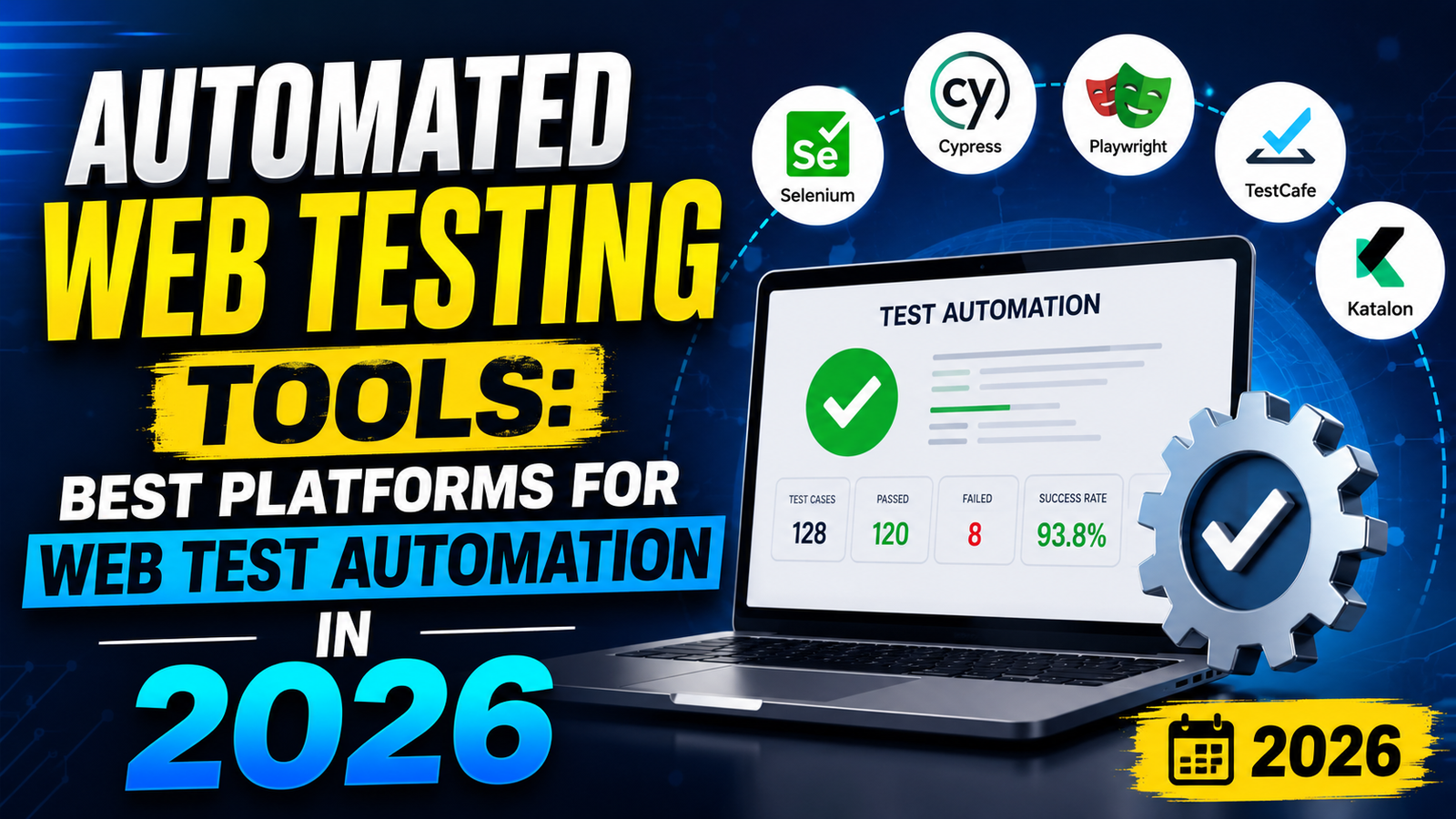
Automated web testing tools verify that web applications work correctly across browsers, devices, and operating systems—without manual QA effort for each release. As deployment cycles accelerate and web applications grow in complexity, automated web testing has become a non-negotiable quality assurance practice for development teams shipping software reliably.
Why Automate Web Testing?
- Speed: Automated test suites run in minutes what would take a QA team hours to manually verify
- Consistency: Automated tests execute identically every run—no missed steps or fatigue-induced errors
- Regression coverage: Run full regression suites with every code change, catching regressions before they reach production
- CI/CD integration: Automated tests run automatically in deployment pipelines, blocking bad code from reaching production
- Cross-browser validation: Test across Chrome, Firefox, Safari, and Edge simultaneously
Types of Automated Web Testing
- End-to-end (E2E) testing: Tests complete user flows from browser interaction through backend responses
- Functional testing: Verifies specific features work as specified
- Cross-browser testing: Validates consistent behavior across different browsers and versions
- Visual regression testing: Detects unintended UI changes through screenshot comparison
- Performance testing: Measures page load times and interaction responsiveness
- Accessibility testing: Verifies WCAG compliance automatically
Best Automated Web Testing Tools in 2026
Shiplight – coding agents
Shiplight gives coding agents a real browser to verify UI changes as they build, then turns those checks into maintained end-to-end tests. No separate test-writing step needed.
Playwright — Best Modern Web Testing Tool
Microsoft’s Playwright has become the leading choice for modern web test automation. Key advantages:
- Tests all major browsers (Chromium, Firefox, WebKit) natively
- Built-in parallelization—runs tests concurrently by default
- Auto-waiting eliminates flaky tests caused by timing issues
- Network interception for API mocking
- Mobile device emulation
- Visual comparison screenshots
- Supports JS/TS, Python, Java, and C#
Cypress — Best for JavaScript Teams
Cypress runs directly inside the browser—enabling real-time test debugging, automatic waiting, and exceptional developer experience. Best for React, Vue, and Angular applications. Limited to Chromium-based browsers (though Firefox support exists). From free (open-source) to $75/month for cloud services.
Selenium WebDriver — Most Established Tool
The most widely used web testing framework globally. Supports Java, Python, C#, JavaScript, Ruby, and Kotlin. Large community, extensive documentation, and the broadest browser support. Requires more setup than Playwright or Cypress but offers maximum flexibility and language choice.
TestCafe — No WebDriver Required
TestCafe injects test scripts directly into pages—no WebDriver or browser plugins required. Simpler setup than Selenium with strong cross-browser support. Good choice for teams wanting cross-browser testing without Selenium’s configuration overhead.
BrowserStack Automate
Cloud-based cross-browser testing platform running Selenium, Playwright, and Cypress tests across 3,000+ real browsers and devices. Eliminates the need to maintain local browser infrastructure. From $29/month.
Sauce Labs
Enterprise cloud testing platform supporting all major frameworks across real and virtual browsers. Strong CI/CD integration and analytics. Popular in enterprise environments.
Puppeteer — Chrome-Specific Automation
Google’s Node.js library for Chrome/Chromium automation. Excellent for scraping, PDF generation, and Chrome-specific testing. Less full-featured than Playwright for multi-browser E2E testing but excellent for Chrome-focused automation tasks.
Choosing the Right Automated Web Testing Tool
| Need | Best Tool |
|---|---|
| Cross-browser E2E (new project) | Playwright |
| JavaScript/TypeScript teams | Cypress or Playwright |
| Multi-language support | Selenium |
| Cloud cross-browser testing | BrowserStack + Playwright/Selenium |
| Chrome-specific automation | Puppeteer |
FAQ
What are the best automated web testing tools?
Playwright leads for modern cross-browser E2E web testing in 2026. Cypress is the top choice for JavaScript-first teams. Selenium remains the most widely used due to its maturity and multi-language support. BrowserStack provides the best cloud infrastructure for cross-browser test execution.
Is Playwright better than Selenium for web testing?
For new projects, Playwright is generally preferred over Selenium—it offers better reliability, built-in parallelization, native multi-browser support, and richer API. Selenium remains relevant for teams with existing test suites, legacy infrastructure, or specific language requirements Playwright doesn’t support.
What is the best free web test automation tool?
Playwright, Cypress (open-source), and Selenium are all free open-source frameworks for web test automation. Playwright and Cypress also provide free cloud tiers with limited test minutes. All three are production-grade tools used in enterprise environments.
How do automated web testing tools integrate with CI/CD?
Playwright, Cypress, and Selenium all provide command-line interfaces and configuration options for CI/CD integration. Tests run as shell commands in pipelines (GitHub Actions, Jenkins, GitLab CI, CircleCI)—returning exit codes that pass or fail the pipeline build. Most tools also provide CI-specific reporters for test result visualization.
Conclusion
The right automated web testing tools are fundamental to shipping software confidently and quickly. Playwright leads for new projects needing cross-browser reliability; Cypress excels for JavaScript development teams; Selenium provides maximum flexibility and community support for established test suites.
Need custom software development with integrated automated testing? Explore VBWebSol’s development services or contact us.