
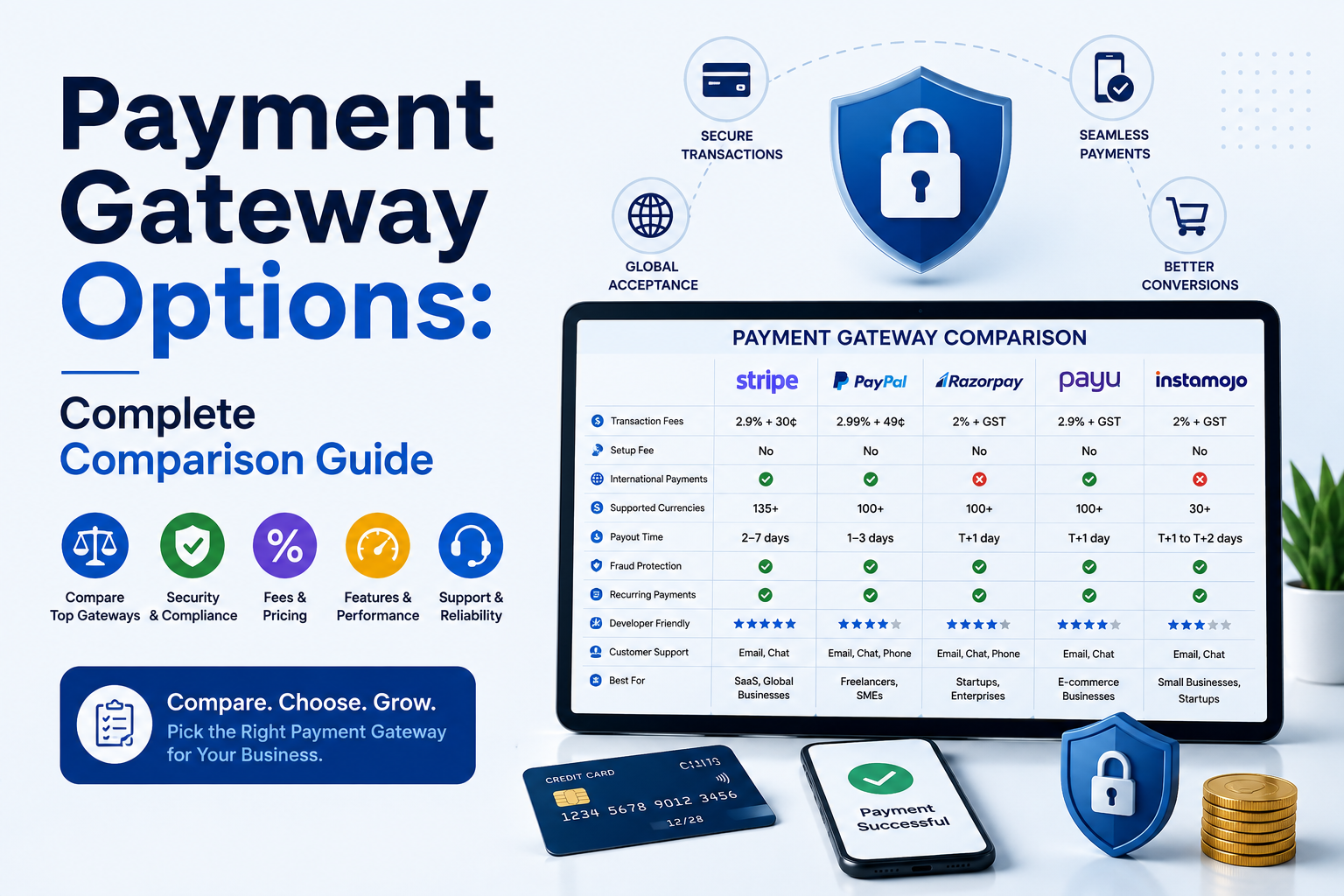
Choosing a payment gateway is one of the most consequential technical and business decisions an online business makes — it affects checkout conversion rate, transaction fees, fraud exposure, and how quickly you can expand into new markets or payment methods. This guide breaks down the types of payment gateways available, compares leading providers, and outlines the key factors to weigh when choosing one.
What Is a Payment Gateway, and How Does It Differ From a Payment Processor?
A payment gateway is the technology layer that securely captures and transmits payment information from a customer’s checkout to the payment processing network. A payment processor is the entity that actually handles the transaction between the customer’s bank and the merchant’s bank, moving funds and managing settlement.
In practice, many modern providers (Stripe, Square, PayPal) bundle both gateway and processing functionality into a single integrated service, which is why the terms are often used interchangeably in casual conversation, even though they technically describe distinct parts of the payment flow.
Types of Payment Gateways
Hosted Payment Gateways
Hosted gateways redirect customers to the payment provider’s own secure checkout page to enter payment details, then return them to the merchant’s site after completion. This reduces PCI compliance burden significantly for the merchant, since sensitive card data never touches the merchant’s own servers, at the cost of a slightly less seamless, on-brand checkout experience.
Self-Hosted (Integrated) Payment Gateways
Self-hosted gateways keep the entire checkout experience on the merchant’s own site, with payment data transmitted directly to the gateway via API. This offers a more seamless, fully branded checkout experience but requires stricter PCI DSS compliance obligations for the merchant, since sensitive payment data does pass through (even if not stored by) the merchant’s own infrastructure.
API-Based Gateways
Modern API-based gateways (like Stripe’s Elements or similar tokenization-based approaches) offer a middle ground — the checkout UI is fully custom and hosted on the merchant’s site, but sensitive card data is tokenized directly in the customer’s browser before ever reaching the merchant’s servers, reducing PCI compliance scope while preserving a seamless branded experience.
Local/Bank-Integrated Gateways
In many markets outside the U.S. and Europe, banks and local payment networks offer their own gateway solutions, often required or strongly preferred for accepting locally popular payment methods that major international gateways may not support natively.
Leading Payment Gateway Providers Compared
Stripe
Stripe is widely regarded as the developer-friendliest payment gateway, with extensive API documentation, strong support for subscription/recurring billing, and broad international payment method support. Its pricing is generally competitive with other major providers, structured as a percentage plus fixed fee per transaction, with volume-based discounts available at higher processing volumes.
PayPal
PayPal offers broad brand recognition and customer trust, which can meaningfully improve checkout conversion for certain customer segments who specifically prefer or trust PayPal over entering card details directly. Its developer experience and customization flexibility are generally considered less extensive than Stripe’s, though its consumer brand recognition remains a genuine conversion advantage in some markets and demographics.
Square
Square is particularly strong for businesses with both online and in-person sales, offering unified point-of-sale hardware and online payment processing under a single account and reporting system — a meaningful advantage for retail or hospitality businesses operating across both channels.
Adyen
Adyen is an enterprise-focused payment platform offering extensive global payment method coverage and unified reporting across online, in-app, and in-person payments, commonly chosen by larger, international e-commerce and marketplace businesses needing sophisticated multi-market payment infrastructure.
Braintree (PayPal)
Braintree, owned by PayPal, offers a more developer-focused, customizable payment gateway than PayPal’s standard consumer checkout product, while still supporting PayPal as a payment method alongside standard card processing.
Authorize.net
Authorize.net is a long-established payment gateway, often integrated with a separate merchant account rather than bundling processing and gateway into a single account the way Stripe or Square do — a structure that can offer more negotiating flexibility on processing rates at higher volumes, at the cost of more complex initial setup.
Key Factors in Choosing a Payment Gateway
Transaction Fees
Most gateways charge a percentage plus fixed fee per transaction, though exact rates vary by provider, payment method, and processing volume. High-volume businesses should specifically evaluate whether a provider offers negotiated volume discounts, since standard published rates often aren’t the final rate available to larger merchants.
Supported Payment Methods
Beyond standard credit/debit cards, confirm support for digital wallets (Apple Pay, Google Pay), buy-now-pay-later options, and any regionally significant local payment methods relevant to your target markets — payment method preferences vary significantly by country and demographic.
International Support
If you sell internationally, confirm multi-currency support, local payment method coverage, and any country-specific compliance requirements the gateway handles versus requires you to manage separately.
Developer Experience and Integration Effort
For businesses building custom checkout experiences, API documentation quality, SDK availability for your tech stack, and community/support resources meaningfully affect implementation time and ongoing maintenance burden.
Fraud Prevention Tools
Built-in fraud detection and prevention tools (machine learning-based risk scoring, 3D Secure support) vary in sophistication between providers, and are particularly important for businesses in higher-risk categories or with significant international transaction volume.
Subscription and Recurring Billing Support
For subscription-based businesses, confirm native support for recurring billing logic — failed payment retry logic, proration, plan changes — since building this logic manually on top of a gateway not designed for it adds significant engineering overhead.
PCI DSS Compliance Considerations
Any business accepting card payments has PCI DSS compliance obligations, though the scope varies significantly based on how payment data flows through your systems. Hosted and tokenization-based gateways (where sensitive card data never touches your own servers) generally qualify for simplified compliance requirements (SAQ A or similar), while gateways where card data passes through your own server infrastructure carry more extensive compliance obligations. This distinction is worth understanding clearly before choosing an integration approach, since compliance scope directly affects both implementation complexity and ongoing audit/documentation burden.
Multi-Gateway Strategies
Larger businesses, particularly those operating across multiple countries or with significant transaction volume, sometimes use multiple payment gateways simultaneously — routing transactions based on customer location, payment method, or for redundancy in case of provider outages. This adds integration complexity but can improve authorization rates (different gateways have different success rates with different card issuers and regions) and provides negotiating leverage on processing rates.
Frequently Asked Questions
What’s the difference between a payment gateway and a payment processor? A payment gateway is the technology layer that securely captures and transmits payment data, while a payment processor handles the actual movement of funds between banks. Many modern providers bundle both functions into a single integrated service, which is why the terms are often used interchangeably in practice.
Which payment gateway has the lowest fees? Fee structures vary by provider, payment method, and transaction volume, and published rates aren’t always the final rate available to higher-volume merchants who can often negotiate. Rather than relying on a single “cheapest” answer, it’s worth requesting current quotes based on your specific expected volume and payment method mix.
Is Stripe better than PayPal for a new online business? Stripe generally offers a stronger developer experience and more customization flexibility for building a fully branded checkout, while PayPal offers strong existing consumer trust and recognition that can improve conversion for customers who specifically prefer paying via PayPal. Many businesses offer both as payment options rather than choosing exclusively one or the other.
Do I need a separate merchant account if I use Stripe or Square? No — Stripe and Square both operate as integrated payment facilitators, meaning they handle the merchant account relationship on your behalf, simplifying setup compared to traditional gateways like Authorize.net that typically require a separate merchant account arrangement.
What payment gateway supports the most countries? Adyen and Stripe both offer extensive international payment method and currency support, making them common choices for businesses with significant multi-country sales, though specific payment method coverage should be confirmed for your particular target markets since coverage details change and vary by provider.
Is PCI compliance different depending on which payment gateway I use? Yes, significantly — hosted and tokenization-based gateways where sensitive card data never touches your own servers generally qualify for simplified PCI compliance requirements, while gateways where card data passes through your own infrastructure carry more extensive compliance obligations.