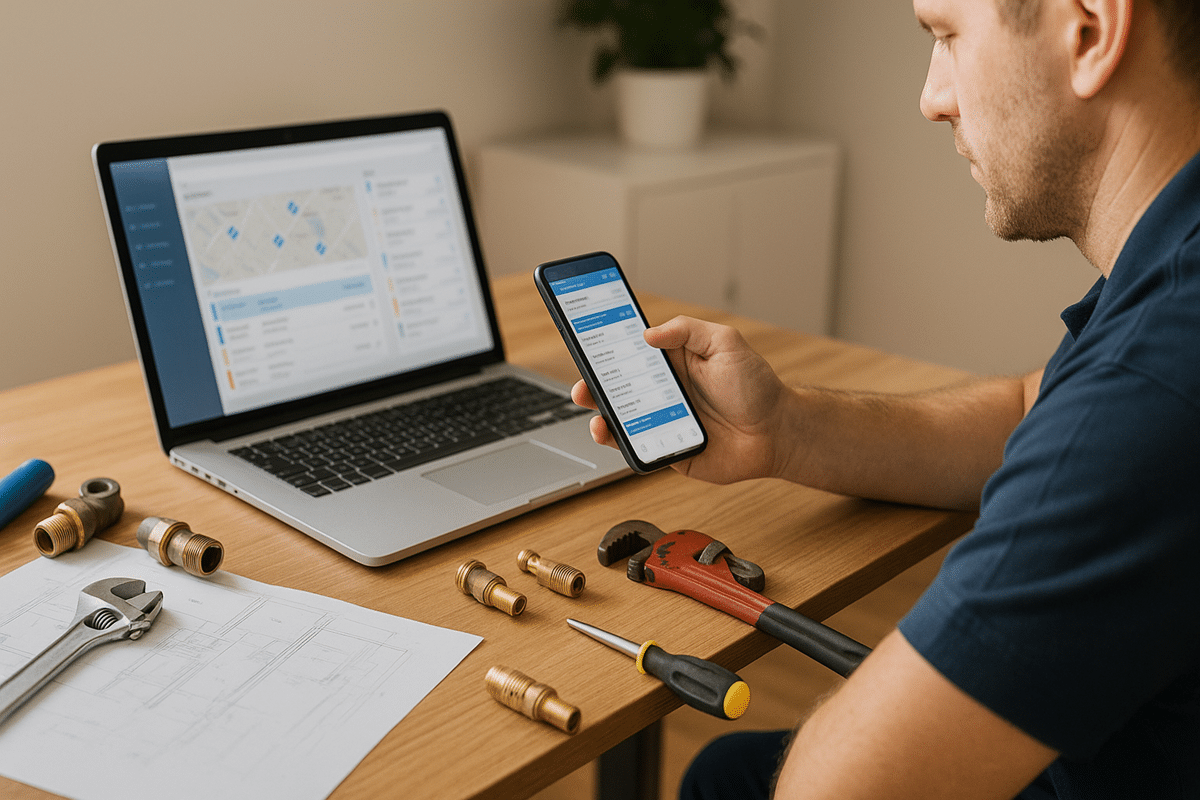
Running a plumbing business in 2025 without dedicated software is like trying to fix a burst pipe with duct tape — it might hold for a while, but it will eventually fail. The best software for plumbing businesses integrates scheduling, dispatch, invoicing, inventory, CRM, and field service management into a single, unified platform. In this comprehensive technical guide, we explore what to look for, which solutions lead the market, and how to evaluate each option based on your specific operational requirements.
Why Plumbing Businesses Need Specialized Software
The plumbing industry operates under unique constraints that generic business software simply cannot address. Technicians work in the field, often without reliable connectivity. Jobs vary wildly in scope — from a leaking tap to a full commercial pipe installation. Customers expect real-time updates, precise arrival windows, and instant digital invoices. Regulatory compliance (backflow certifications, gas licensing) requires document tracking. Without purpose-built software, businesses rely on paper forms, spreadsheets, and fragmented apps — costing an average of 6-10 hours per week in administrative overhead per technician.
According to a 2024 Field Service Management survey, plumbing businesses using integrated management software reported a 34% increase in jobs completed per technician per week, a 28% reduction in billing errors, and a 22% improvement in customer retention rates. The ROI is measurable and rapid — typically within 3-6 months of deployment.
Core Modules Every Plumbing Software Must Have
1. Job Scheduling and Dispatch
The scheduling engine is the heartbeat of any plumbing software. Look for drag-and-drop calendar interfaces, GPS-based technician location tracking, skill-based job assignment (ensuring a certified gas fitter goes to gas jobs), and automated SMS/email notifications to customers. Advanced platforms offer AI-assisted scheduling that factors in travel time, technician proximity, and job priority scores.
2. Mobile Field Service App
Your technicians need a robust mobile app that works offline. Key requirements include: digital job sheets with photo capture, on-site signature collection, parts and material usage logging, real-time status updates, access to customer history and previous job notes, and the ability to generate and send invoices directly from the field. iOS and Android support is mandatory in 2025.
3. Invoicing and Payments
Plumbing invoicing is complex — it must handle labour rates, material markups, emergency call-out fees, and warranty parts. The best platforms integrate with accounting software (Xero, QuickBooks, MYOB) and support on-site payment collection via credit card readers, payment links, or buy-now-pay-later integrations. Automated invoice generation from completed job sheets eliminates billing delays.
4. Customer Relationship Management (CRM)
A built-in CRM stores every customer interaction — calls, jobs, quotes, complaints, and follow-ups. It enables automated service reminders (annual maintenance, boiler checks), smart upsell opportunities, and loyalty programme management. Customer portals, where clients can book jobs and review history online, dramatically reduce inbound call volumes.
5. Inventory and Parts Management
Plumbers carry significant inventory in their vans. The software must track van stock levels, trigger reorder alerts when parts run low, integrate with supplier catalogues for real-time pricing, and allow technicians to log parts used on each job automatically. This prevents both stockouts (leaving a job incomplete) and over-ordering (tying up capital).
6. Quoting and Estimating
Fast, accurate quoting wins jobs. Look for pre-built price books, templated quote sections, photo-based estimates sent directly from the field, and electronic quote acceptance with e-signature. Some platforms offer price-book integrations with national plumbing suppliers so your rates auto-update when material costs change.
Top Plumbing Software Platforms: Technical Comparison
| Platform | Scheduling | Mobile App | Accounting Integration | Best For |
|---|---|---|---|---|
| ServiceTitan | Advanced AI | iOS/Android | QuickBooks, Sage | Large fleets (10+ techs) |
| Jobber | Drag-drop calendar | iOS/Android offline | QuickBooks, Xero | SMB (1-20 techs) |
| Workiz | Real-time GPS | iOS/Android | QuickBooks | Growing businesses |
| ServiceM8 | Smart routing | iOS-first | Xero, QuickBooks | Small Australian/UK businesses |
| FieldPulse | Auto-assign | iOS/Android | QuickBooks, Xero | Solo to 10 techs |
| Custom CRM | Fully custom | Custom app | Any ERP/accounting | Enterprise or unique workflows |
Key Technical Features to Evaluate
API and Integration Capabilities
Modern plumbing businesses use multiple tools — accounting software, parts suppliers, marketing platforms, and communication tools. Your chosen software must offer a documented REST API, webhook support for real-time data sync, and pre-built integrations with common tools. Platforms with open APIs allow your development team (or a partner like VBWebSol) to build custom integrations as your business evolves.
Data Security and Compliance
Customer data, financial records, and compliance certificates must be protected. Look for TLS 1.3 encryption in transit, AES-256 encryption at rest, role-based access control (office staff vs. field technicians), Australian Privacy Act or GDPR compliance depending on your market, and automatic backup with point-in-time recovery. Ask vendors about their SOC 2 compliance status.
Offline Functionality
Plumbers often work in basements, crawl spaces, and rural locations with poor connectivity. Your mobile app must cache job data locally and sync automatically when connectivity is restored. Test this specifically during evaluation — some vendors claim offline support but only cache limited data.
Reporting and Business Intelligence
The best software for plumbing provides real-time dashboards showing revenue by technician, job completion rates, average job value, parts margin analysis, and customer satisfaction scores. Look for exportable reports, scheduled email reports to management, and ideally, integration with BI tools like Power BI or Tableau for enterprise-level analysis.
Cloud vs On-Premise: Which is Right for Plumbing Businesses?
In 2025, cloud-based software dominates the plumbing industry for compelling technical reasons. Cloud platforms eliminate local server maintenance, provide automatic updates with new features, scale easily as your business grows, enable remote access from any device, and typically cost less in total ownership than on-premise solutions. The monthly SaaS model also improves cash flow versus large upfront licence fees.
On-premise solutions may still be considered by very large commercial plumbing contractors with strict data sovereignty requirements or highly customized workflows. However, even these businesses are increasingly migrating to private cloud or hybrid deployments.
Implementation Checklist for Plumbing Software
- Define your core workflows before selecting software — don’t mould your business around the software
- Audit your current data (customer records, job history) and plan migration
- Negotiate a trial period with real jobs running through the system
- Train all technicians before go-live — consider a parallel run period
- Configure integrations with your accounting software and supplier catalogues
- Set up automated notifications and customer communication templates
- Establish KPIs to measure post-implementation performance
Custom Plumbing Software vs Off-the-Shelf Solutions
While off-the-shelf platforms work for most plumbing businesses, larger operations with unique workflows — franchise networks, commercial plumbing contractors, or businesses with complex compliance requirements — often find that custom-built software delivers significantly better ROI. Custom platforms can be built exactly to your specifications, integrate natively with your existing systems, eliminate unnecessary features you’re paying for but never use, and include proprietary algorithms (like intelligent pricing or predictive maintenance scheduling) that give you a competitive edge.
VBWebSol specialises in building custom CRM and field service management platforms for plumbing and trade businesses across India, Australia, the UK, and the USA. Our solutions are built on modern tech stacks (React, Node.js, PostgreSQL, AWS) with full mobile app support and are typically delivered in 8-14 weeks.
Frequently Asked Questions
What is the best software for small plumbing businesses?
For small plumbing businesses (1-5 technicians), Jobber and ServiceM8 are popular off-the-shelf choices due to their ease of use and affordable pricing. Custom CRM solutions become more cost-effective as your business grows beyond 5 technicians.
Does plumbing software work offline?
Leading plumbing software platforms like Jobber, ServiceTitan, and custom-built solutions offer offline mobile apps that cache job data and sync when connectivity is restored. Always test offline functionality before committing to a platform.
How much does plumbing business software cost?
Off-the-shelf plumbing software typically costs $50-300 per technician per month. Custom-built platforms have higher upfront development costs (typically $15,000-$60,000) but lower ongoing costs and better fit for complex businesses.
Can plumbing software integrate with QuickBooks?
Yes, most leading plumbing software platforms — including ServiceTitan, Jobber, Workiz, and custom solutions — offer QuickBooks integration. This eliminates double-entry and keeps your financial records in sync.
What technical features should I prioritise in plumbing software?
Prioritise GPS tracking, offline mobile functionality, real-time scheduling, API integration capability, role-based access control, and robust reporting. These features deliver the highest operational ROI for plumbing businesses.
Ready to Build Your Custom CRM & Field Service Platform?
VBWebSol has helped 500+ businesses across India and the USA build powerful, scalable software solutions. Our expert team delivers on time, within budget, and tailored to your exact needs.