
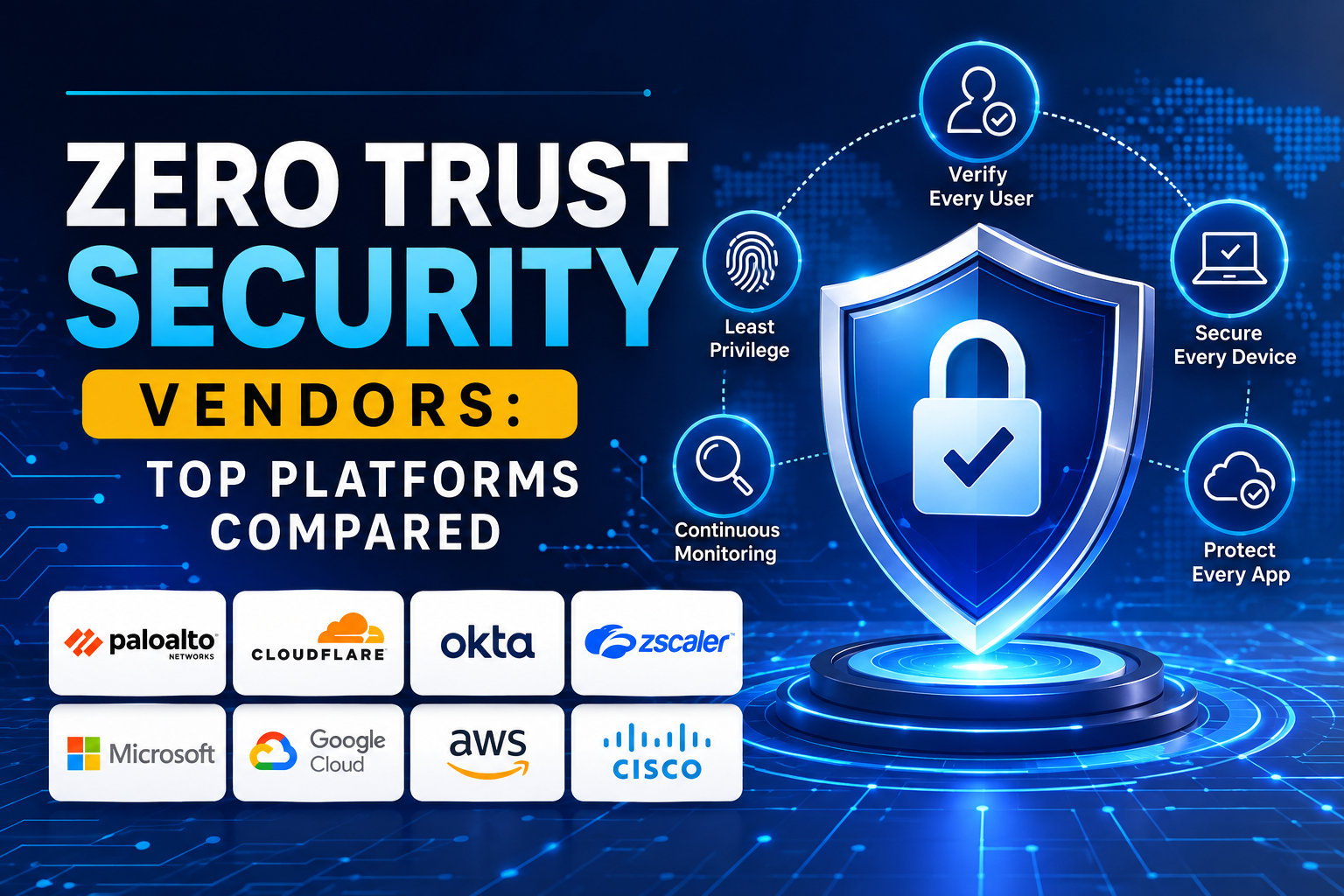
The traditional security model of trusting anything inside a corporate network perimeter has become increasingly untenable with remote work, cloud infrastructure, and sophisticated attacks that routinely bypass perimeter defenses. Zero trust security — the principle of “never trust, always verify,” requiring continuous authentication and authorization for every access request regardless of network location — has become the dominant security architecture approach for modern organizations. This guide covers what zero trust actually means in practice, the core components of a zero trust architecture, and how leading vendors compare.
What Is Zero Trust Security?
Zero trust is a security model built on the principle that no user or device should be automatically trusted, whether inside or outside the traditional network perimeter. Every access request is verified based on identity, device health, and context before granting access, and access is limited strictly to what’s needed for a specific task (the principle of least privilege) rather than broad network-level trust.
Core Components of a Zero Trust Architecture
Identity and Access Management (IAM)
Strong identity verification — multi-factor authentication, single sign-on, and continuous session validation — forms the foundation of zero trust, since identity verification replaces network location as the primary basis for granting access.
Device Security and Posture Assessment
Zero trust architectures typically evaluate device health (patch status, security software, compliance with organizational policy) as part of the access decision, not just user identity alone, since a compromised or non-compliant device represents risk even with valid user credentials.
Micro-Segmentation
Rather than broad network access once inside the perimeter, zero trust architectures segment network access tightly, limiting lateral movement even if one system or credential set is compromised.
Continuous Monitoring and Verification
Zero trust isn’t a one-time authentication check — it involves continuous monitoring of user and device behavior, with the ability to revoke access dynamically if anomalous or risky behavior is detected mid-session.
Application-Level Access Control
Rather than granting broad network access, zero trust architectures typically grant access to specific applications and resources individually, based on need, rather than implicit access to everything on a trusted network segment.
Leading Zero Trust Security Vendors
Zscaler
Zscaler is one of the most established zero trust network access (ZTNA) vendors, offering cloud-delivered security that routes and inspects traffic through its global security cloud rather than traditional network perimeter hardware, popular among large enterprises transitioning away from legacy VPN-based remote access models.
Palo Alto Networks (Prisma Access)
Palo Alto Networks’ Prisma Access offers zero trust network access as part of its broader security platform, appealing to organizations already using other Palo Alto Networks security products who want unified policy management across their security stack.
Cloudflare Zero Trust
Cloudflare’s zero trust offering leverages its extensive global network infrastructure, providing zero trust network access, secure web gateway, and browser isolation capability, often praised for strong performance given Cloudflare’s network scale and relatively accessible pricing compared to some enterprise-focused competitors.
Okta
While primarily known as an identity and access management platform, Okta’s strong identity verification and single sign-on capability forms a core building block of many organizations’ zero trust architectures, often deployed alongside dedicated network access vendors to provide the identity layer of a broader zero trust implementation.
Microsoft Entra (formerly Azure AD)
Microsoft’s identity and access management platform, tightly integrated with the broader Microsoft 365 and Azure ecosystem, is a common zero trust foundation for organizations already invested in Microsoft’s enterprise software stack.
CrowdStrike
CrowdStrike’s endpoint security and identity threat detection capability contributes the device and endpoint security layer of a zero trust architecture, commonly deployed alongside dedicated network access vendors for comprehensive coverage.
Cisco (Duo Security)
Cisco’s Duo Security provides multi-factor authentication and device trust verification, widely used as an accessible entry point into zero trust identity verification, particularly for organizations already using other Cisco networking infrastructure.
Choosing a Zero Trust Vendor: Key Considerations
Existing Security Stack Integration
Organizations already invested in a specific security vendor’s broader ecosystem (Palo Alto, Cisco, Microsoft) often find meaningful integration benefits from choosing that vendor’s zero trust offering, reducing policy management complexity across tools.
Network Architecture and Scale
Very large, globally distributed organizations may prioritize vendors with extensive global network infrastructure (Zscaler, Cloudflare) for performance reasons, while smaller organizations may prioritize simplicity and cost over global network scale.
Cloud vs. Hybrid Infrastructure
Organizations that are heavily cloud-native versus those maintaining significant on-premises infrastructure may find different vendors better suited to their specific architecture, given varying levels of support and optimization for hybrid deployment models across vendors.
Identity Provider Compatibility
Since identity verification is foundational to zero trust, confirming smooth integration with your existing identity provider (Okta, Microsoft Entra, or another IAM system) is an important practical consideration, even when evaluating a separate network access vendor.
Implementing Zero Trust: A Phased Approach
Phase 1: Strengthen Identity Foundations
Before implementing broader zero trust network access, ensure strong multi-factor authentication and identity verification are in place across the organization — this foundational layer underlies everything else in a zero trust architecture.
Phase 2: Implement Device Posture Assessment
Establish device health and compliance checking as part of the access decision process, ensuring only properly secured, compliant devices can access sensitive resources.
Phase 3: Deploy Zero Trust Network Access
Replace or supplement traditional VPN-based remote access with zero trust network access tools that grant application-specific rather than broad network-level access.
Phase 4: Implement Micro-Segmentation
Segment internal network access to limit lateral movement, a more complex undertaking typically implemented after the foundational identity and access layers are mature.
Phase 5: Establish Continuous Monitoring
Deploy tools and processes for ongoing behavioral monitoring and anomaly detection, enabling dynamic access revocation for suspicious activity rather than relying solely on point-in-time authentication.
Common Zero Trust Implementation Challenges
- Underestimating the identity foundation work required — organizations sometimes attempt to implement network access controls before establishing robust identity verification, undermining the effectiveness of the broader architecture
- User experience friction — overly aggressive verification requirements without thoughtful implementation can create significant user friction, leading to workarounds that undermine security goals
- Legacy application compatibility — older applications not designed with modern authentication protocols in mind can be challenging to incorporate into a zero trust architecture without additional integration work
- Organizational change management — zero trust represents a significant shift from traditional network security thinking, requiring genuine buy-in and understanding from both security teams and general staff to implement effectively
Frequently Asked Questions
What is the difference between zero trust and a traditional VPN? Traditional VPNs typically grant broad network access once authenticated, implicitly trusting users and devices within that network segment. Zero trust grants access to specific applications and resources individually, based on continuous identity and device verification, without assuming trust based on network location.
Which zero trust vendor is best for a small business? Cloudflare Zero Trust and Duo Security (Cisco) are often considered more accessible entry points for smaller organizations, given their relatively straightforward implementation and pricing compared to some enterprise-focused competitors like Zscaler or Palo Alto Networks’ more comprehensive platforms.
Do I need multiple vendors to implement zero trust, or can one vendor cover everything? Some vendors offer fairly comprehensive zero trust platforms, but most organizations end up combining multiple tools — an identity provider (Okta, Microsoft Entra), a network access vendor (Zscaler, Cloudflare), and endpoint security (CrowdStrike) — since no single vendor typically excels at every layer of a complete zero trust architecture.
How long does it take to implement zero trust security? Zero trust implementation is typically a phased, multi-month to multi-year effort for larger organizations, starting with identity foundation work and progressively adding network access controls, micro-segmentation, and continuous monitoring capability rather than a single, one-time deployment.
Is zero trust only relevant for large enterprises? No, organizations of all sizes benefit from zero trust principles, though implementation approach and vendor choice often scale with organizational size and complexity — smaller organizations can implement meaningful zero trust improvements through accessible tools like strong MFA and cloud-based network access solutions without enterprise-scale infrastructure investment.
What’s the relationship between zero trust and remote work security? Zero trust architecture directly addresses many remote work security challenges, since it doesn’t rely on a trusted network perimeter that remote workers are inherently outside of — this is a major reason zero trust adoption accelerated significantly alongside the broader shift toward remote and hybrid work models.