
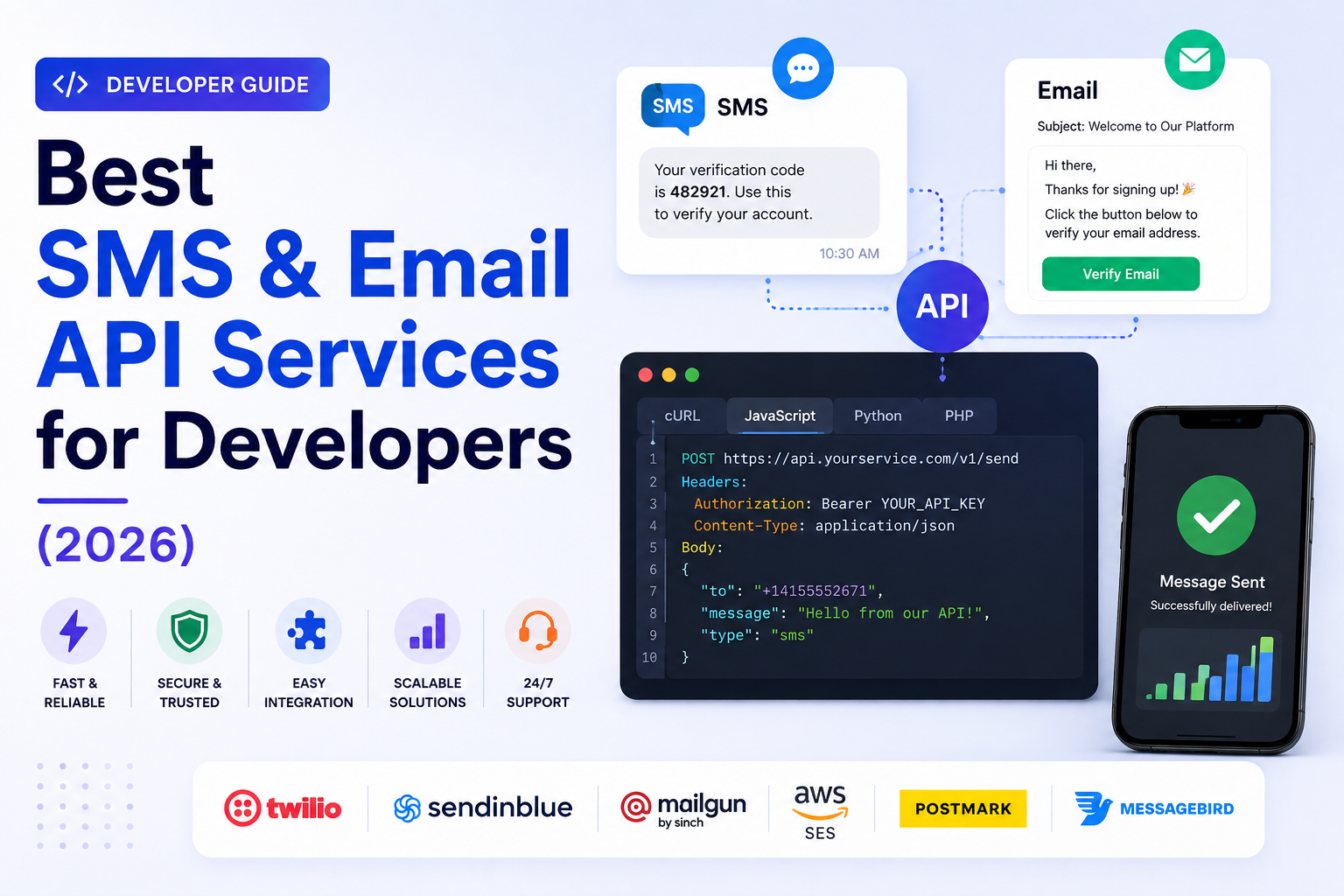
Nearly every product with user notifications, two-factor authentication, or transactional communication needs a reliable API for sending SMS and email at scale. While Twilio dominates general awareness of this space, there’s a broad and mature market of SMS and email API providers, each with different strengths around deliverability, pricing, and developer experience. This guide compares leading options across both categories and outlines how to choose based on your specific use case.
SMS API Services
What to Evaluate in an SMS API Provider
- Deliverability and carrier relationships — direct carrier connections generally produce more reliable delivery than providers routing through multiple intermediary aggregators
- Global coverage — if you’re sending internationally, coverage and per-country compliance (like 10DLC in the U.S.) varies significantly between providers
- Pricing transparency — some providers have simpler, more predictable pricing than others, which matters for cost forecasting at scale
- Developer experience — SDK quality, documentation clarity, and webhook reliability for delivery status tracking
- Compliance tooling — built-in support for opt-in/opt-out management and regulatory requirements (TCPA in the U.S., GDPR in Europe)
Leading SMS API Providers
Twilio remains the most widely recognized SMS API provider, offering broad global coverage, a mature developer ecosystem, and extensive documentation, at a price point that’s often at or slightly above competitors for comparable core functionality.
Vonage (Nexmo) offers competitive SMS API pricing with strong international coverage, frequently evaluated as a direct Twilio alternative for straightforward SMS sending use cases.
Plivo is commonly cited as a lower-cost SMS API alternative, particularly attractive for high-volume senders where per-message rate differences compound significantly at scale.
MessageBird (Bird) offers SMS alongside broader omnichannel messaging (WhatsApp, email), appealing to businesses wanting a single API for multiple messaging channels rather than integrating separate providers.
AWS SNS is a strong option for businesses already deeply invested in AWS infrastructure, offering SMS sending integrated with the broader AWS ecosystem and potentially favorable pricing through existing AWS billing relationships.
Sinch offers strong SMS API coverage with particular strength in specific international markets, commonly evaluated by businesses with significant cross-border messaging volume.
Email API Services
What to Evaluate in an Email API Provider
- Deliverability reputation — the sending infrastructure’s IP reputation directly affects whether emails land in inbox versus spam, making this the single most important factor for transactional and marketing email alike
- Template and personalization tools — dynamic content insertion and template management capability varies significantly between providers
- Analytics and event tracking — opens, clicks, bounces, and spam complaints need to be tracked reliably via webhooks for both optimization and compliance purposes
- Dedicated vs. shared IP options — high-volume senders often benefit from dedicated sending IPs to control their own sender reputation independently
Leading Email API Providers
SendGrid (Twilio) is one of the most widely used transactional and marketing email API providers, offering strong deliverability infrastructure, detailed analytics, and a mature developer API — now part of the Twilio product family.
Mailgun is popular specifically for transactional email use cases (password resets, receipts, notifications), known for strong developer documentation and flexible API design for teams building custom email workflows.
Amazon SES (Simple Email Service) offers some of the most cost-effective email sending at scale, particularly for businesses already using AWS infrastructure, though it requires more manual configuration for deliverability optimization compared to more full-featured platforms.
Postmark focuses specifically on transactional email deliverability and speed, deliberately avoiding marketing email use cases to maintain a cleaner sending reputation optimized purely for critical, time-sensitive transactional messages.
Resend is a newer entrant popular among developers building modern web applications, known for a clean, minimal API design and strong integration with modern frontend frameworks.
SparkPost offers enterprise-scale email API infrastructure with strong analytics and deliverability tools, commonly used by larger organizations sending high email volumes across both transactional and marketing use cases.
SMS vs. Email API: Choosing the Right Channel
Many products need both, but understanding the distinct use cases helps prioritize implementation:
- SMS is best for time-sensitive, high-open-rate communication — two-factor authentication codes, appointment reminders, delivery notifications — where near-immediate visibility matters more than rich formatting
- Email supports richer content, is generally lower cost per message at scale, and remains the standard channel for detailed transactional communication (receipts, account notifications) and marketing campaigns
Combining SMS and Email in a Single Provider vs. Best-of-Breed
Some providers (Twilio with SendGrid, MessageBird/Bird) offer both SMS and email under a unified API and billing relationship, simplifying vendor management at the cost of potentially not having the single best option in each specific category. Other teams choose best-of-breed providers for each channel separately — for example, Postmark for transactional email deliverability and Plivo for cost-effective SMS — accepting more integration and vendor management overhead in exchange for optimizing each channel independently.
Compliance Considerations for SMS and Email APIs
SMS Compliance
In the U.S., businesses sending application-to-person SMS via standard long code numbers are required to register under the 10DLC framework, and must maintain clear opt-in and easy opt-out mechanisms under TCPA regulations. International SMS sending carries its own country-specific compliance requirements that vary significantly.
Email Compliance
Email sending is governed by regulations like CAN-SPAM in the U.S. and GDPR in the EU, requiring clear sender identification, functional unsubscribe mechanisms, and appropriate consent management for marketing email specifically. Transactional email (receipts, password resets) generally has fewer compliance restrictions than marketing email, though clear sender identification remains important regardless of message type.
Estimating Costs at Scale
Both SMS and email API costs scale with volume, but the cost structures differ meaningfully: – SMS costs are driven primarily by message segment count and destination country, with U.S. domestic messaging generally cheaper per message than most international destinations – Email costs are typically driven by total monthly send volume, often with tiered pricing that decreases per-email cost at higher volume, and can be substantially cheaper per message than SMS at comparable scale
Frequently Asked Questions
What’s the cheapest SMS API for high-volume sending? Plivo and AWS SNS are frequently cited as lower-cost options for high-volume SMS sending, though actual cost comparisons should be based on your specific destination country mix and volume, since per-message rates vary significantly by these factors.
Is SendGrid the same company as Twilio? Yes, SendGrid was acquired by Twilio and now operates as part of the broader Twilio product family, though it continues to be marketed and used as a distinct email API product.
What’s the best email API for transactional email specifically? Postmark is specifically optimized for transactional email deliverability and speed, deliberately separating from marketing email use cases to maintain a cleaner sending reputation, making it a common choice for time-sensitive transactional messages like password resets and receipts.
Do I need 10DLC registration for all SMS sending in the U.S.? 10DLC registration is required specifically for application-to-person (A2P) SMS sent via standard 10-digit long code numbers to U.S. recipients. Toll-free numbers and short codes have different registration requirements, so the specific number type you use affects your compliance obligations.
Is Amazon SES cheaper than SendGrid or Mailgun? Amazon SES is generally among the more cost-effective options for high-volume email sending, particularly for businesses already using AWS infrastructure, though it typically requires more manual setup for deliverability optimization and reputation management compared to more full-featured platforms like SendGrid or Mailgun.
Should I use one provider for both SMS and email, or separate providers? Using a unified provider (like Twilio with SendGrid) simplifies vendor and billing management, while using separate best-of-breed providers for each channel can optimize deliverability and cost independently for each — the right choice depends on whether simplicity or per-channel optimization matters more for your specific use case and scale.