
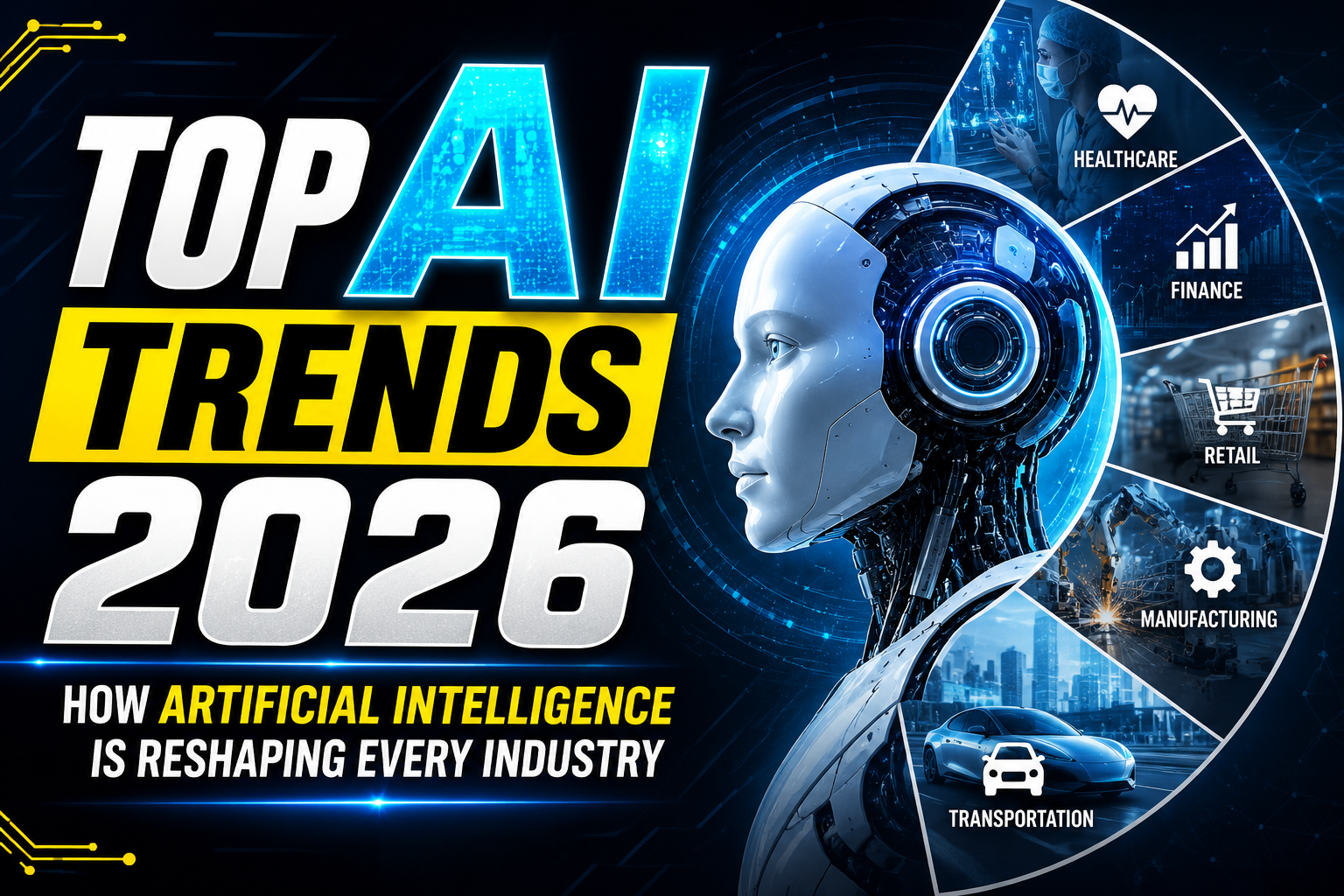
AI trends 2026 represent the most transformative shift in technology history. 15As we step into 2026, artificial intelligence is no longer just a cutting-edge technology or a buzzword — AI has transcended the realm of novelty and has become a foundational force shaping how industries operate, societies function, and daily life unfolds, from the way we work and heal to how global economies shift and media evolves.
1. Agentic AI: The Biggest Trend of 2026
19 AI agents are autonomous software entities designed to support agentic AI systems,
focusing on automation, reasoning and adaptation — agentic AI can gather data,
plan and act with high levels of autonomy, processing vast amounts of real-world data to yield faster and more accurate business decisions,
reduce manual errors and offer ongoing optimization at a scale that humans can’t surpass. 6 Gartner reckons that by the end of 2026,
40% of enterprise apps will have these task-specific AI agents, up from less than 5% in 2025.
2. Multimodal AI Going Mainstream
18 Many multimodal AI products are now moving from research and experimentation into real-world commercial applications,
making it one of the top AI trends in 2026 — experts foresee that trends in generative AI will enable a universal function, facilitating multimodal AI for commercial applications. 11 These models will be able to perceive and act in a world much more like a human — they’ll be able to bridge language, vision and action, all together.
3. AI as a Digital Coworker
12 AI agents are set to become digital coworkers, helping individuals and small teams punch above their weight — with a workplace where a three-person team can launch a global campaign in days,
with AI handling data crunching,
content generation and personalization while humans steer strategy and creativity.
4. Vertical AI Integration
18 One of the biggest AI trends for 2026 is the spread of vertical AI integration — this AI trend involves developing AI models tailored for specific sectors like healthcare, finance, retail, or manufacturing,
such as an automated receptionist for the healthcare industry or algorithmic trading in the financial sector.
5. AI Sovereignty & Governance
11 AI sovereignty — the ability to govern AI systems,
data and infrastructure without relying on external entities — has become mission-critical,
with 93% of executives surveyed indicating that factoring AI sovereignty into business strategy will be a must in 2026.
6. Sustainable & Green AI
15 2026 will mark a turning point where sustainable AI development takes center stage — researchers and companies will innovate more energy-efficient model architectures,
hardware accelerators, and training methods, with smaller, task-specific AI models running on edge devices reducing the need for constant cloud computation.
Conclusion
15 These AI trends illustrate the broad and deep ways AI will influence our world — offering unprecedented opportunities alongside complex challenges — and as designers, leaders, creators, and citizens,
it is our responsibility to engage thoughtfully with AI’s evolution, shaping it to reflect our values and aspirations.