

Marketing fundamentals are the foundation of every successful brand, campaign, and growth strategy. If you’ve ever felt overwhelmed by new tools, trends, or “must-try” tactics, you’re not alone. Many businesses chase rapid results without strengthening their marketing fundamentals, which leads to short-term wins but long-term confusion. When the basics are strong, every marketing decision becomes clearer, more effective, and more sustainable.
Marketing fundamentals act like the blueprint of a building: invisible from the outside, but absolutely essential for stability, growth, and longevity. Once you start operating from these basics, your decisions become clearer, your messaging sharper, and your results far more predictable.
Why Marketing Fundamentals Still Matter Today
In a world of changing algorithms and shortening attention spans, it’s easy to think the rules keep changing. But while consumer behavior evolves, the underlying human needs—belonging, safety, status, convenience, value—stay surprisingly constant.
That’s why brands built on strong fundamentals tend to:
Grow steadily instead of only in “lucky spikes”
Survive platform changes and new competitors
Earn trust, loyalty, and word-of-mouth over time
Think of fundamentals as your GPS. Trends are like side roads; useful at times, but useless without a clear destination.
What Are Marketing Fundamentals?
Marketing fundamentals are the core principles businesses use to understand their audience, shape their offer, and communicate value effectively. They help you build real relationships with customers instead of just collecting clicks.
At a basic level, they focus on:
Understanding what your customers truly need and value
Designing offers that clearly solve those needs
Communicating that value in a way that is simple, believable, and relevant
Every channel—social, email, SEO, events—is just a loudspeaker. Fundamentals decide what you’re actually saying through that loudspeaker.
The Core Purpose of Marketing
marketing fundamentals, at its core, is about connecting your offer with the people who are most likely to benefit from it. If nobody understands what you do or why it matters, even the best product sits on the shelf.
Done well, marketing helps you:
Explain what you offer in a way people immediately “get”
Build trust through clear, honest, consistent communication
Reduce doubt so customers can decide with confidence
You’re not just “pushing” products—you’re guiding people toward solutions that make sense for them.
Market Research: Stop Guessing, Start Knowing
Too many strategies are built on gut feeling alone. Market research turns those hunches into informed decisions. It shows you what people actually do and care about, not what you assume they care about.
Good research helps you:
Identify real demand and avoid building the wrong thing
Understand how customers talk about their problems (so you can mirror their language)
Discover gaps your competitors haven’t filled yet
Think of research as the difference between throwing darts in the dark and turning the lights on.
Primary vs Secondary Research: Two Angles You Need
You don’t need to be a big corporation to use research properly. Combining primary and secondary research gives you a powerful 360° view.
Primary research
This is data you collect first-hand:Surveys and polls
Customer interviews
Feedback forms, reviews, and support tickets
It tells you what your actual or ideal customers think, feel, and struggle with right now.
Secondary research
This is information others have gathered:Industry reports and white papers
Articles, case studies, and market analyses
Public data and statistics
It helps you see overall trends, benchmarks, and market direction.
Use primary research to go deep into your customer’s mind, and secondary research to understand the landscape you’re operating in.
Competitor Analysis: Stand Out, Don’t Blend In
Your competitors are like a live test of what the market rewards and rejects. Ignoring them means missing out on free lessons.
A solid competitor analysis lets you:
See what offers and messages are already working
Spot overused angles you should avoid copying
Identify “white space” where you can position your brand differently
You don’t want to be a slightly cheaper version of someone else. You want to become the obvious choice for a specific kind of customer.
Industry and Trend Insights: Staying Ahead of the Curve
Every industry goes through cycles—booms, plateaus, disruptions. If you understand the trends shaping your space, you can ride waves instead of getting crushed by them.
Tracking industry and consumer trends helps you:
Anticipate shifts in demand
Adjust your offers or pricing before everyone else does
Innovate in ways that feel timely, not random
The goal isn’t to chase every trend; it’s to recognize which ones are relevant to your audience and brand.
The 7Ps of Marketing: Your Strategic Toolkit
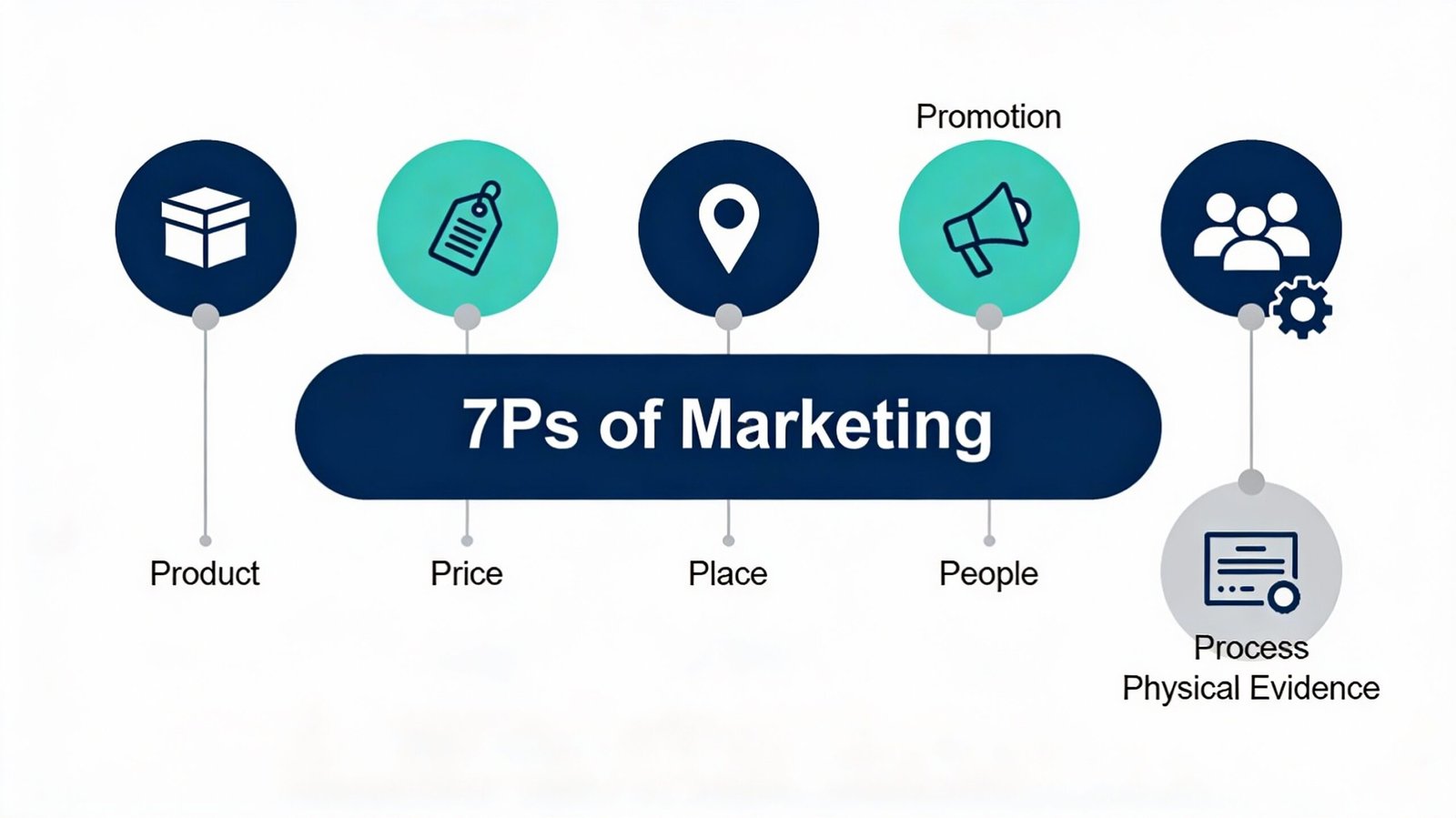
To turn insight into action, marketer often rely on the 7Ps of marketing: Product, Price, Place, Promotion, People, Process, and Physical Evidence. This framework extends the classic 4Ps and fits today’s service- and experience-driven world.
Each “P” is a lever you can adjust to strengthen your strategy.
1. Product – Your Promise in Action
Your product is more than a physical item or service package; it’s the promise you’re making to your customer. It should solve a real problem or deliver a benefit people care about.
When thinking about your product, consider:
Features and performance
Design, usability, and packaging
Customer support and after-sales experience
Every interaction shapes how customers feel about your brand. If the product disappoints, no amount of clever marketing can fix that for long.
2. Price – The Silent Message You Send
Price doesn’t just affect revenue—it communicates where you sit in the market. A high price might signal premium quality. A low price might shout affordability—but can also raise doubts about quality.
Good pricing should:
Keep your business profitable
Reflect your positioning (luxury, value, mid-range, disruptive, etc.)
Consider perceived value, not just costs
Discounts, bundles, and offers are tools. They work best when they support your strategy. Not when they’re used as a panic button.
3. Place – Where Customers Actually Find You
“Place” is where and how customers access your product. That might be:
A retail store, kiosk, or showroom
An e-commerce website or marketplace
Social media shops or messaging apps
Effective placement ensures:
Your product is present where your audience already shops
Availability matches demand (no constant stockouts)
The buying journey feels simple and convenient
If customers struggle to find or buy from you, they will quickly move to someone else.
4. Promotion – How You Tell Your Story
marketing fundamentals, Promotion is how you spread the word and persuade people to care. It includes:
Advertising (online and offline)
Social media posts and campaigns
Public relations and influencer collaborations
Events, webinars, and email campaigns
Your promotional efforts should aim to:
Capture attention in crowded spaces
Communicate your benefits clearly and quickly
Nudge people toward a clear next step (subscribe, sign up, buy)
Random, disconnected campaigns waste budget. Consistent, aligned promotion builds momentum.
5. People – The Human Face of Your Brand
marketing fundamentals, Brands are built by people, experienced by people, and remembered because of people. Employees, sales reps, customer support, and even community managers all shape your reputation.
Strong “People” fundamentals mean:
Hiring for attitude and alignment with your values
Training teams to communicate consistently and solve problems
Empowering frontline staff to go beyond scripts when needed
A single great interaction can turn a casual buyer into a loyal fan. A single bad one can undo months of marketing work.
6. Process – The Journey Behind the Scenes
Process is how you deliver your promise from start to finish. It covers everything from order placement and payment to delivery, onboarding, and aftercare.
Well-designed processes:
Reduce errors, delays, and confusion
Ensure each customer has a predictable, positive experience
Make it easier to scale without everything breaking
Mapping your customer journey and tightening each step often yields some of the fastest, cheapest wins in your marketing.
7. Physical Evidence – Proof You’re Credible
Physical evidence includes all the tangible and visual cues that make your brand feel real and trustworthy. Examples include:
Packaging and printed materials
Store layout, signage, and uniforms
Website design, case studies, reviews, and testimonials
These cues help customers feel safe choosing you—especially if they’re buying from you for the first time. It’s the difference between a website that looks sketchy and one that feels professional and reassuring.
Traditional (Manual) vs Digital Marketing: Not Either/Or
Marketing fundamentals can show up in both manual (traditional) and digital channels. The core purpose is the same—reach the right people with the right message—but the tools differ.
Manual / traditional marketing includes:
Print ads, flyers, posters, billboards
Cold calling and in-person selling
Events, trade shows, and local sponsorships
Its strengths are physical presence, human connection, and lasting impressions (like a brochure someone keeps). Its downsides are higher costs, limited tracking, and slower feedback.
Digital marketing includes:
Websites and blogs
Social media platforms
Email campaigns
Search and display ads
Its strengths include precise targeting, real-time analytics, and the ability to tweak campaigns quickly. In practice, many brands get the best results by blending both, based on their audience and objectives.
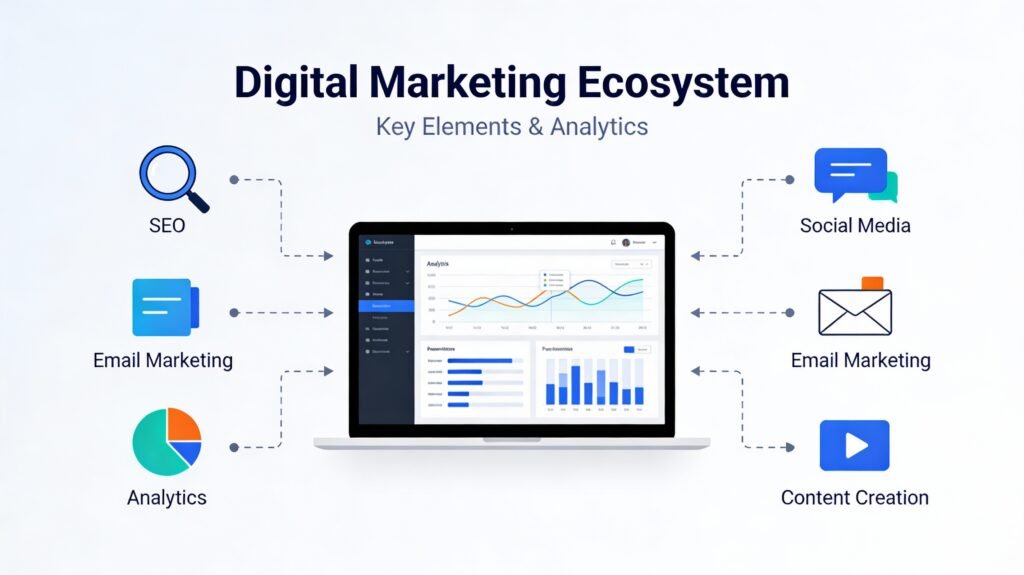
Digital marketing is broad, but several pillars show up in almost every strong strategy:
Search Engine Optimization (SEO)
SEO is about making it easy for search engines to understand, index, and rank your site.
Drives consistent, “free” organic traffic over time
Builds authority and trust through valuable content
Requires ongoing attention to technical health, content, and links
Content Marketing
Content marketing uses articles, videos, podcasts, infographics, and more to attract and engage your audience.
Educates and builds trust
Supports SEO and social media
Positions you as a helpful expert, not just a seller
Social Media Marketing
Social platforms let you share updates, build community, and have conversations with your audience.
Boosts visibility and brand personality
Enables direct feedback and interaction
Combines organic reach with paid targeting options
Email Marketing
Email is still one of the highest-ROI channels when done right.
Offers direct communication without platform algorithms
Supports nurturing, upselling, and retention
Allows deep personalization and segmentation
Pay Per Click (PPC) Advertising
PPC gives you immediate visibility by placing ads on search engines and other platforms.
Great for testing offers or capturing high-intent searchers
Highly measurable and adjustable
Requires careful keyword, audience, and budget management
Affiliate & Influencer Marketing
Here, you partner with affiliates or creators who promote your products to their audiences.
- Extends your reach into new communities
- Leverages third-party trust and authority
- Often performance-based (you pay per result)
Mobile Marketing
With so much attention on smartphones, mobile experiences are non-negotiable.
Includes SMS, apps, push notifications, and mobile-friendly sites
Supports location-based and on-the-go engagement
Demands fast, simple, and responsive design
Together, these elements create a multi-channel engine that can meet your audience wherever they are.
Essential Marketing Books to Sharpen Your Thinking
Some books are repeatedly recommended because they capture timeless ideas in a practical way:
Influence: The Psychology of Persuasion – Robert Cialdini
Explores why people say “yes,” unpacking principles like reciprocity, social proof, scarcity, and authority.Contagious: How to Build Word of Mouth in the Digital Age – Jonah Berger
Breaks down what makes ideas and products go viral, with actionable frameworks for “shareable” content.This Is Marketing – Seth Godin
Emphasizes empathy, storytelling, and serving a specific audience rather than trying to shout at everyone.
Digital Marketing Strategy & Planning: Simple But Serious
A winning marketing fundamentals, digital strategy is not a random mix of channels; it’s a clear plan tied to specific goals. You can think of it as answering five questions: What, who, where, how, and how will we know?
Key elements include:
Setting SMART goals – Clear, measurable, and time-bound, like “Increase qualified leads by 25% in 12 months.”
Defining target audience & buyer personas – Mapping demographics, behavior, motivations, and objections.
Budget allocation – Deciding how much to invest in content, ads, tools, creative, and analytics.
Multi-channel integration – Ensuring your message is consistent across SEO, PPC, email, and social, rather than siloed.
Measurement and optimization – Using KPIs and analytics to see what’s working and adjust in real time.
When each part supports the others, your strategy becomes more than the sum of its tactics.
Key Trends in Digital Marketing You Should Know
Certain shifts are reshaping how brands compete online:
AI & automation: From content drafts and image generation to chatbots and predictive analytics, AI is speeding up workflows and enabling smarter personalization.
Personalization: Users expect experiences tailored to them—like personalized emails, recommended products, and dynamic website content.
Video & short-form content: Short videos dominate social feeds and can quickly communicate emotion, story, and value.
Voice search & conversational experiences: As more people use voice assistants and chat interfaces, optimizing for natural language becomes more important.
Again, these trends work best when anchored in solid fundamentals: real understanding of your audience and clear positioning.
Creating Your Marketing Strategy: Step by Step
Building a strategy doesn’t have to be complicated. It does, however, need to be intentional. You can break it down like this:
Define clear, realistic goals
Understand your audience through research and personas
Analyze competitors and market trends
Clarify your value proposition and key messages
Choose your main channels and tactics
Plan execution with timelines and responsibilities
Track, review, and continually optimize your efforts
This structured approach turns your marketing from a series of one-off experiments into a sustainable growth system.
Common Mistakes That Quietly Kill Strategy
Even with good intentions, a few recurring mistakes derail many brands:
Skipping market research – Acting on assumptions instead of evidence leads to misaligned offers and wasted ad spend.
Ignoring customer feedback – Reviews, complaints, and questions are free insight; ignoring them locks you into repeating the same errors.
Focusing only on short-term wins – Constantly chasing quick revenue bursts can damage brand trust and confuse your positioning.
Avoiding these pitfalls is less about genius and more about discipline and humility.
Turning Fundamentals into Long-Term Growth
When you stay grounded in marketing fundamentals, everything else gets easier. Your message gets clearer, your campaigns become more effective, and your brand feels more consistent no matter where people find you.
These basics—research, the 7Ps, smart channel choices, and structured planning—work like gears in a machine. Each gear supports the others, and together they turn effort into sustainable progress. With a clear structure and steady action, you’re not just chasing growth—you’re building it, layer by layer.
Conclusion
In the end, “Marketing Fundamentals 101” isn’t about outdated theory—it’s about the backbone of every winning strategy. When you deeply understand your audience. Design offers that truly serve them, and communicate with clarity across the right channels. You create a brand that doesn’t just survive the next trend cycle—it thrives beyond it.
If you commit to these basics and keep refining them. You won’t have to rely on luck or quick hacks. Your marketing will have direction, your brand will have depth, and your growth will have a solid foundation.