
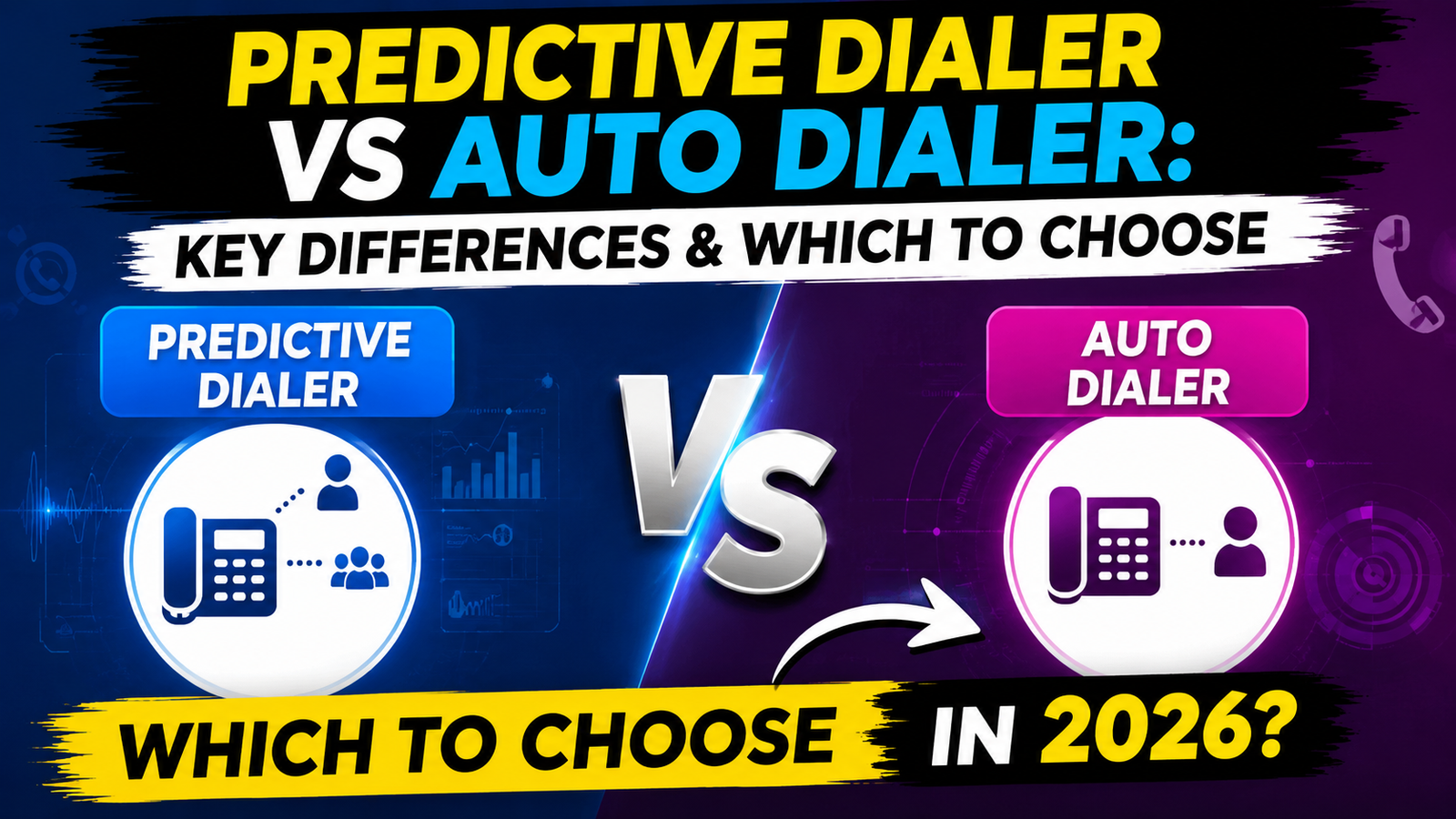
Outbound calling teams frequently encounter the terms ‘predictive dialer’ and ‘auto dialer’ as if they are interchangeable — but they describe distinct technologies with different operational models, productivity profiles, and regulatory compliance implications. Choosing the wrong type of automated dialler can either leave agent productivity unrealised or expose your organisation to significant legal liability from non-compliant automated calling. Understanding exactly how each technology works, and matching that to your specific operational context, is essential for making the right investment.
This comprehensive guide explains the technical differences between predictive dialers and auto dialers, compares their productivity and compliance profiles, reviews the leading platforms in each category, and provides a clear decision framework for choosing the right solution for your outbound calling operation.
What Is an Auto Dialer?
An auto dialer is a broad category of technology that automates outbound telephone dialling from a list of numbers, eliminating the manual dialling process. The term ‘auto dialer’ encompasses several specific dialler modes that operate quite differently from each other. Preview dialers show the agent the next contact’s information before dialling, allowing the agent to review context and decide whether to call. Progressive/power dialers automatically dial the next number as soon as the agent becomes available, maintaining a strict one-to-one agent-to-call ratio that eliminates abandoned calls. Predictive dialers dial multiple numbers simultaneously ahead of agent availability, using algorithms to predict when agents will become free.
In common usage, ‘auto dialer’ often refers specifically to progressive/power dialling or even to fully automated robocall systems (where a recorded message plays to answered calls without a live agent). The TCPA (Telephone Consumer Protection Act) defines an ‘automatic telephone dialling system’ (ATDS) broadly, with interpretations that affect compliance requirements across all dialler categories. Understanding both the technical and legal definitions is important when evaluating auto dialler compliance.
Regulatory Context
The regulatory treatment of auto dialers varies significantly by country and has evolved substantially in recent years. In the US, the TCPA regulates automated calling, requiring prior express consent for calls to mobile numbers using an ATDS. The FTC’s Telemarketing Sales Rule imposes abandonment rate limits (3% maximum over 30 days) for predictive dialers in telemarketing contexts. The FCC’s 2024 one-to-one consent rule further tightened consent requirements. In the EU, GDPR and ePrivacy Directive regulations govern automated marketing communications. Always seek legal counsel before deploying auto dialler technology at scale in regulated markets.
Predictive Dialer vs Auto Dialer: Technical Comparison
The core technical difference is the dialling ratio and timing mechanism. A predictive dialer uses historical data analysis to predict agent availability and dials multiple numbers simultaneously — typically 2-5 calls per available agent — anticipating that some calls will not be answered. When the number of answered calls exceeds available agents, calls are either abandoned or held briefly. The predictive algorithm continuously adjusts the dial ratio to maintain a target answer-to-agent ratio that maximises talk time while managing abandonment rates.
An auto dialer (in the progressive/power mode) dials exactly one number per available agent, advancing to the next number only when the previous call ends or confirms unanswered. This one-to-one ratio eliminates the possibility of abandoned calls — every answered call has an immediately available agent. The trade-off is slightly lower agent utilisation (brief gaps between calls as the system detects unanswered calls and advances to the next) compared to predictive dialling. In most B2B sales contexts, this difference is 5-15 minutes of talk time per agent per eight-hour shift.
Productivity and Compliance Comparison
Five dimensions define the predictive vs auto dialer choice. Talk time: Predictive delivers 45-55 minutes/hour vs auto dialer’s 40-50 minutes/hour. A meaningful advantage at scale. Abandoned call risk: Predictive has inherent abandoned call risk requiring compliance management; auto dialer has zero abandoned call risk. Call quality: Auto dialer wins — no ‘pause’ when answered, agent immediately available. Compliance complexity: Auto dialer is inherently compliant with abandonment rate regulations; predictive requires active abandonment rate monitoring and management. Best use case: Predictive for high-volume B2C with compliance management; auto dialer for B2B, regulated industries, and quality-sensitive calling.
The financial case for predictive over auto dialling is strongest in large B2C operations. For a 100-agent call centre at $25/hour fully loaded agent cost, a 12-minute/day average talk time advantage from predictive dialling represents approximately $250,000/year in productivity value at 250 working days — significant but requiring weighed against the compliance management cost and legal risk. For smaller operations or B2B sales teams where call quality affects conversion rates, the auto dialler’s compliance simplicity and superior first-impression often delivers better total ROI.
Leading Auto Dialler and Predictive Dialler Platforms
Enterprise predictive dialers: Five9 (market-leading CCaaS with advanced compliance management, AI-powered predictive), NICE CXone (comprehensive CCaaS with predictive and blended outbound), Genesys Cloud (full CCaaS with sophisticated outbound campaign management). Sales-focused auto dialers: Outreach (sales engagement with power dialling), Salesloft (B2B sales platform with auto dialler), HubSpot Sales Hub (CRM-native power dialler), PhoneBurner (specialist auto dialler with CRM integrations), Kixie (auto dialler with local presence and voicemail drop).
Mid-market solutions: JustCall (cloud phone system with auto and predictive dialling at $49-149/user/month), CloudTalk (omnichannel platform with power dialling), RingCentral Engage Voice (auto and predictive for mid-market contact centres). Platform selection should start with use case (B2B sales vs B2C contact centre), then compliance environment (regulated industry or not), then CRM ecosystem (choose the dialler that integrates most natively with your CRM), and finally pricing model (per-user vs per-minute vs per-seat billing).
Frequently Asked Questions
What is the difference between a predictive dialer and an auto dialer?
An auto dialer is the broad category of technology that automates outbound dialling, encompassing preview, progressive/power, and predictive modes. A predictive dialer is a specific type that dials multiple numbers simultaneously ahead of agent availability, maximising talk time at the cost of some abandoned call risk. In common usage, ‘auto dialer’ often refers to progressive/power dialling (one call per agent, no abandoned calls) as distinct from predictive dialling (multiple calls per agent).
Are predictive dialers legal?
Predictive dialers are legal when operated in compliance with applicable regulations. US requirements include FTC’s 3% abandonment rate limit, TCPA consent requirements for calls to mobile numbers, and proper handling of abandoned calls with compliant recorded messages. Penalties for non-compliance are significant — $500-$1,500 per TCPA violation. Legal operation requires a compliance management programme, legal counsel review, and robust abandonment rate monitoring. Consult an attorney before deploying predictive dialling at scale.
Which is better for a B2B sales team?
For B2B sales teams, an auto dialer (power/progressive mode) is typically the better choice. B2B calls require strong first impressions — the ‘robocall pause’ of predictive dialling negatively impacts initial rapport in consultative sales contexts. Auto dialers in modern sales engagement platforms (Outreach, Salesloft) provide deep CRM context before each call, improving conversion rates. The modest talk time advantage of predictive dialling rarely justifies the compliance overhead and call quality cost in B2B environments.
What is a good abandonment rate for a predictive dialer?
The FTC requires that predictive dialer abandonment rates do not exceed 3% of answered calls over any 30-day period in telemarketing contexts. Industry best practice targets 1-2% abandonment, providing a compliance buffer while still achieving the talk time benefits of predictive dialling. Abandonment rates above 3% require immediate algorithm adjustment and may require regulatory disclosure. Monitor abandonment rates in real time through your dialler platform’s reporting dashboard.
Conclusion
Understanding the distinction between predictive dialers and auto dialers is essential for building a legally compliant, operationally efficient outbound calling operation. Match your dialler type to your specific use case, compliance environment, and call quality requirements — and ensure proper legal counsel review before deploying automated dialling technology at scale.
Related Articles
Ready to grow your business with the right technology? Explore VBWebSol’s Web Development Services or contact our expert team for a free consultation. With over 12 years of IT expertise in Ahmedabad, we help businesses across India and globally implement solutions that deliver real, measurable results.