CRM sales force automation (SFA) is the combination of customer relationship management and sales process automation that enables sales teams to manage more opportunities, close more deals, and spend more time selling rather than on administrative tasks. When implemented effectively, CRM sales force automation transforms sales operations from a relationship-dependent, manually managed process into a systematic, data-driven revenue engine that scales predictably with headcount additions and market expansion.
This comprehensive guide covers what sales force automation within CRM means in practice, the specific capabilities that deliver the most value, how leading platforms compare, and how to implement SFA in a way that drives genuine adoption and measurable revenue improvement.
What Is CRM Sales Force Automation?
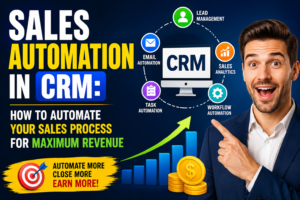
Sales force automation refers to the use of software to automate repetitive, manual tasks in the sales process — freeing sales representatives to focus on high-value activities: building relationships,
understanding customer needs, and closing deals. Within a CRM platform, SFA encompasses: automatic logging of calls, emails, and meetings to contact records; lead assignment and routing rules that distribute new leads to the right representative automatically; pipeline stage advancement triggers that update deal status based on defined criteria; follow-up task creation based on deal stage or time elapsed since last activity; and quote generation that pulls pricing and product data from the CRM database.
The impact of sales force automation on team productivity is well-documented. Research consistently shows that sales representatives spend only 28-35% of their time actively selling — the majority of their time goes to CRM data entry, email management, research, and administrative tasks. SFA targets this wasted time: automating data capture, removing manual task creation,
and streamlining the administrative overhead of managing a large pipeline. The result is more selling time per representative and more consistent process adherence across the team.
Lead Management Automation
Lead management automation is the highest-value SFA capability for most organisations. When new leads arrive (from web forms, marketing campaigns, trade shows, or inbound calls),
SFA automatically creates CRM records, enriches them with firmographic data, assigns them to the appropriate representative based on routing rules (territory, product line, lead source, company size), creates an immediate follow-up task,
and sends an acknowledgment email to the prospect — all without any manual intervention. This automated response speed (studies show that responding within 5 minutes of lead submission increases conversion rates by 9x) is impossible to achieve manually at scale.
Key Sales Force Automation Features
Effective CRM sales force automation includes eight core capabilities. Email automation: Personalised email sequences that send automatically based on deal stage, time elapsed, or prospect behaviour. Activity auto-logging: Automatic capture of emails, calls, and calendar meetings to CRM records — eliminating manual data entry for the most time-consuming CRM task. Lead scoring: Automatic ranking of leads by conversion probability based on demographic fit and engagement behaviour, enabling representatives to prioritise the highest-value opportunities. Pipeline stage automation: Rules that advance, regress,
or flag deals based on defined criteria — ensuring the pipeline accurately reflects deal status.
Task and reminder automation: Automatic creation of follow-up tasks based on deal activity patterns — flagging deals that have been inactive for too long, creating call tasks after email opens, generating proposal preparation tasks when a deal advances to the proposal stage. Quote and proposal generation: Pulling deal, product, and pricing data from the CRM to generate professional quotes and proposals in minutes rather than hours. Notification and alert automation: Real-time alerts to managers when deals stall,
when high-value prospects visit the website, or when competitors are mentioned in email communications. Reporting automation: Scheduled delivery of pipeline reports, conversion funnel analytics, and activity metrics dashboards to sales leaders without manual report generation.
Top CRM Sales Force Automation Platforms
Salesforce Sales Cloud: The most comprehensive SFA platform, with Einstein AI-powered lead scoring, advanced workflow automation (Flow builder),
and the deepest ecosystem of SFA add-ons through AppExchange. Pricing from $80/user/month (Professional). HubSpot Sales Hub: Excellent SFA capabilities including email sequences, meeting scheduling automation, deal stage automation, and predictive lead scoring. Free starting tier with paid Professional from $90/user/month. Best for: SMBs wanting strong SFA without Salesforce complexity. Pipedrive: Sales-focused CRM with AI-powered sales assistant, automated workflow builder,
and excellent pipeline automation at $21.90-$59.90/user/month.
Zoho CRM: Comprehensive SFA including AI assistant (Zia), workflow automation, web-to-lead automation, and blueprint process automation at $14-52/user/month. Strong value for feature-rich SFA at competitive pricing. Microsoft Dynamics 365 Sales: Enterprise SFA with AI insights, relationship analytics, and deep Microsoft 365 integration from $65/user/month. Best for: Microsoft-invested enterprises. Outreach and Salesloft: Sales engagement platforms that extend CRM SFA with AI-powered sequence automation, conversation intelligence,
and revenue operations analytics — typically used alongside a core CRM for outbound-heavy sales teams.
Measuring Sales Force Automation ROI
Measuring SFA ROI requires establishing pre-implementation baselines and tracking improvement across four metric categories. Productivity metrics: Average selling time per representative per week (target: 40-50% of total work time),
number of opportunities managed per representative, and average activities per deal. Pipeline metrics: Deal velocity (average time from creation to close), pipeline conversion rate at each stage, pipeline accuracy (actual close rate vs forecast), and pipeline coverage ratio.
Revenue metrics: Revenue per representative, average deal size, win rate by lead source and segment, and time to first purchase for new customers. Data quality metrics: CRM completion rate (percentage of required fields populated), activity logging rate (percentage of calls and emails captured in CRM), and pipeline update frequency. Track these metrics monthly for the first six months post-implementation, comparing against pre-implementation baselines. Organisations with high SFA adoption consistently report 15-30% improvements in representative productivity and 10-20% improvements in win rates within 12 months.
Frequently Asked Questions
What is sales force automation in CRM?
Sales force automation (SFA) in CRM is the use of rules, workflows, and AI to automatically handle repetitive sales tasks — logging activities, routing leads, advancing pipeline stages,
creating follow-up tasks, sending email sequences, and generating reports — without manual intervention. SFA frees sales representatives to spend more time on high-value relationship activities while ensuring consistent process adherence across the entire sales team.
What is the difference between CRM and sales force automation?
CRM (Customer Relationship Management) is the broader category of software for managing customer relationships — including sales, marketing, and service. Sales Force Automation is a specific functional area within CRM focused on automating the sales process. Most modern CRM platforms include SFA capabilities,
and the terms are often used interchangeably in a sales context,
but technically SFA is a subset of CRM functionality.
How long does SFA implementation take?
Basic SFA implementation — setting up lead routing, email templates, and standard workflow automations — takes 2-4 weeks. Comprehensive SFA with custom workflows, lead scoring models, territory management, and advanced reporting typically takes 8-16 weeks. Successful implementation requires active involvement from sales leadership to define workflows and change management to drive adoption among the sales team.
What are the most important SFA features for B2B sales?
For B2B sales teams, the highest-value SFA features are: automated email sequences for prospect nurturing,
activity auto-logging to eliminate manual data entry, lead scoring to prioritise high-potential opportunities,
deal stage automation with stale deal alerts, and automated reporting for pipeline reviews. These five capabilities address the highest-impact manual tasks in most B2B sales processes and deliver the fastest,
most measurable productivity improvement.
Conclusion
CRM sales force automation is one of the highest-ROI investments available to sales organisations — transforming time spent on administrative tasks into time spent building relationships and closing deals. By choosing a platform with the right SFA capabilities for your sales process,
configuring automations that reflect your actual workflow,
and driving genuine adoption through training and accountability,
you build a sales engine that scales predictably and delivers consistent revenue growth.
Related Articles
Ready to grow your business with the right technology? Explore VBWebSol’s Custom CRM Software Solutions or contact our expert team for a free consultation. With over 12 years of IT expertise in Ahmedabad,
we help businesses across India and globally implement solutions that deliver real, measurable results.