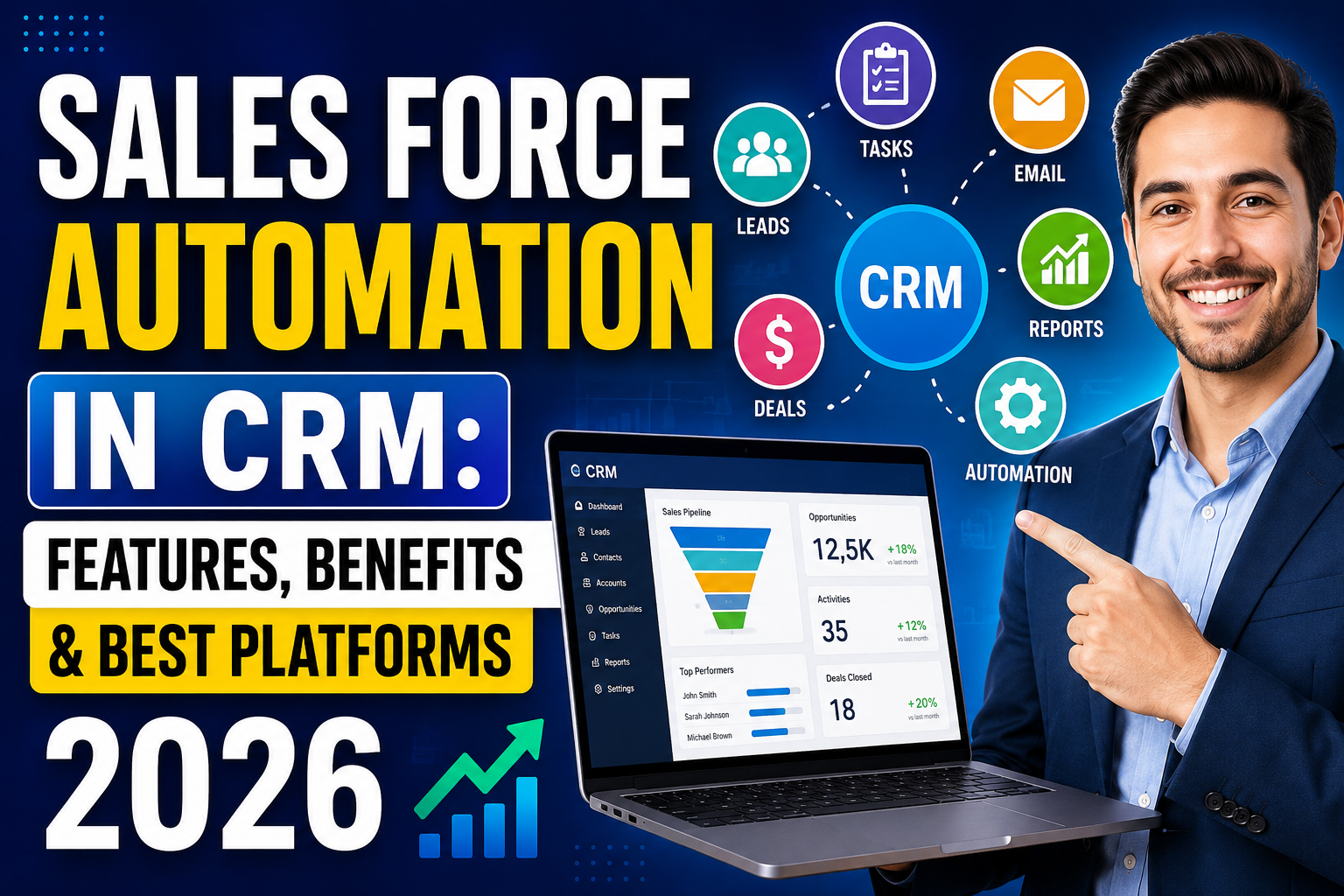
Sales force automation in CRM represents the convergence of customer relationship management and intelligent process automation — creating a sales technology foundation that amplifies team productivity, enforces process consistency, and generates the data insights that enable continuous sales performance improvement. For sales leaders seeking to build high-performing, scalable sales organisations, understanding and effectively deploying sales force automation capabilities is not optional — it is the operational standard that separates consistently high-performing sales teams from those relying primarily on individual heroics.
This guide provides a comprehensive examination of sales force automation within CRM — the specific features that deliver the most measurable value, the top platforms available in 2026,
and a practical implementation framework for achieving high adoption and strong ROI.
Core Features of Sales Force Automation in CRM
Sales force automation in CRM encompasses seven core feature categories. Lead and opportunity management: Automated lead capture from all sources (web forms, chat, social, phone), intelligent lead routing to appropriate representatives, opportunity tracking with automated stage advancement,
and probability-weighted pipeline forecasting. Activity management: Automatic logging of calls, emails,
and meetings to relevant CRM records; automated task creation based on deal stage or time triggers; and activity analytics dashboards providing visibility into team behaviour.
Email and communication automation: Personalised outreach sequences that send automatically based on prospect behaviour, email open and click tracking, template libraries with performance analytics, and AI-generated email suggestions based on successful historical patterns. Quote and proposal automation: Product and pricing data integration enabling one-click quote generation, e-signature workflows, and automatic deal update when proposals are viewed or signed. Sales analytics and forecasting: AI-powered pipeline predictions, historical win/loss analysis, individual performance benchmarking, and automated report distribution to sales leadership.
AI in Sales Force Automation
AI is transforming SFA capabilities in 2026. Conversational intelligence tools (Gong, Chorus, now integrated into Salesforce Einstein and HubSpot) transcribe and analyse sales calls, identifying talk patterns correlated with wins and losses, competitor mentions, and customer sentiment. AI lead scoring models predict conversion probability more accurately than rule-based scores,
enabling better prioritisation. AI-generated next best action recommendations guide representatives on the optimal follow-up for each deal at each stage — creating a virtual sales coach available to every representative at every moment.
Measurable Benefits of SFA in CRM
The benefits of sales force automation in CRM are well-documented and measurable. Productivity: 28-35% of sales representative time is typically spent on administrative tasks; SFA reduces this to 15-20%, effectively adding the equivalent of 1-2 days of selling time per representative per week. For a 20-person sales team,
this represents the equivalent of 4-8 additional sales representatives’ worth of capacity without additional headcount cost. Consistency: SFA enforces process adherence automatically — every lead receives the same immediate response regardless of which representative handles it; every deal at a critical stage triggers the same follow-up workflow.
Pipeline visibility: Real-time, accurate pipeline data enables sales leaders to forecast with confidence, identify at-risk deals early, and allocate coaching resources to the opportunities and representatives that most need attention. Ramp time reduction: New representatives following SFA-defined processes and receiving AI coaching reach full productivity 20-40% faster than those learning purely from experience. Data quality: Automated activity logging produces consistently complete CRM records,
enabling the analytics and AI insights that manual entry cannot support reliably.
Implementing SFA: A Practical Roadmap
Successful SFA implementation follows a five-phase roadmap. Phase 1 – Foundation (Weeks 1-4): Configure activity auto-logging (email and calendar sync), set up basic lead routing rules, and create standard email templates. These capabilities deliver immediate productivity value with minimal configuration complexity. Phase 2 – Automation (Weeks 4-8): Build lead management workflows,
configure pipeline stage automation, and implement deal stall alerts. Define and configure your primary email sequences for new leads and active opportunities.
Phase’s 3 – Intelligence (Weeks 8-12): Implement lead scoring, configure AI-powered pipeline forecasting, and deploy conversation intelligence if using tools like Gong or Chorus. Phase’s 4 – Optimisation (Months 3-6): Analyse automation performance data,
A/B test email sequences, refine lead scoring models based on actual conversion data, and expand automation coverage to edge cases and new product lines. Phases 5 – Advanced capabilities (Months 6+): Explore predictive deal health scoring, AI-powered coaching,
and custom automation integrations with adjacent systems (marketing automation, customer success, ERP). Each phase should be fully adopted before progressing to the next — partial implementation of many features delivers less value than comprehensive adoption of fewer features.
Frequently Asked Questions
What features should I look for in CRM sales force automation?
Prioritise: automatic email and call logging (eliminates the single most time-consuming manual CRM task), email sequence automation (ensures consistent prospect follow-up), lead routing and assignment rules (ensures immediate lead response), pipeline stage automation with stall alerts (maintains pipeline accuracy),
and AI-powered lead scoring (prioritises highest-probability opportunities). These five features address the highest-impact manual tasks in most sales processes.
What is the ROI of sales force automation?
Sales force automation delivers ROI through productivity improvement (5-10 hours saved per representative per week), improved win rates (10-20% improvement from consistent follow-up and better prioritisation), faster ramp time for new hires (20-40% faster to full productivity),
and improved pipeline accuracy (enabling better resource allocation). Most organisations see positive ROI within 3-6 months of SFA deployment,
with full ROI realisation at 12 months.
How do I get my sales team to adopt CRM automation?
SFA adoption requires demonstrating personal value to each representative — showing them specifically how automation saves their time and improves their results,
not just how it improves management reporting. Configure automation to make the representative’s job easier (removing manual tasks) rather than creating new administrative requirements. Train on role-specific workflows,
not generic system features. Set clear adoption expectations from sales leadership and measure adoption metrics publicly.
Can SFA work for small sales teams?
Yes — SFA is valuable for sales teams of any size. Even a 3-5 person team benefits from automated lead follow-up, email sequences, and activity logging. HubSpot’s free CRM provides meaningful SFA capabilities at no cost for small teams. Pipedrive and Close CRM offer strong SFA at pricing accessible to small teams. The automation infrastructure built during early growth stages becomes increasingly valuable as the team scales.
Conclusion
Sales force automation in CRM is the operational foundation of high-performing sales organisations. By automating the right tasks,
building workflows that reflect your actual sales process, implementing AI capabilities at the appropriate maturity stage,
and driving adoption through demonstrated personal value to representatives,
you build a sales engine that scales efficiently, performs consistently,
and continuously improves through the data and insights automation generates.
Related Articles
Ready to grow your business with the right technology? Explore VBWebSol’s Custom CRM Software Solutions or contact our expert team for a free consultation. With over 12 years of IT expertise in Ahmedabad,
we help businesses across India and globally implement solutions that deliver real, measurable results.