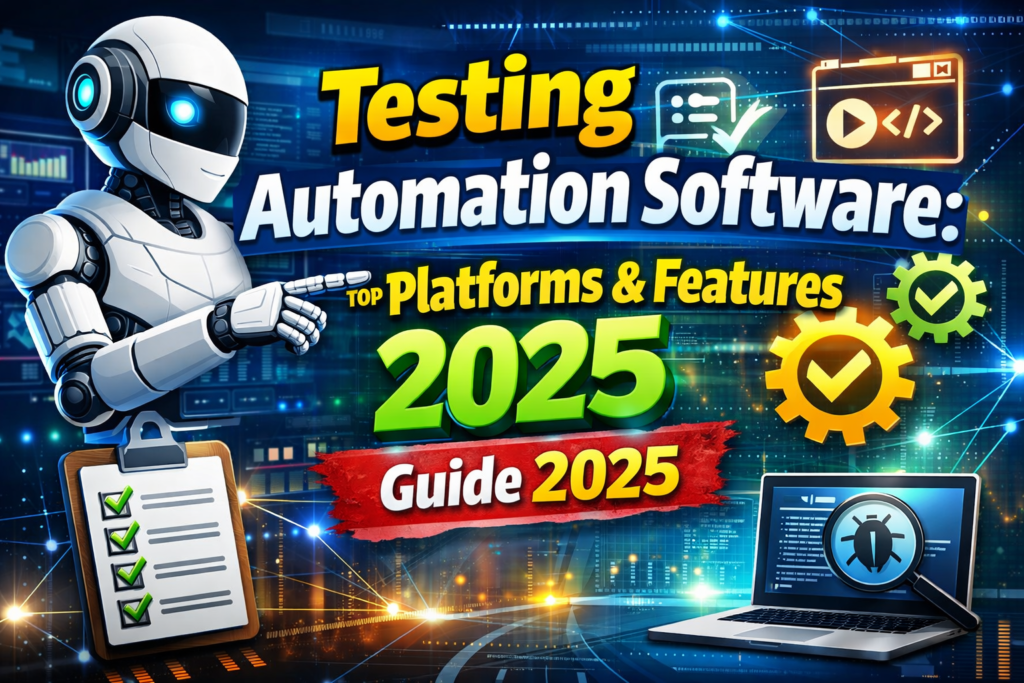
Testing Automation Software: Top Platforms & Features Guide 2025
Testing automation software enables development teams to replace slow, expensive manual regression testing with fast, repeatable automated test suites. In 2025, the market offers platforms for every team size, technical capability level, and technology stack — from open-source frameworks requiring deep coding expertise to AI-powered no-code tools that generate tests automatically from application behaviour. Choosing the right testing automation software is a strategic decision with significant implications for software quality, development velocity, and engineering costs.
This guide provides a structured comparison of the leading testing automation software platforms available in 2025, covering their strengths, ideal use cases, integration capabilities, and pricing — helping you identify the best fit for your specific team and technology context.
Categories of Testing Automation Software
Testing automation software covers several distinct testing domains. Functional UI testing tools automate user interface interactions across web and desktop applications — Selenium, Playwright, Cypress, and TestComplete are the leading options. Mobile testing tools automate native and hybrid app testing on iOS and Android — Appium, Detox, and XCUITest are widely used. API testing tools automate REST, SOAP, and GraphQL API validation — Postman, REST Assured, and Karate are popular choices. Performance testing tools simulate load and measure system behaviour under stress — Apache JMeter, k6, and Gatling lead this category.
Comprehensive testing automation programmes typically use tools from multiple categories, integrated through a CI/CD pipeline that runs the complete test suite automatically on every code change. The choice of specific tools within each category depends on your technology stack, team expertise, and the specific quality risks you are most concerned about. A thoughtful tool selection aligned with these factors delivers dramatically better results than adopting whichever tools are most fashionable.
Unit Testing Frameworks
Unit testing frameworks — Jest for JavaScript, pytest for Python, JUnit/TestNG for Java, NUnit/xUnit for .NET — test individual functions and components in isolation. While often considered separately from testing automation software (which typically refers to UI and integration testing tools), unit test automation is the foundation of every effective quality programme. High unit test coverage catches the majority of defects at the lowest possible cost, reducing the load on slower, more expensive UI and integration tests.
Visual Regression Testing
Visual regression testing tools detect unintended visual changes between application versions by comparing screenshots pixel-by-pixel. Applitools Eyes and Percy (from BrowserStack) are the leading visual testing platforms, using AI to distinguish meaningful visual regressions from acceptable rendering variations. Visual testing is particularly valuable for design-system driven applications, where CSS changes can cause unintended visual effects across many pages simultaneously.
Leading Testing Automation Software Reviewed
Playwright (Microsoft): The strongest all-round web testing automation framework for new projects in 2025. Supports Chromium, Firefox, and WebKit from a single JavaScript/TypeScript API. Features: auto-waiting, parallel execution, built-in test runner, network interception, trace viewer, and screenshot/video capture. Free and open source. Community: large and growing rapidly. Best for: modern JavaScript/TypeScript web applications. Cypress: Developer-favourite for React, Vue, and Angular applications. Real-time test runner with time-travel debugging, automatic waiting, and excellent error messages. Free open source core; Cypress Cloud ($67+/month) for CI parallelisation and test analytics. Best for: component-heavy JavaScript SPAs.
Selenium WebDriver: The original browser automation framework with the largest global community and deepest ecosystem. Supports Java, Python, C#, Ruby, JavaScript. Required for teams with existing Selenium investments or needing specific browser/OS combinations not covered by newer tools. Free and open source. Katalon Studio: Best all-in-one platform for teams with mixed technical expertise — combining low-code test creation with code-based extensibility. Covers web, mobile, API, and desktop. Free community edition; paid plans from $208/month. Tricentis Tosca: Enterprise-grade model-based testing platform with strong SAP and enterprise application support. Custom enterprise pricing.
CI/CD Integration for Testing Automation
Integration with CI/CD pipelines transforms testing automation software from a manual quality check into an automated quality gate that enforces standards on every code change. All major testing frameworks support integration with GitHub Actions, Jenkins,
GitLab CI, CircleCI, and Azure DevOps through standard exit code conventions and test result output formats. Configuring tests to run automatically on pull requests — with failed tests blocking merges — creates immediate developer feedback and maintains the test suite as a reliable regression safety net.
Parallel execution is the critical CI/CD configuration that determines whether your test suite provides fast enough feedback to genuinely influence developer behaviour. A test suite that takes 45 minutes to run will be ignored; one that runs in 8 minutes will be treated as a genuine quality gate. Configure parallelism to target a 10-15 minute maximum E2E suite runtime — typically achievable by distributing tests across 4-8 parallel workers on cloud infrastructure or a local Selenium Grid.
Building a Sustainable Automation Programme
Sustainable testing automation requires investment in four areas beyond the initial tool setup. Test architecture: Implement the Page Object Model for UI tests,
establish test data management practices that ensure test isolation, and define naming and organisation conventions that make the test suite navigable as it grows to hundreds or thousands of tests. Flakiness management: Track and prioritise resolution of flaky tests — those failing intermittently without code changes — as they undermine confidence in the entire suite. A suite where 10% of failures are false positives quickly gets ignored entirely.
Maintenance culture: Tests are code and require the same quality standards as production code — code review, refactoring, documentation, and regular debt management. Teams that treat test maintenance as a first-class engineering activity maintain effective automation programmes long-term; those that treat tests as disposable scripts accumulate unmaintainable test debt rapidly. Coverage strategy: Regularly review what is and is not covered by automation,
prioritising automation of high-value user journeys, critical business flows, and historically bug-prone areas of the application.
Frequently Asked Questions
What testing automation software is best for beginners?
Cypress is the most beginner-friendly testing automation software for web applications, offering excellent error messages, real-time test execution visibility,
and comprehensive documentation. Playwright is slightly more complex but strongly recommended for its superior cross-browser support. Katalon Studio’s low-code interface is the best option for QA professionals without programming experience. All three have free tiers and extensive tutorial content.
Can testing automation software replace manual testing?
No — testing automation software complements rather than replaces manual testing. Automation excels at regression testing of known scenarios, data-driven testing, and performance validation. Manual testing excels at exploratory testing, usability assessment,
and scenarios requiring human judgment about what constitutes correct behaviour. The optimal strategy combines both: automate the repetitive,
well-defined scenarios and use human testers for discovery, edge cases, and user experience evaluation.
What is the ROI of testing automation software?
Testing automation ROI comes from: faster release cycles (automated suites run in minutes vs days for manual), earlier bug detection (10-100x cheaper to fix during development vs production),
reduced manual testing labour costs, and improved release confidence. Most teams achieve positive ROI within 3-6 months if they invest in proper automation architecture and maintain test quality standards consistently.
How do I choose between open source and commercial testing automation software?
Choose open source (Playwright, Cypress, Selenium) if your team has strong engineering expertise, values flexibility and control, and can invest in setup and maintenance. Choose commercial platforms (Katalon, Testim, Mabl) if your team has limited automation expertise,
requires comprehensive out-of-the-box features, or wants vendor support and professional services. The total cost of ownership — including engineering time — often makes commercial platforms more economical for teams without dedicated automation engineers.
Conclusion
Testing automation software is a strategic investment in software quality and development velocity. By selecting a platform that matches your team’s expertise and technology stack,
building on solid architecture patterns from the start, and integrating automation as a genuine CI/CD quality gate, you create a testing capability that enables confident,
frequent releases and catches defects before they reach your users.
Related Articles
- Best Test Automation Software 2025
- Software for Automation Testing
- Automated Test Platform Architecture Guide
Ready to grow your business with the right technology? Explore VBWebSol’s App Development Services or contact our expert team for a free consultation. With over 12 years of IT expertise in Ahmedabad,
we help businesses across India and globally implement solutions that deliver real, measurable results.