
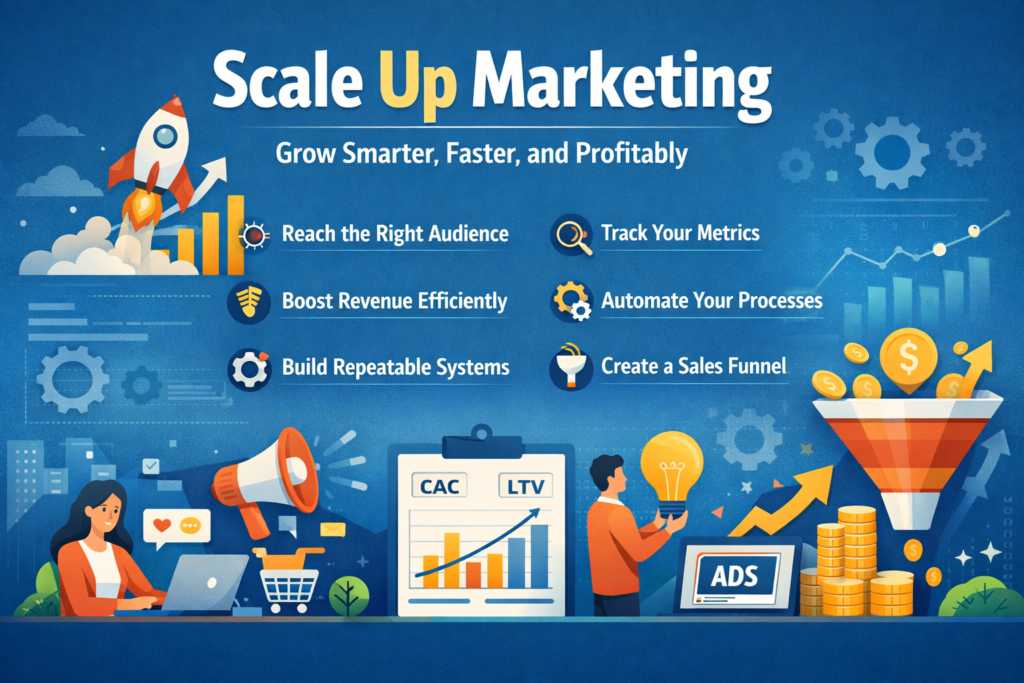
Scale Up Marketing, If you’re not just looking for “a few more leads” but want to really Scale Up Marketing, you’re in the right place. Scale Up Marketing is that point where you stop doing random, one-off tactics and start building a system that can bring in customers predictably and profitably.
It’s the difference between “posting when you remember” and running a marketing engine that works even when you’re asleep. Sounds big, right? It is—but it’s also totally doable if you approach it the right way.
Let’s walk through how to scale up marketing in 2026 without wasting your budget or burning out your team.
What Does “Scale Up Marketing” Actually Mean?
Scaling up marketing isn’t just “doing more marketing.” It means:
Reaching more of the right people
Increasing revenue faster than your costs
Building repeatable and trackable systems
Using data, not guesswork, to grow
Think of it like upgrading from a bicycle to a car. You’re not just moving faster—you’re using a better machine, with more power, structure, and control.
Know Your Numbers Before You Scale
Trying to scale without knowing your numbers is like driving blindfolded. You might move, but you won’t like where you end up.
Key numbers to track:
Customer acquisition cost (CAC): How much you spend to get one customer
Lifetime value (LTV): How much one customer brings in over time
Conversion rates: From visitor to lead, and lead to customer
Return on ad spend (ROAS): Revenue generated from paid ads
If you know, for example, that you can spend INR 1,000INR 1,000 to acquire a customer who’s worth INR 5,000INR 5,000 over a year, scaling becomes a math problem—not a gamble.
Clarify Your Ideal Customer And Core Offer
Before you pour fuel on the fire, make sure the fire is worth feeding. Scaling a weak offer to the wrong audience just burns cash faster.
Ask yourself:
Who exactly is my ideal customer? (age, role, industry, location, problems)
What painful problem do I solve for them?
Why should they choose me over competitors?
What is my main scalable offer (product, plan, package)?
Imagine you run a B2B SaaS for small retailers. Saying “we help businesses” is vague. Saying “we help Indian retail stores increase repeat sales by 30% using automated SMS and email campaigns” is sharp—and much easier to market at scale.
Build A Strong Marketing Foundation First
Scaling without a solid base is like building a skyscraper on sand. Before going big, make sure your essentials are in place:
A clear, benefit-driven website
Strong landing pages for each key offer
Simple, consistent brand messaging
Basic tracking set up (Google Analytics, Facebook Pixel, UTM links)
Email capture forms and lead magnets
Think of this as your marketing “infrastructure.” Once it’s ready, you can safely send more traffic without leaking opportunities everywhere.
Use Multiple Channels, But Don’t Try Everything At Once
When you scale, you want more than one path bringing people to you. But trying 10 channels at once is a recipe for chaos.
Focus first on 2–4 core channels that match your audience and offer:
SEO and content marketing for long-term, inbound traffic
Meta (Facebook/Instagram) ads for broad reach and retargeting
LinkedIn for B2B thought leadership and lead gen
Email marketing for nurturing and upselling
YouTube or short-form video for education and awareness
For example, a D2C skincare brand might scale with Instagram ads, influencers, email flows, and SEO, while a B2B software company might lean on LinkedIn, webinars, and content.
Double Down On What’s Already Working
Scaling isn’t about getting fancy—it’s about multiplying what already works.
Ask:
Which campaigns, posts, or emails have brought the most leads or sales?
Which audiences or keywords perform best?
Which offers people say “yes” to the fastest?
Then:
Increase budgets on winning ad sets
Repurpose best content into multiple formats (blog → video → email)
Create similar campaigns targeting lookalike audiences
Build more landing pages around your top themes
It’s like finding your “greatest hits” and putting them on repeat, instead of constantly chasing the next new thing.
Automate Wherever You Can
To truly scale, you need systems that don’t depend on you doing everything manually. Automation is your silent teammate.
Areas to automate:
Email sequences (welcome series, onboarding, abandoned cart, reactivation)
Lead routing and follow-ups through a CRM
Ad rules (auto-pausing underperforming ads, raising budgets on winners)
Social media scheduling for regular posts
Reporting dashboards so you see key metrics in minutes
Picture a lead landing on your site, downloading a guide, getting a nurturing sequence, booking a call, and receiving reminders—all without a single manual step. That’s scalable marketing.
Leverage Content As Your Growth Engine
When you scale, content isn’t just “blogging for SEO.” It becomes a strategic asset across all channels.
High-performing content types:
In-depth blog posts that target specific keywords and questions
Case studies that prove your results
Comparison pages (you vs. competitors)
How-to videos and webinars
Short-form clips for Reels, Shorts, and TikTok
A good piece of content can:
Attract search traffic
Support sales teams as a “proof” asset
Feed your email list and social channels
Educate leads who aren’t ready to buy yet
Think of each strong content piece as a salesperson that works 24/7 and never gets tired.
Use Paid Ads To Accelerate What Works
Organic growth is powerful but often slow. Paid ads let you press fast-forward—if you’re careful.
Smart ways to scale with ads:
Start small, prove profitability, then gradually increase budgets
Use retargeting ads to re-engage site visitors and warm leads
Test multiple creatives and hooks (headlines, visuals, angles)
Segment campaigns by funnel stage (cold, warm, hot audiences)
Example: A coaching business might run cold ads driving to a free webinar, then retarget attendees with testimonials and a limited-time offer. As long as the numbers stay profitable, they can keep increasing spend.
Build A Marketing Funnel, Not Just Random Touchpoints
Scaling up isn’t about more noise—it’s about building a clear journey from stranger to loyal customer.
A simple scalable funnel:
Top of funnel (TOFU): Ads, content, social posts, SEO bringing in visitors
Middle of funnel (MOFU): Lead magnets, webinars, case studies, email nurturing
Bottom of funnel (BOFU): Sales calls, free trials, demos, strong offers, testimonials
When you map this out, you can see where people drop off and fix weak spots, instead of guessing. It’s like having a clear route on a map instead of wandering around hoping to find the destination.
Track, Test, And Continuously Optimize
Scaling is not a “set it and forget it” game. It’s “launch, learn, optimize, repeat.”
Key habits when you scale:
Weekly performance reviews (ads, emails, content, leads, revenue)
Regular A/B tests (subject lines, CTAs, headlines, landing pages)
Cutting losers quickly and reallocating budget to winners
Listening to sales calls and customer feedback to refine messaging
Think of your marketing like a high-performance engine. You don’t just turn it on; you constantly fine-tune it so it runs smoother and faster over time.
Build The Right Team And Partners
At a certain point, you can’t (and shouldn’t) do everything yourself. Scaling often means growing your team or bringing in experts.
You might need:
A performance marketer for paid ads
A content writer or strategist
A marketing automation/CRM specialist
A designer or video editor
An agency for specific channels (SEO, paid, creative)
Your time should move from “doing tasks” to “setting strategy, priorities, and direction.” The more your systems and people handle execution, the more you can steer the ship.
Common Mistakes When Scaling Marketing
As you scale, watch out for these traps:
Scaling too early before your offer and message are proven
Chasing every new platform or trend
Ignoring backend metrics like LTV and churn
Sending all traffic to a generic homepage instead of focused landing pages
Neglecting existing customers while chasing new ones
Scaling should feel challenging but controlled—not like you’re holding onto a rocket that might explode any second.
Conclusion
Scaling up marketing in 2026 isn’t about doing everything; it’s about doing the right things bigger, better, and more consistently. When you:
Understand your numbers
Clarify your ideal customer and core offer
Build strong foundations
Use multiple channels in a focused way
Automate smartly
Invest in content, ads, and a clear funnel
Continuously test and optimize
you stop relying on luck and start running a marketing machine.
The real power of Scale Up Marketing isn’t just more leads or more sales—it’s the peace of mind that comes from knowing your growth isn’t random anymore. You have a system. And once that system works, turning the dial up becomes a confident decision, not a risky bet.
