
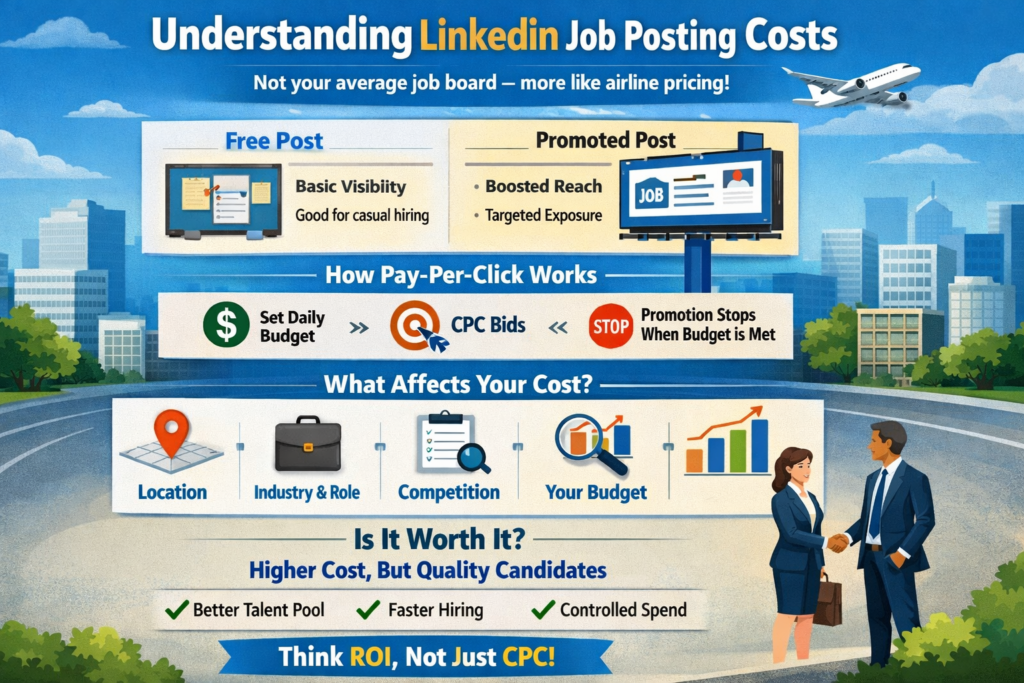
LinkedIn job posting cost, “Why is the pricing so confusing?”, you’re in good company. LinkedIn doesn’t just slap one flat price on a job listing. Instead, it uses a mix of free options, pay‑per‑click promotion, and enterprise setups that can feel more like airline pricing than a simple job board.
The good news? Once you understand the logic behind LinkedIn job posting cost, you can set a budget that fits your needs, avoid nasty surprises, and actually get better candidates for your money.
What Makes LinkedIn Different From Other Job Boards?
LinkedIn isn’t just “another place to post a job.” It’s a professional social network where your job ad sits beside candidate profiles, company pages, and industry content. That context is precisely why the pricing model looks a bit different.
Unlike classic job boards that primarily charge a flat fee per listing, LinkedIn leans heavily on pay‑per‑click (CPC) for promoted posts. You’re effectively paying for attention from a very specific, professional audience. If your ideal hire spends a lot of time on LinkedIn, that audience targeting is why the cost can be higher—but also why the quality can be better.
Free vs Paid LinkedIn Job Posts: What’s The Real Difference?
Before you start worrying about cost, you should know you don’t have to pay on day one. LinkedIn offers both free and promoted (paid) job posts, each with pros and cons.
Free job posts
You can typically post at least one job for free for around 30 days.
The job appears in search results and may be visible to some relevant candidates.
It’s great for occasional hiring or roles that attract plenty of applicants organically.
Promoted (paid) job posts
You set a budget, and LinkedIn pushes your job to more relevant candidates.
Your job appears higher and more often in search results and recommendations.
Ideal when you need to hire faster, for competitive roles, or at scale.
Think of free posts like putting a poster on your office notice board, while promoted posts are like buying a big LED billboard on the main road. Same message, very different reach.
How LinkedIn’s Pay‑Per‑Click Model Really Works
Here’s where most employers get confused. LinkedIn doesn’t say “pay 100 USD and your job runs for 30 days, done.” Instead, it runs on a CPC model for promoted jobs, which means:
You’re charged when someone clicks your job ad (and in LinkedIn’s job system, “clicks” and “views” are often bundled together in reporting).
You set either a daily budget or a total budget (or both).
Once that budget is used up, the promotion stops automatically, but the posting itself usually remains live (just with reduced visibility).
Average CPC for promoted LinkedIn jobs typically falls in a ballpark of about 0.50 to 6 USD per click, depending on your job title, industry, and location. If you know roughly how many serious candidates you need, you can reverse‑engineer a sensible starting budget.

Daily Budget vs Total Budget: What Should You Choose?
When you promote a job, LinkedIn asks you how much you want to spend. You’ll usually see two main controls:
Daily budget
You choose how much you’re willing to spend per day (for example, 10 USD or roughly ₹835).
LinkedIn may spend slightly more or less on certain days, but it balances out over the campaign.
Platforms often cap daily over‑spend at about 50% above your set daily amount and never exceed your overall total budget.
Total budget
This is your hard ceiling for the whole campaign (for example, 300 USD over 30 days).
Once you hit that total, promotion pauses automatically.
A simple example: if you set a 30‑day campaign with a 10 USD daily budget, you’re looking at up to 300 USD total, but you’ll never be charged beyond that cap.
How Much Does A LinkedIn Job Posting Actually Cost?
Because of the auction‑style and CPC model, there’s no single universal price. But practical ranges do exist:
Self‑serve promoted job posts
Average CPC: around 0.50–6 USD per click, depending on factors like job title, seniority, industry, and geography.
Typical small to mid‑sized campaigns: anywhere from 100–500 USD over a few weeks for many roles, depending on your budget and how long you run the promotion.
Enterprise / contracted job slots
For large employers using contracted job slots and high‑visibility boosting, rough estimates suggest costs of 1,500–3,000 USD per job post during the active period.
These arrangements are usually negotiated and bundled with other hiring tools.
For India‑based budgets, guides often suggest daily budgets starting from about 10 USD (~₹835), and for longer campaigns some employers keep 500–1,000 USD aside to maintain consistent visibility.
What Factors Influence Your LinkedIn Job Posting Cost?
Your LinkedIn job posting cost isn’t random; it reacts to a few clear variables:
Job location
Big tech and finance hubs (US, UK, EU metros, Tier‑1 Indian cities) are more competitive than smaller markets.
Industry and role
Highly competitive roles like software engineering, data science, senior management, or niche technical positions usually attract more advertiser competition.
Job title and keywords
Popular, generic job titles may compete with thousands of similar postings.
Very niche titles can be cheaper per click but may attract fewer candidates overall.
Time and market activity
If a lot of companies are hiring for similar roles at the same time, your CPC can rise—this is the auction effect in action.
Your own bid and budget
Higher budgets and more aggressive bidding can increase reach and speed, but also raise total cost.
Every one of these factors feeds into LinkedIn’s algorithm, which calculates how much each click costs on any given day.
Step‑By‑Step: How To Post A Job And Control Cost
While interfaces change over time, the basic flow for a self‑serve LinkedIn job posting and promotion typically looks like this:
Create the job post
Add title, location (or remote), job type, and a clear description.
Use language and keywords your ideal candidate would actually search.
Choose free or promoted
Start with the free post if your hiring need is not urgent.
Switch to “Promote” when you want higher reach or faster results.
Set your budget
Pick a daily budget (e.g., 10–20 USD) and, if needed, a total cap.
Remember: your total is your real safety net.
Add payment details
Link a card or payment method and confirm the promotion.
Monitor and adjust
Use the “Manage” section to see views, clicks, and applications.
If CPC is high but applications are weak, refine your job title, description, or targeting.
Pause or increase as needed
If you’re happy with the pipeline, you can reduce or pause the budget.
If results are strong and profitable, you can extend the campaign or raise your daily spend.
Understanding Cost‑Per‑Click And Cost‑Per‑Applicant
Most employers don’t just care about CPC—they care about cost per qualified applicant, or even cost per hire. CPC is just a stepping stone.
Here’s how to think about it:
If your average CPC is 2 USD, and you spend 200 USD, that’s about 100 clicks.
If 10 of those clicks turn into serious applications, your cost per applicant is 20 USD.
If 1 of those becomes a great hire who stays with you for years, 200 USD suddenly looks like a bargain.
Guides show that the average CPC for promoted LinkedIn jobs often falls within the broader LinkedIn advertising range of a few dollars per click, though job ads can be somewhat cheaper or more expensive depending on competition.
How LinkedIn Compares To Other Advertising And Job Platforms
To understand whether LinkedIn’s job posting cost is “high” or “fair,” you have to compare it with alternatives:
Compared to generic job boards
Many boards charge a flat fee per listing, which can feel simpler.
But they also tend to attract a mix of highly relevant and not‑so‑relevant applicants.
Compared to general LinkedIn ads
Typical LinkedIn ads (for content or lead gen) often cost around 2–3 USD per click and 5–8 USD per 1,000 impressions, depending on campaign type.
Job postings sit in a specialized corner of this ecosystem, with similar auction pressures but a recruitment‑focused objective.
Compared to social platforms (Meta, TikTok, etc.)
Those platforms can be cheaper per click, but they are not inherently job‑focused.
You may need more creative effort and filtering to find qualified candidates.
Bottom line: LinkedIn may cost more per click than generic channels, but the context (professional profiles, public work history, recommendations) often makes each relevant click more valuable.
Enterprise Options: Job Slots And Recruiter Tools
For companies hiring at scale, LinkedIn doesn’t just offer one‑off job posts. It also sells bundled solutions like job slots and LinkedIn Recruiter.
Job slots & contracted posting
Large organizations can negotiate packages where they pay for a number of active slots rather than individual posts.
In such setups, rough estimates show 1,500–3,000 USD per boosted job over a limited period is not unusual, especially for high‑visibility, managed campaigns.
LinkedIn Recruiter / Recruiter Lite
Recruiter Lite pricing is often around 170 USD per month or about 1,680 USD per year per user.
These tools are separate from job posting budgets, giving recruiters direct search and outreach capabilities.
If you’re a small or mid‑sized business, you may not need these enterprise tools yet—but it’s useful to know they exist when you start planning long‑term hiring infrastructure.
Practical Tips To Lower Your LinkedIn Job Posting Cost
You don’t just want “cheap”—you want efficient. Here are ways to improve your results without simply throwing more money at the problem:
Get the job title right
Use standard, searchable titles (“Senior Marketing Manager” instead of “Growth Rockstar”).
Write a clear, focused description
Spell out responsibilities, required skills, and benefits in plain language.
Use keywords candidates are likely to filter for.
Target realistically
Overly narrow targeting can restrict volume and raise CPC.
Overly broad targeting can waste clicks on irrelevant profiles.
Leverage your network
Ask employees to share the job.
Use your company page to post about the role—organic visibility lowers dependency on paid clicks.
Monitor CPC and adjust quickly
If CPC spikes or applications look weak, refine your ad early rather than letting the budget burn.
Some guides suggest starting with a modest budget (around 10 USD/day) and then increasing only when you see a healthy flow of relevant candidates.
Is Paying For LinkedIn Job Posting Worth It In 2026?
So, after all this talk about CPC, daily budgets, and algorithms, one question remains: is it actually worth it?
It often is—if you:
Hire for roles where LinkedIn users are your natural talent pool.
Know the approximate value of a good hire to your business.
Treat your first campaigns as experiments, not all‑or‑nothing bets.
For many companies, especially in professional, tech, and white‑collar fields, a few hundred dollars to land a strong candidate can be an excellent trade. For others, free postings and alternative job sites may be enough for simpler roles.
The key is to think in terms of return on investment, not just raw cost.
Conclusion
LinkedIn job posting cost can look complicated on the surface, but once you break it down, the structure is actually pretty logical. You’re paying mainly for clicks on your promoted job posts, within a daily and total budget that you control. The exact amount depends on your role, industry, location, and how competitive your hiring market is.
At the end of the day, your goal isn’t just to spend less; it’s to spend smarter. A well‑planned LinkedIn job posting can be the bridge between your open role and the exact professional you’ve been trying to find, at a cost that makes sense for your business.
