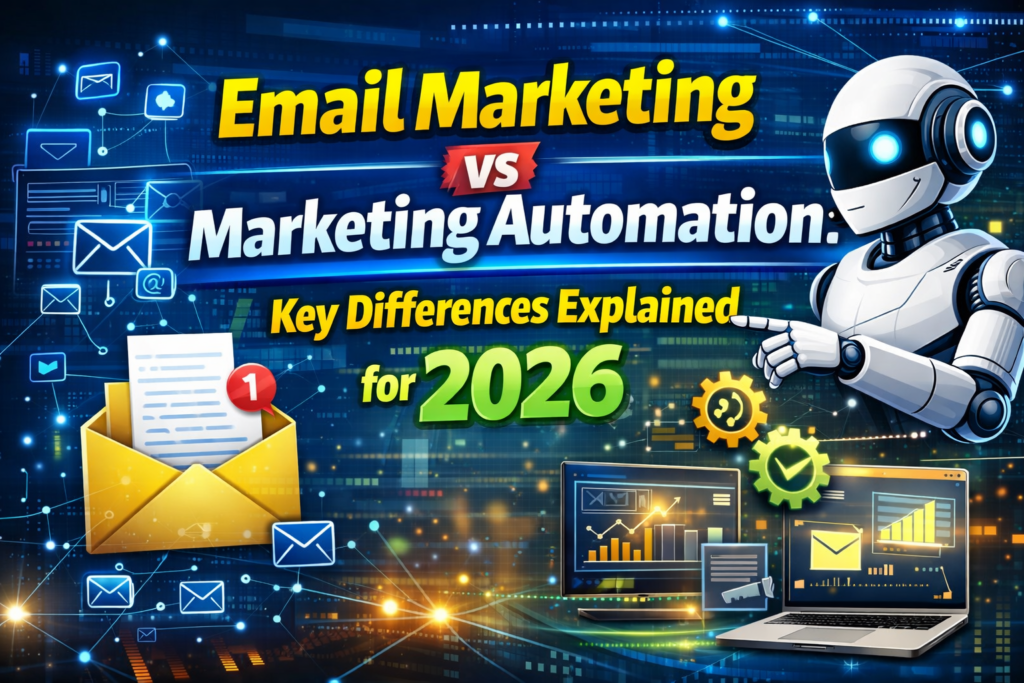
Email Marketing vs Marketing Automation: Key Differences Explained for 2026
email vs marketing automation, Email marketing and marketing automation are often used interchangeably, but they represent meaningfully different approaches to customer communication — with different capabilities, different resource requirements, and different ROI profiles. Understanding the distinction between these two approaches, and knowing when to use each, is essential for building a marketing technology strategy that matches your business’s current stage and growth objectives.
This guide explains exactly what separates email marketing from marketing automation, covers the tools that power each approach, provides a clear framework for deciding which is right for your business, and shows how to combine them for maximum marketing effectiveness in 2026.
What Is Email Marketing?
Email marketing refers to the practice of sending targeted email communications to a list of subscribers or customers. In its traditional form, email marketing involves creating campaigns — newsletters, promotional announcements, product updates — and sending them to segmented lists of recipients at scheduled times. Modern email marketing platforms like Mailchimp, Constant Contact, and Campaign Monitor provide drag-and-drop email builders, audience segmentation, A/B testing, and performance reporting that make professional email campaigns accessible to businesses without dedicated technical resources.
Email marketing’s primary strengths are its simplicity, cost-effectiveness, and direct connection to revenue. For every $1 invested in email marketing, businesses average $36 in return — making it one of the highest-ROI marketing channels available. Basic email marketing is appropriate for businesses at the earliest stages of their digital marketing journey: sending regular newsletters, promoting offers to subscribers, and maintaining awareness among existing customers and leads.
Key Email Marketing Features
Core email marketing platform features: drag-and-drop email builder with professional templates, list management and basic segmentation (by demographics, purchase history, engagement level), A/B testing for subject lines and content, send time optimisation, open rate and click rate reporting, unsubscribe management, and deliverability tools. Platforms like Mailchimp, Klaviyo, and Campaign Monitor provide these capabilities in user-friendly interfaces accessible to non-technical marketing teams.
What Is Marketing Automation?
Marketing automation extends email marketing with sophisticated, behaviour-triggered workflows that respond to individual customer actions in real time. Instead of sending the same email to everyone at the same time, marketing automation sends the right message to each individual at the exact moment they are most likely to engage — triggered by their specific actions: visiting a pricing page, downloading a resource, abandoning a shopping cart, or reaching a particular lifecycle stage.
Marketing automation platforms — HubSpot, Marketo, Pardot, ActiveCampaign — provide workflow builders that connect triggers (customer actions or time-based events) to actions (sending emails, updating CRM records, creating tasks, scoring leads, enrolling in sequences). These workflows can span weeks or months, nurturing prospects through the buyer journey with personalised content that adapts based on their engagement. Marketing automation delivers the efficiency of mass communication with the relevance of one-to-one personalisation.
Lead Scoring and Nurturing
Lead scoring — assigning numerical values to prospect actions and attributes to indicate sales readiness — is a core marketing automation capability unavailable in basic email marketing platforms. When a prospect downloads a whitepaper (+10 points), visits the pricing page three times (+30 points), and has a matching company size and industry (+20 points), their total score of 60 automatically triggers a sales task. This automation of the MQL qualification and handoff process is one of the most impactful capabilities marketing automation provides for B2B businesses.
Email Marketing vs Marketing Automation: Key Differences
The core differences across five dimensions. Targeting: Email marketing targets lists or segments defined before sending. Marketing automation targets individuals based on their real-time behaviour and attributes. Timing: Email marketing sends on a schedule chosen by the marketer. Marketing automation triggers communications based on individual customer actions. Personalisation: Email marketing personalises by segment (different versions for different groups). Marketing automation personalises by individual (each person receives a unique experience based on their specific journey).
Complexity: Email marketing is accessible to most marketing teams with minimal technical expertise. Marketing automation requires greater technical investment in setup, integration with CRM and website, and ongoing workflow management. Cost: Email marketing platforms typically cost $20-500/month. Marketing automation platforms cost $800-3,600+/month at mid-market tiers. The higher investment in marketing automation is justified for businesses with sufficient lead volume and sales cycle complexity to benefit from automated nurturing and scoring.
Which Approach Is Right for Your Business?
Choose email marketing as your starting point if: your business is early stage with a small list (under 5,000 contacts), you lack dedicated marketing operations resources, your sales cycle is short and transactional, or your budget is constrained. Email marketing done well — with quality content, consistent sending frequency,
and regular list hygiene — delivers excellent ROI at minimal cost and complexity.
Upgrade to marketing automation when: your lead volume exceeds what your sales team can manually qualify and follow up, your sales cycle is long enough that nurturing content influences buying decisions, you have sufficient content resources to create the multiple touchpoints that automation requires,
and you are ready to invest in the setup and ongoing management that sophisticated automation demands. Most B2B businesses find marketing automation delivers transformative ROI at the point where they have 500+ leads per month and a sales cycle exceeding 30 days.
Frequently Asked Questions
What is the main difference between email marketing and marketing automation?
Email marketing sends scheduled campaigns to lists. Marketing automation sends behaviour-triggered messages to individuals at the optimal moment based on their real-time actions. Email marketing is simpler and cheaper; marketing automation is more sophisticated, more personalised,
and more impactful for businesses with complex sales cycles and sufficient lead volume to justify the investment.
Do I need marketing automation or can I just use email marketing?
Start with email marketing if you are just getting started or have a simple, transactional business model. Graduate to marketing automation when your lead volume exceeds what you can manually follow up, when your sales cycle is long enough that nurturing influences buying decisions,
and when you have the content and technical resources to set up and maintain sophisticated workflows. Many businesses use both: simple email for broadcast communications and automation for triggered, lifecycle-based sequences.
What are the best marketing automation platforms?
Leading marketing automation platforms: HubSpot Marketing Hub Professional (best all-in-one for SMB to mid-market), Marketo Engage (best for enterprise B2B),
Pardot/Marketing Cloud Account Engagement (best for Salesforce users), ActiveCampaign (best value for SMBs needing automation),
and Klaviyo (best for e-commerce). Platform choice should align with your CRM ecosystem, team technical capabilities, and lead volume.
How much does marketing automation cost?
Marketing automation platforms typically cost $800-3,600+/month for mid-market tiers with full automation capabilities. ActiveCampaign starts from $29/month with basic automation. HubSpot Professional starts from $800/month. Marketo and Pardot are custom-priced enterprise platforms typically costing $2,000-5,000+/month. Total cost of ownership includes platform licensing plus implementation, integration development,
and ongoing management — typically adding 50-100% to licensing costs in year one.
Conclusion
Email marketing and marketing automation are not competing approaches but complementary tools at different maturity stages of a marketing strategy. Start with email marketing,
build your audience and content capabilities, then graduate to marketing automation when your lead volume and sales cycle complexity justify the investment. The combination of both — broadcast email for awareness,
automation for nurturing and conversion — creates the complete customer engagement system that drives predictable, scalable revenue growth.
Related Articles
Ready to grow your business with the right technology? Explore VBWebSol’s Digital Marketing Services or contact our expert team for a free consultation. With over 12 years of IT expertise in Ahmedabad,
we help businesses across India and globally implement solutions that deliver real, measurable results.