
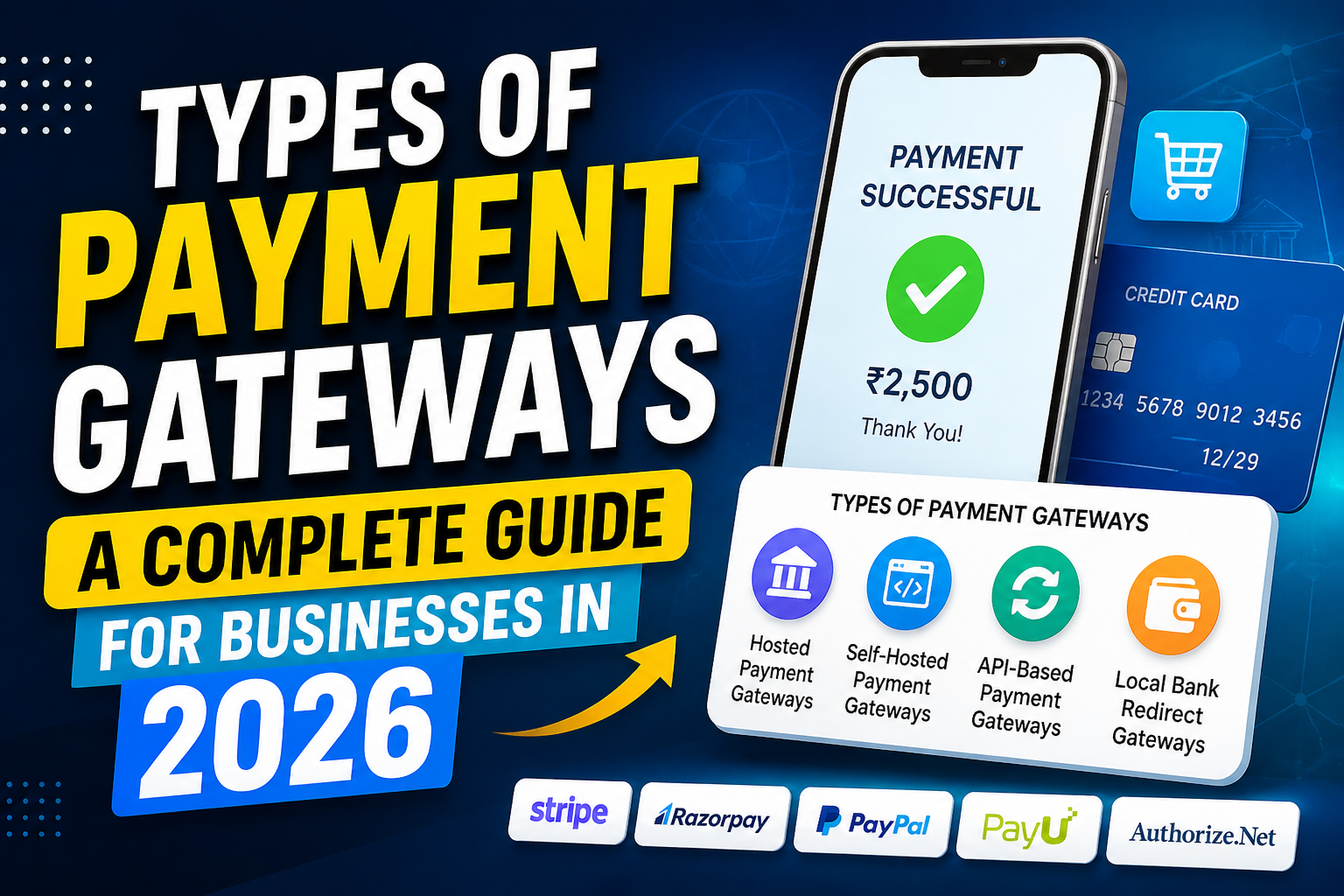
A payment gateway is the technology that securely transmits payment information between a customer, your website, and the payment processor. Understanding the different types of payment gateways helps businesses choose the right solution for their specific needs, technical capabilities, and customer expectations.
What Is a Payment Gateway?
A payment gateway encrypts and transmits payment data (card number, expiry, CVV) from the customer to the payment processor and returns the approval or decline response. It’s the digital equivalent of a physical card terminal—the secure intermediary between buyer and seller.
4 Main Types of Payment Gateways
1. Hosted Payment Gateways
The customer is redirected from your website to the payment provider’s hosted checkout page to complete payment, then redirected back to your site.
Examples: PayPal Standard, Stripe Checkout, 2Checkout
Pros:
- Simplest to implement—no payment page to build or maintain
- PCI compliance is handled entirely by the provider
- Lower development cost and technical risk
Cons:
- Customer leaves your site—breaks brand experience and may reduce conversion
- Less control over checkout design and flow
Best for: Small businesses, low-volume sellers, or anyone wanting simple implementation with minimal development
2. Self-Hosted Payment Gateways
The checkout form lives on your website, and payment data is collected and submitted directly to the payment processor from your server.
Examples: Authorize.Net (AIM), custom implementations
Pros:
- Complete control over checkout experience and design
- Customer never leaves your site
Cons:
- Your server handles payment data—significant PCI DSS compliance burden
- Higher development, security, and ongoing maintenance requirements
Best for: Organizations with strong development teams and specific compliance requirements that need full checkout control
3. API-Based Payment Gateways (Non-Hosted)
The checkout form is on your website and uses JavaScript or server-side APIs to tokenize payment data—the actual card number never touches your server, but the customer stays on your site throughout.
Examples: Stripe Elements/PaymentIntents, Braintree, PayPal Vault, Square API
Pros:
- Full control over checkout UX while reducing PCI scope (tokenization handles sensitive data)
- Excellent developer experience with comprehensive APIs and SDKs
- Supports subscriptions, marketplace payments, split payments, and custom flows
Cons:
- More development work than hosted solutions
- Requires some PCI compliance (SAQ A or SAQ A-EP)
Best for: Most modern e-commerce businesses and SaaS platforms wanting control over UX with manageable PCI compliance
4. Local/Regional Payment Gateways
Payment gateways specific to local payment methods, currencies, or regions—essential for selling in markets where global gateways don’t support preferred local payment methods.
Examples: Razorpay (India), PayU (Eastern Europe/India), PayFast (South Africa), Nets (Scandinavia), Alipay/WeChat Pay (China)
Pros:
- Support for local payment methods customers trust (UPI, net banking, mobile wallets)
- Often lower fees for domestic transactions
- Local language and currency support
Cons:
- Typically limited to specific geographies
- May require local business registration to use
Best for: Businesses selling primarily in specific markets where local payment methods are preferred
Choosing the Right Payment Gateway Type
| Situation | Best Gateway Type |
|---|---|
| Simple setup, low volume | Hosted (PayPal, Stripe Checkout) |
| Full UX control, modern e-commerce | API-based (Stripe, Braintree) |
| Enterprise custom checkout | Self-hosted or API-based |
| Selling in India/Southeast Asia | Local (Razorpay, PayU) |
| Global subscription SaaS | API-based with recurring billing |
FAQ
What are the types of payment gateways?
The four main types of payment gateways are: hosted (customer redirected to provider’s checkout page), self-hosted (payment form on your server), API-based/non-hosted (payment tokenized via JavaScript while customer stays on your site), and local/regional gateways (supporting specific local payment methods and currencies).
Which payment gateway type is most secure?
API-based gateways with JavaScript tokenization (like Stripe Elements) provide the best balance of security and user experience—card data is tokenized before it touches your server, significantly reducing PCI DSS scope without requiring a redirect. Hosted gateways are also secure but redirect customers away from your site.
What is the best payment gateway for small business?
Stripe and Square lead for small businesses in the US. Razorpay leads for India. PayFast for South Africa. Stripe’s Checkout (hosted) provides the simplest setup; Stripe Elements (API-based) provides more control for growing businesses.
What is the difference between a payment gateway and payment processor?
A payment gateway is the technology interface that securely collects and transmits payment data. A payment processor is the financial institution that handles the actual transaction—moving money between the customer’s bank and the merchant’s account. Many modern providers (Stripe, Square, PayPal) combine both gateway and processing in one service.
Conclusion
Understanding the types of payment gateways helps you choose the right architecture for your e-commerce or SaaS platform. API-based solutions like Stripe are the modern standard for most businesses; hosted solutions simplify implementation for small-scale sellers; local gateways are essential for market-specific payment method support.
Need help integrating a payment gateway into your web or mobile application? Explore VBWebSol’s development services or contact us.