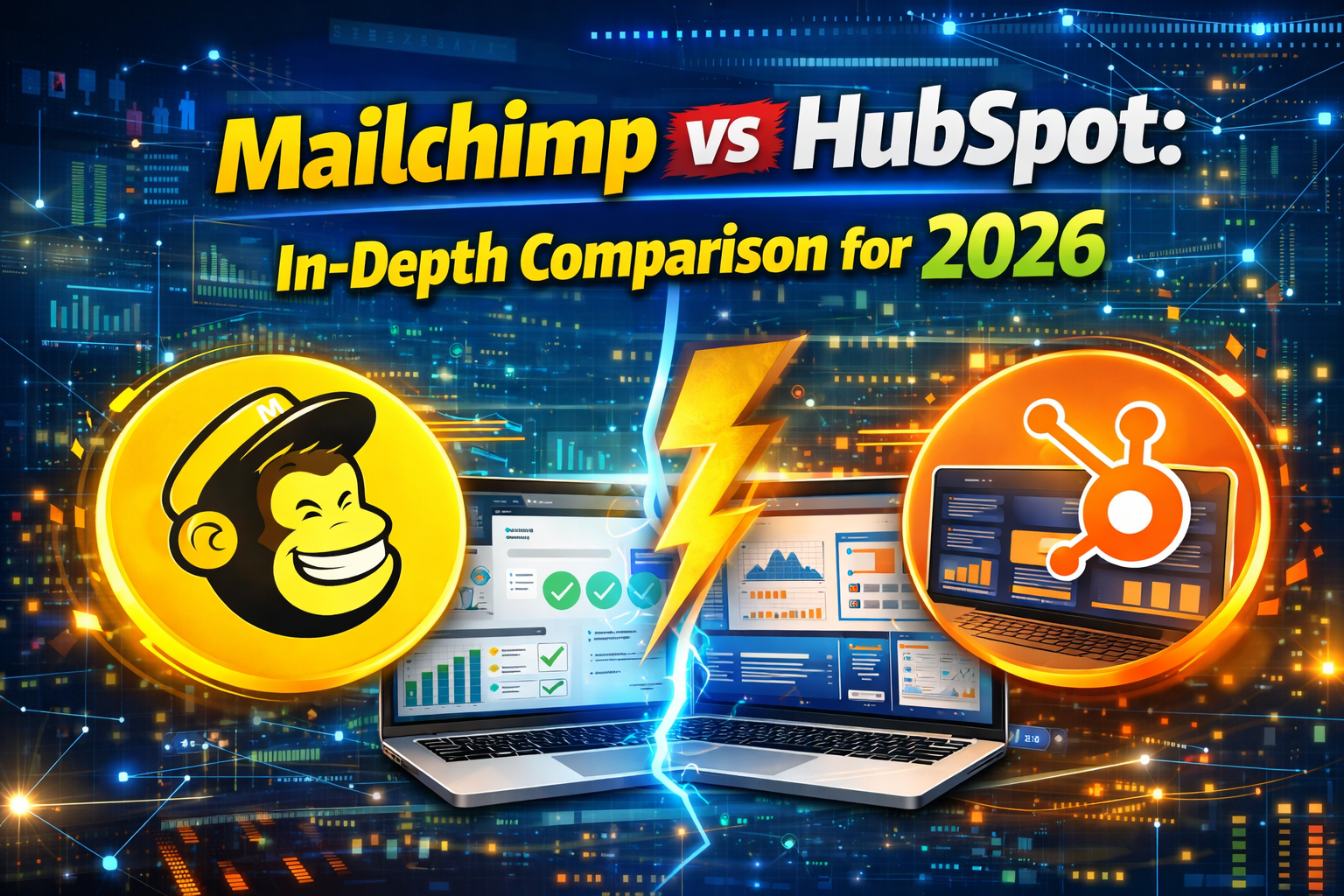
Mailchimp vs HubSpot are two of the most widely used marketing platforms in the world — but they serve fundamentally different needs. Mailchimp started as an email marketing tool and has evolved into a small business marketing platform. HubSpot started as an inbound marketing suite and has evolved into a comprehensive CRM-first business platform covering marketing, sales, service, and operations. Understanding which platform is right for your business requires looking beyond feature checklists to consider your growth stage, team capabilities, and long-term technology strategy.
This in-depth 2026 comparison examines Mailchimp vs HubSpot across every critical dimension: email marketing capabilities, CRM depth, marketing automation sophistication, landing page and content tools, reporting and analytics, integrations, ease of use, and total cost of ownership. By the end, you will have a clear framework for making the right choice for your specific business.
Mailchimp: Platform Overview
Mailchimp is primarily an email marketing and marketing automation platform designed for small to medium businesses. Its core strengths are ease of use — even non-technical users can create professional campaigns within minutes — competitive pricing with a meaningful free tier, and a focused feature set that covers email, basic automation, landing pages, social posting, and simple audience segmentation. Mailchimp’s AI-powered creative tools, including Subject Line Optimizer and Content Optimizer, help smaller businesses produce more effective campaigns without a dedicated marketing specialist.
Mailchimp’s limitations become apparent as businesses grow. Its CRM capabilities are basic — contact management and audience segmentation are available but lack the deal pipeline, activity tracking, and sales workflow automation that a true CRM provides. Its marketing automation, while improved, is less sophisticated than HubSpot’s workflow engine for complex multi-branch nurture sequences. For small businesses primarily needing email newsletters, campaigns, and basic automation, Mailchimp is an excellent choice. For businesses that also need CRM and multi-channel marketing orchestration, its limitations become significant.
Mailchimp Pricing
Mailchimp offers a free plan for up to 500 contacts and 1,000 monthly email sends — sufficient for very small businesses getting started. Paid plans: Essentials from $13/month (500 contacts, 5,000 sends/month), Standard from $20/month (500 contacts, 6,000 sends/month, automation), Premium from $350/month (10,000+ contacts, advanced features). Pricing scales with contact count, becoming expensive for large lists. A 25,000-contact list on the Standard plan costs approximately $270/month.
HubSpot: Platform Overview
HubSpot is a comprehensive CRM platform covering marketing, sales, customer service, and operations through integrated ‘Hubs.’ Its Marketing Hub provides sophisticated email marketing, marketing automation, landing pages, SEO tools, social media management, and attribution reporting. The CRM at HubSpot’s core is genuinely powerful — providing contact management, deal pipelines, activity tracking, and revenue reporting that Mailchimp’s basic audience management cannot match. HubSpot’s integration between marketing and sales data creates a complete customer journey view that is its most powerful competitive advantage.
HubSpot’s free CRM tier is one of the best free offers in the market — providing unlimited contacts, basic deal pipeline management, email tracking, and meeting scheduling at no cost. This makes it an attractive starting point for businesses that want to grow into a more comprehensive platform without upfront investment. The limitations of HubSpot are its cost at scale — the Marketing Hub Professional plan ($800/month for 2,000 contacts) represents a significant investment for SMBs — and its complexity, which can overwhelm smaller teams without dedicated marketing operations resources.
HubSpot Pricing
HubSpot Marketing Hub: Free (basic CRM and email, up to 2,000 sends/month), Starter from $15/month (1,000 contacts, basic automation, ad management), Professional from $800/month (2,000 contacts, advanced automation, ABM, social), Enterprise from $3,600/month (custom objects, predictive lead scoring, advanced reporting). Note that HubSpot bundles drive significant discounts for organisations buying multiple hubs together. Annual billing reduces costs by approximately 25%.
Feature Comparison: Email Marketing
Both platforms provide professional email marketing capabilities, but with different strengths. Mailchimp’s email builder is more intuitive for beginners — drag-and-drop interface, hundreds of templates, and AI-powered content suggestions make campaign creation fast and accessible. Transactional email support is available through Mailchimp Transactional (Mandrill) as an add-on. HubSpot’s email builder is powerful but slightly more complex, rewarded by tighter CRM integration — emails can be personalised with any CRM property, campaign performance flows directly into contact activity timelines, and A/B testing includes automated winner selection.
For deliverability — the percentage of emails that actually reach the inbox — both platforms perform comparably for well-maintained lists. HubSpot provides slightly better deliverability analytics through its integrated CRM, enabling clearer visibility into which contacts are engaging with email communications and which should be suppressed to protect sender reputation. For businesses sending transactional emails (order confirmations, account notifications), HubSpot provides a smoother integration with CRM-driven triggers than Mailchimp’s separate Mandrill add-on.
Feature Comparison: Marketing Automation
Marketing automation is where the gap between Mailchimp and HubSpot is most significant. Mailchimp’s automation (available on Standard plan and above) covers the fundamentals: welcome series, abandoned cart, birthday emails, and basic if/then branching. For simple nurture sequences and triggered emails, Mailchimp’s automation is sufficient and easy to set up. HubSpot’s workflow engine (available on Professional plan and above) is genuinely sophisticated — supporting complex multi-branch logic, cross-object workflows that update deals and companies based on contact behaviour, lead scoring integration, and sales sequence enrollment triggers.
For businesses with complex B2B marketing processes — multi-touch nurture, lead scoring, MQL/SQL handoff automation, and closed-loop marketing-to-revenue attribution — HubSpot’s automation capabilities are significantly superior. For B2C e-commerce businesses primarily needing email-triggered automations based on purchase behaviour, Mailchimp’s automation (especially with its Shopify and WooCommerce integrations) is often sufficient and dramatically more cost-effective.
Frequently Asked Questions
Is Mailchimp or HubSpot better for small businesses?
For small businesses primarily needing email marketing and basic automation, Mailchimp offers better value — particularly at small contact counts where its pricing is significantly lower than HubSpot Professional. HubSpot’s free CRM tier is the best free starting point for small businesses that also need contact and deal management. The tipping point where HubSpot’s additional capabilities justify its higher cost is typically around 10-20 employees with dedicated sales and marketing functions.
Can I migrate from Mailchimp to HubSpot?
Yes — HubSpot provides a native Mailchimp integration and migration tools that import contacts, audience segments, and campaign history. The migration process typically takes a few hours for most list sizes. After migration, you will need to recreate automation workflows in HubSpot’s format,
but the contact data and engagement history transfers cleanly. HubSpot’s migration support documentation is comprehensive,
and HubSpot partners can assist with more complex migrations.
Does HubSpot replace Mailchimp completely?
HubSpot can replace Mailchimp’s email marketing and basic automation functionality for most businesses. However, Mailchimp offers a few capabilities HubSpot lacks: postcard mailing, a simpler interface for non-technical users,
and lower pricing for pure email marketing at small contact counts. Some businesses use both — HubSpot for CRM and sales automation,
Mailchimp for campaign newsletters — though this creates data synchronisation complexity that typically makes a single-platform approach preferable.
Which has better email deliverability: Mailchimp or HubSpot?
Both platforms offer comparable deliverability for well-maintained, permission-based lists. Deliverability is primarily determined by list quality (engagement rates, bounce rates, spam complaint rates) rather than the sending platform. HubSpot provides slightly richer deliverability analytics through its CRM integration. Both platforms enforce permission-based sending policies and provide tools for list hygiene. Regular list cleaning — removing unengaged contacts — is the single most impactful deliverability practice on either platform.
Conclusion
Mailchimp and HubSpot are both excellent platforms that serve different needs. Mailchimp is the better choice for small businesses primarily needing cost-effective email marketing and basic automation. HubSpot is the better choice for businesses that need CRM depth,
sophisticated marketing automation,
and the closed-loop marketing-to-revenue attribution that comes from having marketing and sales data in one platform. Match your choice to your current stage and your growth ambitions.
Related Articles
Ready to grow your business with the right technology? Explore VBWebSol’s Digital Marketing Services or contact our expert team for a free consultation. With over 12 years of IT expertise in Ahmedabad,
we help businesses across India and globally implement solutions that deliver real, measurable results.